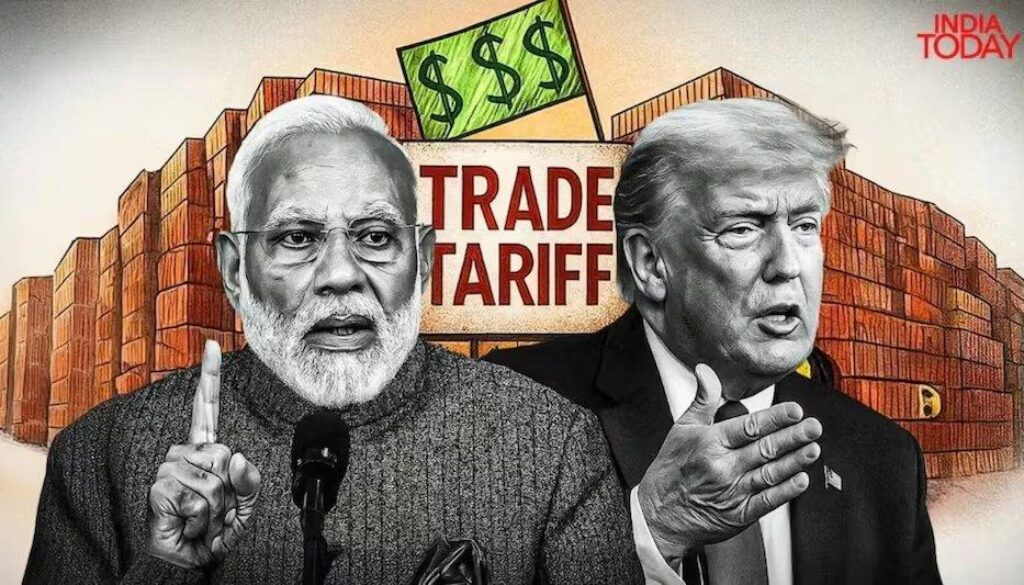
The announcement of new tariffs by United States President Donald Trump on a broad spectrum of Indian imports has generated considerable attention across global financial and economic circles. For India, a country that has long benefited from global integration, the move presents both immediate challenges and long-term questions about its strategic direction. Yet, the implications extend well beyond India. They also carry significant lessons for other emerging economies, including those in the Arab world, where policymakers and banking leaders are seeking to consolidate growth, strengthen resilience, and ensure sustainable integration into the global economy.
This article examines the potential impact of Trump’s tariffs on India, evaluates India’s available responses, and draws parallels and recommendations for Arab banks and financial institutions that must remain alert to the shifting landscape of global trade and investment.
A Sudden Turn in U.S.–India Economic Relations
The new tariffs are framed as a punitive measure for India’s purchase of Russian oil, but they also represent a broader shift in American trade policy. Washington has historically enjoyed strong and cooperative ties with New Delhi, especially under Prime Minister Narendra Modi, who has invested heavily in building closer relations with the United States. The abrupt reversal in tone, therefore, highlights the volatility that can accompany trade relations in today’s world.
For India, the short-term damage of these tariffs is undeniable. Exports worth approximately $65 billion annually are directly affected. Yet, in the context of India’s total merchandise exports of around $441 billion, the share of goods under tariff pressure accounts for less than 15 percent. This is not negligible, but it is far from catastrophic.
Why the Immediate Impact Is Manageable
Several factors help mitigate the near-term disruption. First, geography plays an important role. The United States, while India’s largest single trading partner, remains a distant market. High transportation costs have long compelled India to diversify its trade portfolio and reduce over-dependence on any single destination.
Second, international trade is dynamic. Trump’s global tariff strategy is not aimed exclusively at India; it is reshaping supply chains worldwide. As companies and exporters adjust, new market opportunities inevitably open. For Indian exporters, the shift will not be without cost, but it is also not without potential gain.
Third, India’s trade structure is more complex than merchandise alone. The country’s services exports, exceeding $380 billion annually, have become the true engine of its global economic rise. These include IT services, financial outsourcing, research and development, and other high-value sectors. Crucially, these exports are not subject to tariffs, allowing India to maintain strong momentum in areas that matter most to its long-term economic growth.
Services as the Cornerstone of Growth
India’s services sector has repeatedly proven its resilience and global competitiveness. From large-scale outsourcing contracts to high-level research and technology partnerships, services exports have delivered consistent value, even in times of global uncertainty. This has made India one of the most important players in the international services economy, a status unlikely to be challenged by tariffs aimed at goods.
Moreover, in a global environment characterized by growing policy unpredictability, multinational corporations are rethinking their dependence on the U.S. market. This reassessment opens the door for India, which is already making inroads into European and Asian OECD economies. Evidence suggests that Indian exporters of both goods and services have begun intensifying efforts to develop new partnerships in the European Union, Japan, and Australia.
The Strategic Question: India’s Place in the Global Economy
While the immediate economic costs of U.S. tariffs are important, the deeper issue lies in how they influence India’s long-term strategic orientation. Within India, two competing visions of the country’s role in the global economy have long existed.
The first vision is outward-looking. It emphasizes confidence, openness, and integration. It seeks growth through globalization, by leveraging Western technology, finance, and markets. India’s remarkable economic success between 1991 and 2011 was largely the product of this approach, which enabled the country to attract foreign investment, access advanced technologies, and integrate into global supply chains.
The second vision is more defensive. It portrays international engagement as a vulnerability and advocates for self-reliance, even to the point of economic isolation. This inward posture is shaped by historical skepticism toward the West and often prioritizes autonomy over efficiency or competitiveness.
Trump’s tariffs have provided fresh arguments to proponents of the inward-looking approach. The tariffs reinforce claims that the global trading system is unreliable, that reliance on Western markets creates risks, and that India’s interests are better served by insulating itself. Should this perspective gain momentum, the consequences for India could be significant: reduced growth, diminished regional influence, and a retreat from the global liberal economic order.
Signs of Continued Commitment to Openness
Fortunately, there is evidence that the more outward-looking vision still dominates. India’s recent free-trade agreement with the United Kingdom is a powerful example. The deal commits both sides to lowering protectionist barriers and reflects India’s willingness to deepen ties with OECD countries under frameworks of mutual interest.
Furthermore, ongoing negotiations with the European Union could produce a comprehensive trade agreement that anchors India more firmly in the global economy. Such agreements not only diversify India’s economic base but also send a strong signal of its commitment to international trade principles.
Lessons for Arab Economies
For Arab banking and financial leaders, India’s current experience offers a valuable case study. Arab economies, much like India, face questions about the balance between openness and self-reliance. The global system is undergoing stress from multiple directions—tariffs, sanctions, geopolitical rivalries, and supply chain disruptions. The choices made in this environment will shape long-term growth trajectories.
Several lessons stand out:
- Diversification is essential – India’s ability to withstand the shock of U.S. tariffs is partly due to the broad diversification of its trade and services portfolio. For Arab economies, diversifying both export markets and export categories is crucial to resilience. This applies equally to hydrocarbons, manufacturing, and services.
- Services are a growth engine – India’s rise as a services powerhouse shows the value of investing in sectors that are less vulnerable to tariff shocks. Arab countries, with their young populations and growing investment in technology and financial services, are well-positioned to expand in similar directions.
- Global partnerships matter – India’s proactive pursuit of trade agreements with the UK and EU underscores the importance of strategic partnerships. For Arab economies, deeper trade and financial ties with Europe, Asia, and Africa can help reduce dependence on any single region.
- Policy direction is critical – India’s internal debate between openness and protectionism mirrors similar debates in Arab countries. Choosing openness—albeit balanced with prudence—can enhance competitiveness and long-term growth prospects.
The Role of Arab Banks
Arab banks have a central role to play in reinforcing these lessons. Their financing decisions, international partnerships, and investment strategies can help their countries embrace openness while safeguarding resilience. This means:
- Supporting cross-border trade finance that links Arab exporters with multiple markets.
- Investing in digital banking, fintech, and services sectors that echo India’s experience in IT and outsourcing.
- Encouraging governments to pursue comprehensive trade agreements that provide predictability and stability.
- Financing infrastructure that facilitates integration into global supply chains, from ports to digital connectivity.
Arab banks must also prepare for volatility. Just as Indian exporters are adapting to shifts in trade flows, Arab financial institutions should anticipate similar disruptions and position themselves as facilitators of adjustment.
Opportunities for Strategic Recalibration
The broader message from India’s encounter with U.S. tariffs is that external shocks, while disruptive, also create opportunities. For India, the tariffs may accelerate its pivot toward Europe and Asia. For Arab economies, the lesson is that external pressure can be harnessed to strengthen partnerships, modernize financial systems, and expand economic reach.
As global trade flows evolve, both India and Arab countries stand to gain from greater interconnection. India’s success in services complements the Arab world’s growing focus on digital economies and financial innovation. Collaborative ventures between Arab banks and Indian institutions could open new pathways for shared growth, from joint fintech platforms to cross-border investment vehicles.
Recommendations for Arab Banking Leaders
Trump’s tariffs on India are more than a bilateral trade dispute. They represent a moment of strategic choice for one of the world’s largest emerging economies. Whether India turns inward or reaffirms its outward orientation will shape not only its own prosperity but also the balance of the global economy.
For Arab banking leaders, the key takeaways are clear:
- Invest in diversification to reduce vulnerability to external shocks.
- Prioritize growth in services and technology sectors that offer resilience.
- Support governments in pursuing trade agreements that expand opportunity and anchor economies in predictable frameworks.
Build partnerships with India and other outward-looking economies to seize emerging opportunities.
By doing so, Arab banks and financial institutions can position themselves as drivers of sustainable growth, not only for their own economies but also for the broader region. The lesson from India is not one of retreat, but of strategic engagement—anchored in openness, resilience, and confidence in the opportunities of the global economy.