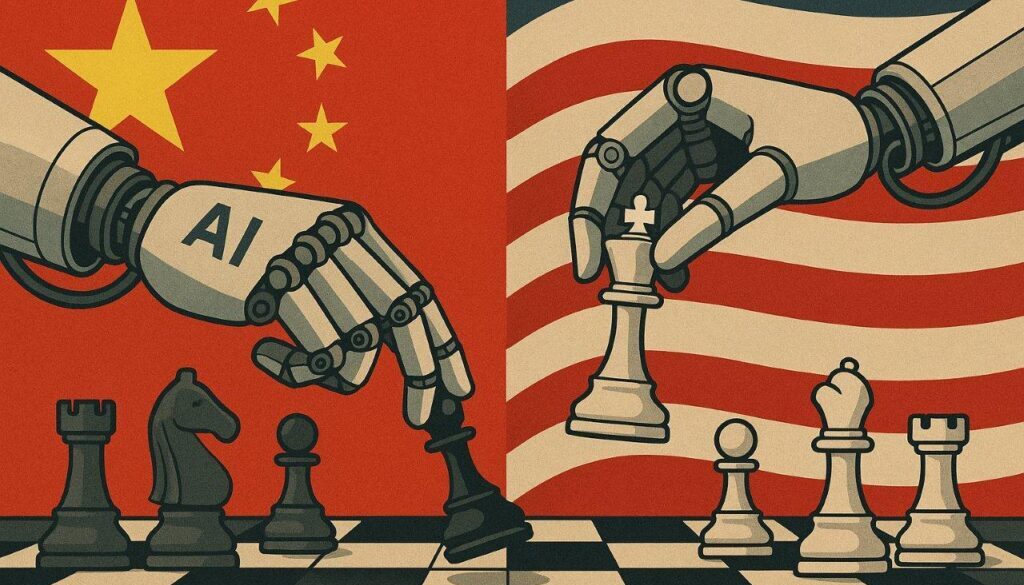
If you’re looking for a clean scoreboard with a final whistle, this isn’t that kind of contest. “AI leadership” isn’t one race—it’s five or six overlapping ones: frontier models, compute and chips, capital formation, talent and research, intellectual property, and real-economy deployment. On some tracks the United States is clearly ahead; on others China is setting the pace. For executives and policymakers, the smarter question is: who is ahead at which game—and what does that mean for strategy in 2025?
1) Capital, Companies, and the Frontier
On the money and model frontier, the United States holds a commanding lead. According to Stanford’s 2025 AI Index, U.S. private AI investment reached $109.1 billion in 2024, almost 12× China’s $9.3 billion. That capital is underwriting an ecosystem of hyperscalers (Microsoft, Amazon, Google), chipmakers (NVIDIA, AMD), and frontier-model labs (OpenAI, Anthropic, Google DeepMind, Meta) that continue to set the technical pace.
Model output tracks the money. The same report notes that in 2024 U.S.-based institutions produced 40 notable AI models versus 15 for China—while also acknowledging that the performance gap is narrowing as Chinese teams climb rapidly on common benchmarks.
What it means: For frontier capability—multimodal models, agentic systems, and foundation-model platforms that others build atop—the U.S. remains the reference point. Access to American cloud scale and leading GPUs compounds this advantage.
2) Compute and Chips: Uneven Access, Shifting Rules
Compute is the oxygen of modern AI—and here policy shapes the market. U.S. export controls introduced in 2022–2023 and tightened in 2025 restrict China’s access to the highest-end AI accelerators and, more recently, place worldwide controls on the diffusion of the most advanced closed-weight AI models and their model weights.
The screws continue to turn. On September 2, 2025, the U.S. revoked fast-track export status for shipments of certain U.S.-origin tools to TSMC’s Nanjing fab, signaling less flexibility for advanced equipment flows into China even via non-Chinese companies.
What it means: U.S. firms enjoy more ready access to top-tier compute; Chinese labs and clouds can still scale—but often with domestic accelerators and more emphasis on efficiency. Constraints nudge Chinese players toward smaller, highly optimized models and application-first strategies.
3) Patents, Publications, and IP Gravity
On intellectual property, China leads by volume—dramatically so in generative AI. WIPO’s 2024 landscape report finds 38,000+ GenAI inventions from China between 2014–2023, about six times the U.S. count, with Chinese firms (Tencent, Ping An, Baidu, Alibaba, ByteDance) prominent among the top assignees.
Stanford’s 2025 AI Index similarly highlights China’s lead in AI publications and patents, even as the U.S. leads in notable model outputs.
What it means: IP quantity is not the same as platform dominance, but it signals deep industrial experimentation. Expect more Chinese ownership of methods and sector-specific innovations, even when the very top general-purpose models remain U.S.-centric.
4) Regulation and Governance: Different Operating Systems
The governance approaches diverge. In the United States, Executive Order 14110 (Oct. 30, 2023) directed agencies to set safety, reporting, and testing baselines for frontier developers, with NIST’s AI Risk Management Framework providing a voluntary, risk-based playbook businesses can adopt.
China’s Interim Measures for Generative AI (effective Aug. 2023) emphasize security reviews, content management, and provider accountability, shaping how GenAI services are launched and operated domestically.
What it means: U.S. policy increasingly targets frontier risk and model diffusion; Chinese policy centers content, safety, and control in consumer-facing services. Multinationals must localize both compliance and product behavior.
5) Deployment Playbooks: AGI versus “AI+”
There is also a philosophical split. U.S. players are still pushing hardest on the frontier/AGI vector, aiming for step-change capabilities that unlock new markets. China, constrained on chips yet rich in industrial scale, is pushing “AI+”—embedding practical AI in manufacturing, logistics, public services, healthcare triage, and finance. This pragmatic emphasis is backed by state initiatives and funding programs to accelerate sector adoption.
What it means: If AGI-style breakthroughs stall or take longer than expected, a deployment-first model can win near-term economic impact. If the frontier keeps leaping, platform economics favor the U.S. incumbents and partners.
6) National Capacity: Funds, Talent, and the Long Game
Both sides are investing for the long haul. The 2025 AI Index notes governments worldwide stepping up; among them, China launched a $47.5 billion semiconductor fund (Big Fund III), while the United States doubled the number of federal AI regulations issued in 2024, signaling governance maturation alongside industrial policy (and complementing CHIPS Act incentives for domestic capacity). St
On talent, flows still generally favor U.S. labs and companies, attracted by compensation, equity upside, and access to compute—self-reinforcing advantages that are hard to replicate quickly. China, meanwhile, is building capacity at scale in applied AI engineering and systems integration, benefitting from the world’s largest manufacturing base and vast data-rich platforms.
A Fair Scorecard for 2025
Frontier models & platforms: U.S. leads. Greater capital intensity, cloud scale, and access to top GPUs keep American firms ahead at the bleeding edge.
Compute access: U.S. leads, and policy keeps widening the gap at the very top end—though China is progressing with domestic accelerators and efficiency gains.
Patents & publications: China leads on volume, signaling broad experimentation and sector breadth, even as the very top general-purpose systems remain mostly U.S.-built.
Industrial deployment: Advantage China in “AI-at-scale” within domestic services and manufacturing; advantage U.S. in platform-style deployment via global SaaS and cloud ecosystems.
Governance capability: Different strengths. The U.S. is shaping global norms for frontier safety and model handling; China is calibrating fast implementation rules for consumer and enterprise use at home.
Net-net: In 2025, the United States is ahead in frontier AI, which sets standards and captures outsize value when breakthroughs land. China is ahead in breadth of applied adoption across key domestic sectors, and its IP engine is prolific. Neither position is static—and policy will continue to reshape the field.
How Leaders Should Respond (Practical Moves)
- Pick the right race. If your advantage depends on frontier capability, align with U.S. clouds, model providers, and chip roadmaps; design for rapid model refresh and agentic workflows. If your advantage is in industrial deployment, study Chinese “AI+” patterns—lean models, edge inference, data-ops discipline—and adopt where it fits.
- Plan for compute volatility. Export rules can reprice supply overnight. Build multi-path compute strategies (on-prem + multi-cloud + emerging domestic accelerators), and design models with parameter-efficiency and distillation in mind.
- Localize governance. Operationalize NIST AI RMF for internal controls and procurement; in China, harden content, provenance, and security reviews to meet local service rules. Treat compliance as a product feature, not a paperwork burden. Own your problem spaces. China’s patent surge shows how quickly applied niches get captured. If you rely on proprietary workflows (e.g., underwriting, logistics, clinical pathways), convert know-how into defensible data and micro-models, not just generic LLM prompts.
- Talent and partners. Whether your build center is Dubai, Riyadh, Singapore, or Frankfurt, align with ecosystems that give you access to models, data partnerships, and compliance support. In a fast-moving field, speed to safe deployment is the real moat.
Bottom line: Asking “who is winning?” only makes sense if you specify the race. Today, the U.S. is winning the frontier, and that matters enormously for platform economics and global standards. China is winning on breadth of applied use and IP volume, which matters for sustained diffusion across the real economy. For executives, the play is not to pick a flag—it’s to design an AI strategy that borrows strength from both models: frontier where it differentiates, “AI+” where it compounds.