BY DR SOHA MAAD
Introduction
The European Commission has proposed a 2026 EU budget of €193.26 billion, with an additional €105.32 billion expected to be disbursed under the NextGenerationEU recovery instrument. This budget aims to fund key European Union EU priorities such as climate action, digital transformation, and continued support for Ukraine. The draft budget includes policy highlights and strategic objectives, expenditure breakdowns across programs and institutions, revenue sources and financial forecasts, and performance statements for EU-funded programs. The Council of the European Union proposed €186.24 billion in commitments and €186.49 billion in payments This excludes special instruments outside the multiannual financial framework.
This article overviews the risks and opportunities of the EU 2026 budget followed by a SWOT (Strength, Weakness, Opportunity, Threat) Analysis. The wider impact of the EU 2026 budget is assessed and a future roadmap for Arab banks is depicted to navigate the challenges and opportunities of the EU 2026 budget.
Opportunities and Risks of EU 2026 Budget
The EU 2026 budget presents a dynamic mix of opportunities and risks, reflecting its ambition to tackle global volatility while advancing strategic priorities.
The EU 2026 budget offers various opportunities including:
- Strategic Investment: Major funding for defence, digital transformation, and climate action positions the EU as a global leader in innovation and resilience.
- Support for Ukraine: Continued aid strengthens geopolitical influence and fosters stability in Eastern Europe.
- Green and Digital Transitions: Investments in clean energy, biodiversity, and digital infrastructure align with global sustainability goals.
- Youth and Innovation: Funding for education, job creation, and startups boosts long-term competitiveness.
- External Engagement: €15.5 billion allocated to neighbourhood and global partnerships enhances trade and diplomatic ties.
However, the EU 2026 budget entails various risks including:
- Limited Flexibility: budgetary room for new initiatives is tight.
- Debt Repayment Strain: Repaying NextGenerationEU borrowing could pressure future program funding.
- Geopolitical Uncertainty: Conflicts, migration pressures, and climate disruptions may shift priorities or divert resources.
- Implementation Challenges: Complex coordination across member states could slow fund absorption and reduce impact.
- Economic Volatility: Inflation, interest rate shifts, and reduced international funding may affect execution and outcomes.
This budget is both a stabilizing force and a strategic lever.
Critique of EU 2026 Budget
The EU’s 2026 budget has drawn both praise and criticism, reflecting the complexity of balancing strategic ambitions with fiscal constraints.
Critics argue that the multiannual financial framework (MFF) restricts the EU’s ability to respond swiftly to emerging crises, such as geopolitical instability or climate shocks. Some Members of the European Parliament (MEPs) have raised concerns about the growing emphasis on defence and security, fearing it may come at the expense of cohesion, food security, and social programs. While designed to promote climate goals, CBAM could disproportionately impact developing economies, including Arab countries, by increasing export costs and straining trade relations.
The draft budget reflects input from multiple political groups, leading to competing priorities and a lack of clarity on long-term strategic direction. Minority MEPs have proposed amendments to rebalance spending and improve transparency.
The budget is undergoing trilogue negotiations between the European Commission, Parliament, and Council to reconcile differing views. Despite these critiques, the budget is still viewed as a vital tool for advancing EU competitiveness, sustainability, and strategic autonomy.
Swot Analysis of EU 2026 Budget
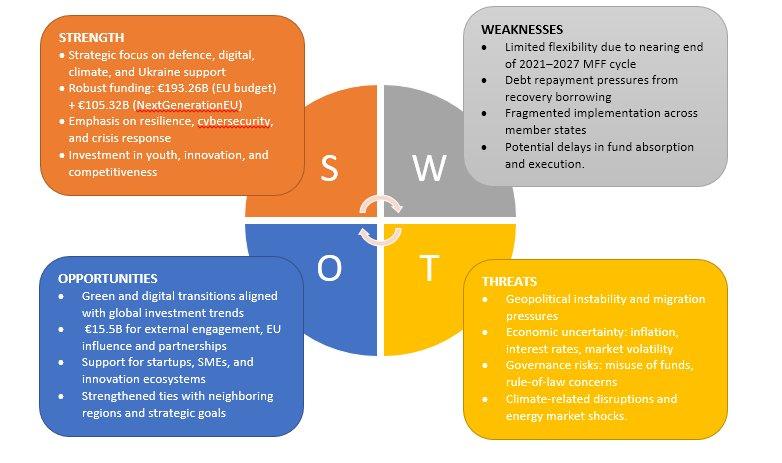
A SWOT analysis of the EU’s 2026 budget, summarizing its strengths, weaknesses, opportunities, and threats based on its strategic priorities, structure, and geopolitical context is as follows:
Impact on Global Financial Markets
The EU’s 2026 budget is poised to ripple across global financial markets in several key ways:
- Market Confidence and Stability: The budget’s emphasis on security, defence, and Ukraine support signals geopolitical commitment, which may stabilize European equities and sovereign debt markets. Predictable funding flows and reinforced fiscal discipline could bolster investor confidence in EU bonds and the euro.
- Green and Digital Investment Surge: Significant allocations to climate resilience and digital innovation may attract global capital into EU-based green tech and digital infrastructure firms. Environmental, Social, and Governance ESG-focused investors may increase exposure to EU markets due to alignment with sustainability goals.
- Currency and Trade Dynamics: Increased spending on competitiveness and strategic autonomy could strengthen the euro, especially if paired with robust economic performance. The budget’s support for migration and border management may influence labour market dynamics and trade flows, particularly with neighbouring regions.
- Spill-over Effects on Emerging Markets. EU funding for external engagement (€15.5 billion) may boost development and stability in partner countries, influencing regional markets and cross-border investments. Enhanced support for Ukraine and Middle East crisis response could affect commodity prices and risk premiums globally.
- Bond Issuance and Liquidity: Continued use of NextGenerationEU instruments implies sustained EU bond issuance, impacting global fixed-income markets and benchmark rates.
Impact on Technology
The EU’s 2026 budget places a strong focus on technology and innovation, with funding channeled through several key programs and initiatives including:
- Horizon Europe: Continues to be the EU’s flagship research and innovation program, supporting cutting-edge science, digital transformation, and green tech.
- Digital Europe Programme: Invests in supercomputing, artificial intelligence, cybersecurity, and advanced digital skills.
- European Institute of Innovation and Technology (EIT): Allocates funding to Knowledge and Innovation Communities (KICs) across sectors like ICT, climate, and manufacturing.
- NextGenerationEU: Provides additional support for digital infrastructure and tech-driven recovery efforts.
The strategic priorities include:
- Boosting Artificial Intelligence AI and quantum computing capabilities
- Expanding 5G and future connectivity
- Supporting startups and Small and Medium size enterprises SMEs in tech innovation
- Enhancing cybersecurity resilience across member states.
Impact on Crypto
The EU 2026 budget is set to influence the crypto landscape in several nuanced ways, especially as Europe pivots toward regulating decentralized finance (DeFi) rather than expanding the Markets in Crypto-assets (MiCA) framework.
- Regulatory Shift in DeFi: The EU is preparing to regulate DeFi protocols starting mid-2026, as MiCA (Markets in Crypto-Assets Regulation) leaves many decentralized platforms in legal limbo. This shift may bring clarity depending on how “decentralization” is defined, which remains unresolved.
- Investor Protection and Compliance: MiCA’s final phase (effective since late 2024) focuses on stablecoin reserves, fraud prevention, and Know Your Customer (KYC) requirements, which could tighten compliance for centralized crypto platforms. Fully decentralized platforms may be exempt, but ambiguity persists around enforcement.
- Budgetary Influence on Crypto Adoption: Funding for digital transformation and financial innovation may indirectly support blockchain infrastructure and fintech start-ups. However, no direct budget line is earmarked for crypto development, signalling a cautious stance.
- Risks and Uncertainties: The absence of a MiCA II framework means no major overhaul is expected, but targeted legislative updates, especially around stablecoins and Anti–money laundering (AML) rules, are likely. New anti-money laundering provisions restricting anonymous crypto accounts are scheduled for 2027, which could reshape user behaviour and platform design.
The EU 2026 budget sets the stage for a more regulated and possibly fragmented crypto environment.
Impact on Strengthening EU Power
The EU’s 2026 budget is more than just a financial plan; it is a strategic instrument to expand the Union’s influence and autonomy across multiple domains. Increased funding for defence, cybersecurity, and critical infrastructure reduces reliance on external actors and enhances the EU’s ability to act independently in global affairs. By centralizing resources for climate action, migration, and support for Ukraine, the budget enables the EU to speak and act with a more cohesive voice. Instruments like the Carbon Border Adjustment Mechanism (CBAM) give the EU regulatory power over global trade, encouraging partners to align with EU climate standards. Massive investments in innovation, sustainability, and digital transformation position the EU as a global standard-setter in emerging technologies. With over €15 billion allocated to “Neighbourhood and the World,” the EU is deepening its role in regional stability, development, and diplomacy.
In essence, the 2026 budget is a blueprint for a more assertive, resilient, and globally influential EU.
Impact on Defence
The EU’s 2026 budget places strong emphasis on defence and security, reflecting growing geopolitical tensions and the need for strategic autonomy. European Parliament priorities include boosting EU defence and cybersecurity capabilities, investing in dual-use transport infrastructure, and enhancing crisis preparedness. The European Defence Fund and other instruments continue to receive support to foster joint procurement and innovation in defence technologies. Germany, as the EU’s largest economy, plans to spend $94.5 billion on defence in 2026, including $9.7 billion in military aid to Ukraine. France will increase its defence budget to €53.7 billion, with an additional €3.5 billion earmarked for strategic upgrades.
The EU’s 2026 budget is poised to significantly strengthen the bloc’s defence posture, reflecting heightened geopolitical tensions and a push for strategic autonomy. The European Parliament has prioritized funding for military defence, cybersecurity, and dual-use transport infrastructure to improve rapid deployment and resilience.
Continued, unconditional financial and logistical support for Ukraine remains a central pillar, reinforcing the EU’s commitment to regional stability. Funds are earmarked for bolstering crisis response mechanisms, including health and migration management, which intersect with defence readiness.
Member states are expected to channel increased national and EU-level funding into modernizing equipment, rebuilding stockpiles, and developing autonomous systems like drones and cyber tools.
Defence investments may stimulate industrial production, innovation, and job creation, especially in high-tech sectors tied to military applications. The budget supports reducing reliance on non-EU defence systems and enhancing the EU’s ability to act independently in global affairs. This budget marks a turning point in how the EU integrates defence into its broader economic and strategic planning.
Impact on EU Economy
The EU’s 2026 budget is expected to play a pivotal role in shaping the bloc’s economic trajectory, especially amid global volatility and strategic shifts. Key economic impacts include:
- Resilience and Competitiveness: Investments in innovation, digital infrastructure, and industrial production aim to strengthen the EU’s economic backbone.
- Support for Strategic Sectors: Funding for defence, cybersecurity, energy transition, and migration management will help safeguard long-term stability.
- Recovery and Sustainability: The NextGenerationEU instrument adds over €105 billion to support recovery from past crises and accelerate green and digital transitions.
- Jobs and Youth Opportunities: Programs targeting education, health, and cultural initiatives are designed to empower young people and close skill gaps.
- Cohesion and Territorial Equity: Reprogramming of cohesion funds will address emerging priorities like affordable housing and water resilience, promoting balanced growth across regions.
Overall, the budget is seen as the EU’s largest investment tool to complement national efforts, reinforce strategic autonomy, and ensure economic stability in a rapidly changing world.
Impact on Arab Countries
The EU’s 2026 budget is expected to have indirect but significant effects on Arab countries, especially through trade, climate policy, and regional cooperation.
The Carbon Border Adjustment Mechanism (CBAM), part of the EU’s climate strategy, will require exporters to the EU to pay for carbon emissions embedded in goods like cement, steel, and fertilizers starting January 2026. Countries like Egypt, which exported €4.6 billion worth of CBAM-covered goods to the EU in 2022, could face substantial costs. Arab exporters may need to invest in greener production methods or negotiate for technical and financial assistance to remain competitive.
The budget allocates €15.5 billion under the “Neighbourhood and the World” heading, which includes funding for migration management, security partnerships, and economic development programs in neighbouring regions, including North Africa and the Middle East.
Arab countries may benefit from EU-funded initiatives aimed at stabilizing the region, but they will also need to adapt to new regulatory pressures. The EU’s push for green and digital transitions could open doors for collaboration in renewable energy, tech innovation, and infrastructure development.
Geopolitical Impact
The EU’s 2026 budget is strategically crafted to reinforce the bloc’s geopolitical influence amid rising global tensions and shifting alliances.
Continued, unconditional financial and logistical aid to Ukraine signals the EU’s commitment to defending democratic values and deterring aggression in Eastern Europe. Increased funding for defence, cybersecurity, and dual-use infrastructure aims to reduce reliance on non-EU military systems and bolster the EU’s ability to act independently on the global stage. With over €5 billion allocated to migration and border control, the EU is reinforcing its external borders and addressing root causes of migration. The rollout of the Carbon Border Adjustment Mechanism (CBAM) in 2026 will reshape trade dynamics, especially with countries exporting carbon-intensive goods to the EU. This could pressure global partners to adopt greener practices, but may also strain relations with developing economies.
The budget earmarks significant funding for regional stability, including €1.6 billion for Palestine and continued support for Syrian refugees in Turkey. These moves reflect the EU’s intent to remain a stabilizing force in the Mediterranean and Middle East.
By investing heavily in sustainability and innovation, the EU positions itself as a model for climate action and tech governance, influencing global standards and partnerships.
This budget is a statement of intent on how the EU sees its role in a rapidly evolving world.
Impact on International Relations and Diplomacy
The EU 2026 budget is designed not just for internal resilience but also to shape the EU’s global role. Its diplomatic and geopolitical impact is already being felt across several dimensions:
- Strengthening Global Partnerships with €15.5 billion allocated to “Neighbourhood and the World”, the EU is deepening ties with neighbouring regions, including Eastern Europe, the Mediterranean, and Africa. Continued support for Ukraine reinforces the EU’s commitment to democratic values and regional stability.
- Strategic Autonomy and Security Diplomacy: Increased funding for security and defence bolsters the EU’s ability to act independently in global crises, reducing reliance on external powers. Investments in cyber security and dual-use infrastructure enhance the EU’s credibility as a strategic partner.
- Migration and Border Management: Budget allocations for migration and humanitarian aid support diplomatic engagement with origin and transit countries, helping to manage flows and reduce tensions. Implementation of the Asylum and Migration Pact is expected to influence EU relations with North African and Middle Eastern nations.
- Soft Power and Global Influence: Funding for education, health, and cultural programs promotes EU values abroad and strengthens its soft power footprint. Support for climate action and green transitions positions the EU as a global leader in sustainability diplomacy.
- Risks to Diplomatic Cohesion: Budgetary constraints and debt repayment pressures may limit flexibility in responding to emerging global crises. Diverging member state priorities could complicate unified foreign policy execution.
This budget is a blueprint for how the EU intends to engage with the world.
Strategic Roadmap to Adapt To EU 2026 Budget
Adapting to the EU’s 2026 budget requires a forward-looking roadmap that aligns with its core priorities (resilience, sustainability, competitiveness, and strategic autonomy). A tailored strategy for businesses, governments, and institutions include:
Alignment with Strategic Priorities
- Focus on defence, digital transformation, and climate action, which are central to the budget’s objectives.
- Prioritize security and preparedness, especially in sectors vulnerable to geopolitical shifts.
Embracing Green and Digital Transitions
- Invest in low-carbon technologies to meet CBAM requirements and avoid trade penalties.
- Upgrade digital infrastructure using funds from Digital Europe and Horizon Europe.
Leveraging EU Funding Instruments
- Apply for grants under NextGenerationEU, European Defence Fund, and Cohesion Policy
- SMEs should explore innovation support through regional development funds.
Strengthening Regional Partnerships
- Collaborate with EU institutions on migration, border management, and neighbourhood stability
- Arab countries and neighbouring regions can benefit from the €15.5 billion allocated to external engagement.
Enhancing Financial and Regulatory Readiness
- Align with EU ESG standards and prepare for digital euro integration.
- Monitor regulatory changes, especially around carbon pricing, cybersecurity, and trade compliance.
This roadmap helps in positioning institutions to thrive in a reshaped European landscape and in building a sector-specific strategy or exploring funding opportunities.