Introduction: The Stakes Couldn’t Be Higher
When a billion-dollar construction project falters, the impact ripples far beyond unfinished buildings or delayed roads. For banks, it can mean distressed loans, strained relationships, and even regulatory scrutiny. Construction finance carries unique risks—projects are long, complex, and vulnerable to delays, overruns, and disputes. For lenders, this makes credit risk management not just a protective measure, but a survival strategy.
Studies show that more than 70% of major capital projects suffer from cost overruns or schedule delays. That statistic should alarm every banker and regulator. It means the probability of a financed project running into trouble is not a remote possibility—it’s the baseline. The challenge is clear: how can banks maintain confidence that the projects they finance will be completed on time, within budget, and with repayment secured?
This is where strategic oversight, supported by digital tools such as Project Management Information Systems (PMIS), is changing the landscape. While PMIS is not the story itself, it increasingly underpins the story of resilience: banks equipped with real-time visibility, structured governance, and early warning systems are better positioned to safeguard their capital and strengthen client trust.
Pillar One: Risk Assessment – Seeing Trouble Before It Starts
Every failed loan begins with risks that were either overlooked or underestimated. In construction finance, risks come from everywhere—design flaws, weak contractors, regulatory hurdles, or volatile markets. For banks, identifying and quantifying those risks before disbursing funds is essential.
A disciplined approach starts with a comprehensive risk register. Rather than relying on fragmented reports or scattered spreadsheets, banks should demand structured, central documentation of all risks—technical, financial, operational, and external. This is where PMIS quietly proves its worth: it centralizes risk data, assigns probability and impact scores, and allows lenders to evaluate exposure in a systematic way.
Consider a scenario: a contractor proposes an aggressive schedule with minimal contingency. Without structured tools, the bank might accept the schedule at face value. With PMIS-enabled risk assessment, however, the bank sees the likelihood of slippage, the absence of adequate buffers, and the potential financial consequences—all before the loan is approved. The decision becomes informed, not blind.
“When banks can see risks early, they gain the power to structure loans that are realistic, protective, and resilient.”
Pillar Two: Cost & Schedule Validation – Guarding Against Overruns
One of the oldest lessons in construction finance is that budgets lie—sometimes unintentionally, sometimes by design. Contractors may front-load bills of quantities to secure early cash flow, or underestimate costs to win bids. Without independent validation, banks are effectively gambling on numbers that may not hold.
This is why schedule and cost validation should be non-negotiable. Leading lenders now engage cost consultants to verify contractor estimates. The true power emerges when these validations are logged and compared in PMIS. Instead of anecdotal reassurance, the bank sees contractor and consultant data side by side, highlighting discrepancies in real time.
The same principle applies to schedules. Delays are not only common—they are expected. With PMIS, every schedule update, every extension-of-time request, every variance from the baseline is captured in a traceable record. Banks no longer wait for bad news; they see slippages as they develop and can act before repayment is endangered.
Here, digital oversight shifts the bank’s role. Rather than reacting when projects spiral out of control, lenders become proactive guardians of financial discipline.
Pillar Three: Cash Flow & Commitments – Protecting the Lifeline
Cash flow is the heartbeat of any project. When it falters, work stops, claims rise, and loans sour. For banks, ensuring that project cash flow aligns with financing arrangements is one of the most critical aspects of credit risk management.
Traditionally, banks relied on static reports to monitor progress payments. But static reports often conceal problems until it is too late. By contrast, PMIS links the cost-loaded project schedule directly to cash flow planning. It integrates planned disbursements, contractor invoices, and actual progress, producing a real-time picture of liquidity.
Imagine a project where a contractor repeatedly submits inflated invoices against minimal progress. In a paper-based world, detection might take months. With PMIS, every invoice is cross-checked against physical progress and approved workflows. The discrepancy becomes visible instantly, allowing the bank to intervene before funds are misused.
“Cash flow is where projects live or die. Digital oversight ensures that banks know exactly how money is flowing, and whether it matches reality.”
This visibility extends to procurement and commitments. Every subcontract, every purchase order, every approved change order is logged, preventing hidden liabilities from eroding financial stability. For lenders, this means confidence that the financing plan is grounded not in assumptions, but in verified transactions.
Pillar Four: Portfolio Transparency – Managing the Bigger Picture
Banks rarely finance just one project at a time. Exposure is spread across multiple borrowers, contractors, and sectors. Yet too often, oversight remains siloed. A problem with one contractor may quietly repeat across several projects, and concentration risks may build unnoticed.
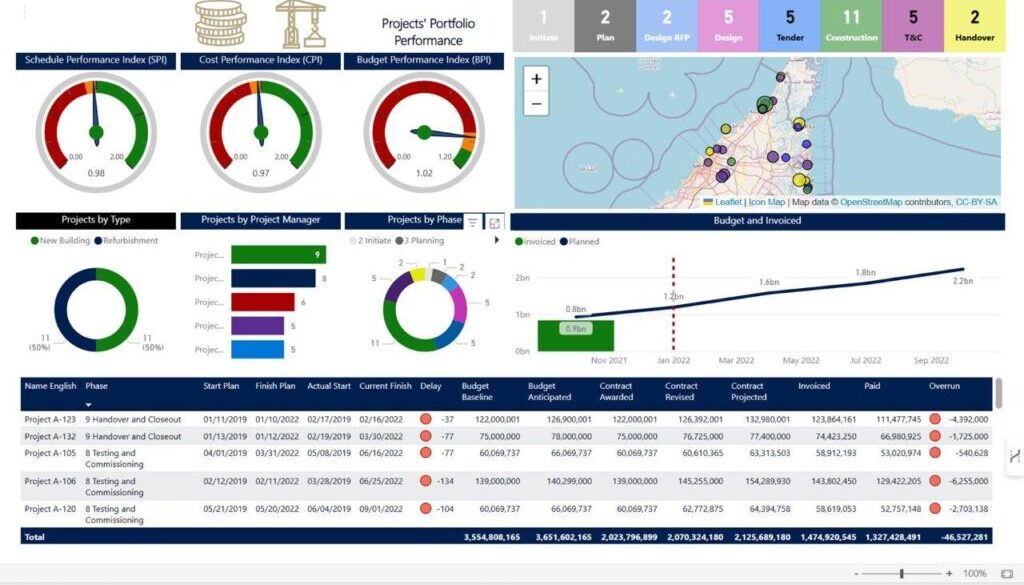
Portfolio transparency is the final, often overlooked, pillar. PMIS allows banks to consolidate all financed projects into a single dashboard. By filtering exposure by contractor, geography, sector, or risk category, credit teams gain an enterprise-level view of where vulnerabilities lie.
This is not just risk management—it is strategy. With portfolio-wide visibility, banks can allocate capital more efficiently, price risk with precision, and engage with clients from a position of informed strength. Regulators, too, look favorably on institutions that can demonstrate such structured oversight, aligning with Basel standards and local supervisory expectations.
“What gets measured gets managed. Portfolio-wide visibility transforms risk management from a defensive exercise into a strategic advantage.”
Lessons from the Field
History is crowded with cautionary tales: infrastructure projects that ballooned to double their budgets, real estate developments halted mid-construction, or liquidity crises triggered by misaligned disbursements. In nearly every case, the warning signs existed. They were simply not captured, not analyzed, or not acted upon in time.
Conversely, where banks insisted on structured, digital oversight, outcomes improved dramatically. Delays were detected early, claims were managed transparently, and disputes were resolved before they became lawsuits. PMIS was not the story the headlines told—but it was often the quiet enabler behind successful projects and healthy loan repayments.
The Human Element
Technology can illuminate the truth, but it cannot make decisions. That remains the role of experienced bankers, risk officers, and credit committees. What digital platforms such as PMIS do is free those professionals from the burden of chasing paperwork and reconciling conflicting reports. Instead, they can focus on higher-order judgment: negotiating with clients, structuring protective covenants, and steering capital toward sustainable projects.
“With the right oversight, banks are not just lenders to projects—they are partners in their success.”
Conclusion: Leadership in an Era of Risk
Construction finance will always be risky. Complexity, uncertainty, and external shocks are part of the sector’s DNA. But risk need not mean vulnerability. Banks that adopt structured strategies, supported by digital oversight, are proving that resilience is achievable.
The message is clear: credit risk in construction cannot be left to chance. By embedding the Four Pillars—Risk Assessment, Cost & Schedule Validation, Cash Flow & Commitments, and Portfolio Transparency—into their governance, banks can transform risk into foresight and foresight into resilience.
In this journey, PMIS is not a sales pitch or a technical detail—it is the infrastructure of modern risk management. Just as projects need concrete and steel, banks need transparent, accountable, and data-driven systems. Those who embrace it will not only protect their capital but also strengthen their role as trusted partners in economic development.
About the Author
Bassam Samman, PMP, PSP, EVP, GPM is a Senior Project Management Consultant with over 35 years of experience delivering more than 100 projects worth over US $5 billion, spanning commercial, residential, healthcare, infrastructure, oil & gas, and IT sectors.
He is the author of “Let’s Transform: Enabling Digital Transformation of Capital Construction Projects Using the PMIS Project Management Information System” and has written over 700 articles featured in global and regional publications.
Bassam holds a Master’s in Engineering Administration (Construction Management) from The George Washington University, a Bachelor’s in Civil Engineering from Kuwait University, and has attended executive programs at Harvard Business School and London Business School.