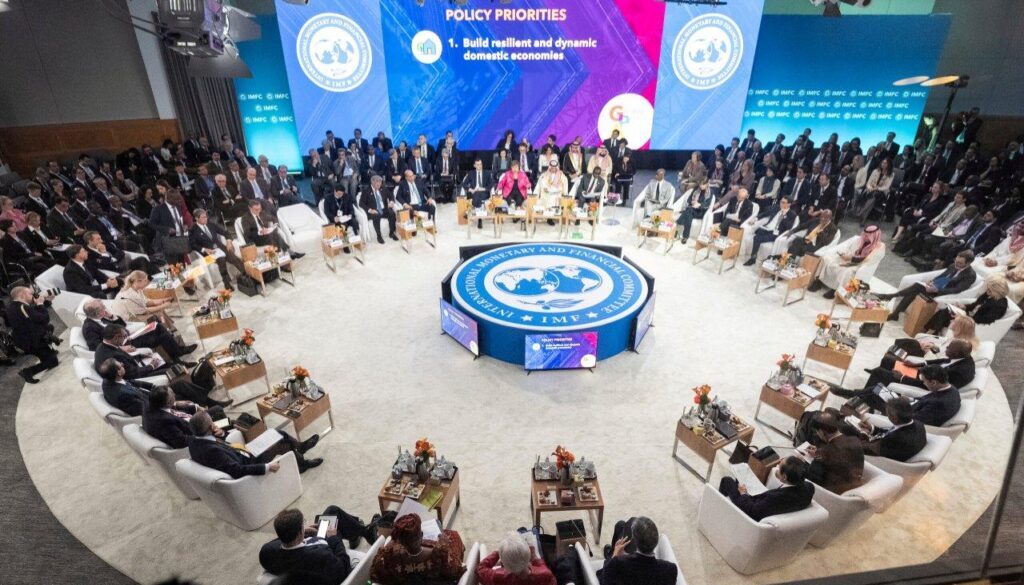
From a security-ringed IMF headquarters on 19th Street to packed hotel ballrooms around DuPont Circle, Washington, D.C. once again became the nerve center of global economic diplomacy as finance ministers, central bank governors and development leaders gathered for the 2025 IMF–World Bank Group Annual Meetings. Over six dense days, delegates wrestled with a deceptively calm global economy: growth holding around 3%, but under pressure from record public debt, renewed trade tensions, accelerating climate shocks and an artificial-intelligence investment boom reshaping capital flows.
For Arab policymakers and bankers, these meetings carried particular weight. The Middle East and North Africa (MENA) region is navigating an unusual mix of stronger near-term growth, post-conflict reconstruction needs in Gaza and Syria, and a once-in-a-generation energy and digital transition. In Washington, Arab ministers and governors used their expanded platform to push for fairer representation in the Bretton Woods institutions, more nimble crisis and reconstruction tools, and greater emphasis on jobs, human capital and private investment across the region.
What emerged from a week of speeches, flagship reports, closed-door negotiations and corridor conversations was a clear message: the world is coping better than many feared, but not nearly as well as it needs to—and the next two years will be decisive for how emerging markets, including in the Arab world, ride the cross-currents of trade realignment, AI-driven growth, climate finance and tightening fiscal constraints.
1. Setting the Scene: A Calm Surface, Restless Undercurrents
The timing of the Washington meetings was extraordinary. The global economy had absorbed a new round of U.S. “reciprocal” tariffs and countermeasures—especially between Washington and Beijing—without tipping into recession. The IMF’s October World Economic Outlook (WEO) upgraded 2025 growth to 3.2% (from 3.0% in July and 2.8% in April), with 3.1% projected for 2026. Yet the Fund stressed that this is still well below pre-pandemic norms, and that the medium-term growth outlook remains “subdued and uneven.”
At the same time, an AI investment wave is reshaping trade, productivity and energy demand. IMF Managing Director Kristalina Georgieva underscored that AI could add between 0.1 and 0.8 percentage points to global growth, but only for countries that are ready—those with robust digital infrastructure, skills, innovation ecosystems and credible regulation. The Fund’s new AI Preparedness Index ranks 174 countries, with advanced economies and most Gulf states in the top third, and many low-income countries lagging far behind.
Overlaying this is a geopolitical map in flux. Peace developments in Gaza and Syria have opened the door to reconstruction planning, even as wider regional tensions remain acute. World Bank Group President Ajay Banga spoke of expert groups already working on reconstruction frameworks for Gaza and Ukraine and stressed that “rebuilding what has been lost” must go hand in hand with preventing future conflict through jobs, inclusion and institutional resilience.
For Arab delegations—from the Gulf to the Levant and Maghreb—the Washington meetings were about more than macro projections. They were an opportunity to assert a more confident regional voice on debt, climate finance, digital transformation and the evolving architecture of global economic governance.
2. Main Themes and Global Context
Global Growth & Inflation: “Better Than Feared, Worse Than Needed”
In her Global Policy Agenda press briefing, Georgieva captured the mood with a memorable line: the world is “better than feared but worse than needed.” Global growth has proven resilient: the October WEO projects 3.3% in 2024, dipping slightly to 3.2% in 2025 and 3.1% in 2026. Advanced economies hover around 1.5% growth, while emerging and developing economies are expected to grow just above 4%.
The tariff shock earlier in the year initially pulled forecasts down; April’s WEO cut the 2025 projection to 2.8%. As negotiations moderated tariff rates and firms front-loaded imports and reorganized supply chains, the outlook improved, prompting the October upgrade.
Inflation is easing, though unevenly. Most regions have seen headline rates fall back towards target ranges, but services inflation and wage dynamics remain sticky in a number of advanced economies. For many MENA countries, food and energy prices have cooled, allowing central banks to maintain tight but less brutally restrictive stances. The IMF’s Middle East and Central Asia Department now expects growth in the MENA region plus Pakistan to reach 3.2% in 2025 and 3.7% in 2026, with inflation projected to moderate as earlier shocks fade.
Yet the Fund’s message was clear: this is not a return to the pre-2008 environment of abundant growth and benign inflation. The medium-term outlook is weighed down by weak productivity, demographic pressures in advanced economies and the scarring effects of repeated shocks. Structural reforms—labor market flexibility, competition, governance, and climate and digital policies—are now central to macro stability, not add-ons.
Sovereign Debt & Restructuring: A Slow-Burn Crisis
If growth was the “better than feared” part of the story, debt was the “worse than needed.” The Fiscal Monitor painted a stark picture: global public debt is projected to rise above 100% of GDP by 2029, its highest level since the aftermath of World War II. There is even a small but non-trivial probability that debt could reach 120% of GDP by 2029 if downside risks materialize.
Advanced economies account for much of the increase, but the burden is most dangerous for emerging and low-income countries with weak market access and limited fiscal space. The IMF warned of “widespread and tilted” risks, with global markets still appearing relatively calm even as vulnerabilities mount. For many Arab countries, including Egypt, Tunisia, Jordan and a number of low-income and conflict-affected states, rising global yields and elevated debt levels mean less room for counter-cyclical spending and more pressure to mobilize domestic revenue and concessional financing.
Georgieva used several platforms—including meetings of the Global Sovereign Debt Roundtable and press briefings—to press G20 members to prioritize debt. She called for faster, more predictable restructuring processes, better coordination among traditional and new creditors, and a more systematic use of IMF “good offices” to unblock negotiations.
The message to markets and policymakers was blunt: absent decisive action to rebuild fiscal buffers and improve spending efficiency, debt problems will morph from country-specific to systemic. For banks and investors, sovereign risk is once again a central driver of portfolio strategy.
Financial Stability & Banking Sector Risks
The Global Financial Stability Report (GFSR) built on that warning. While near-term systemic risks are assessed as contained, the report underscores three forward-looking vulnerabilities: stretched asset valuations in key markets, growing strains in sovereign bond markets, and the rising systemic footprint of nonbank financial institutions (NBFIs), especially in private credit, real estate, and parts of the crypto ecosystem.
Tighter links between NBFIs and banks—through funding, derivatives and shared asset exposures—mean that shocks can propagate quickly. The GFSR highlights the “sovereign–bank nexus” as a particular concern in highly indebted countries, where banks hold large quantities of domestic sovereign debt and may face mark-to-market losses if yields spike.
For regulators and bank boards, the take-home from Washington was clear: this is a time to strengthen capital and liquidity buffers, enhance stress testing that explicitly incorporates sovereign and nonbank channels, and intensify cross-border supervisory cooperation.
Climate Finance & the Green Transition
Climate ran as a continuous thread through both IMF and World Bank discussions. Banga’s plenary speech framed much of the World Bank Group’s evolving agenda: development must be “smart,” meaning resilient to climate shocks and rooted in strong institutions. He noted that nearly half of the Bank’s recent financing qualifies as having climate co-benefits, with a growing share focused on resilience—roads built to withstand flooding, schools and clinics designed for extreme heat, and agricultural support that improves yields while managing water stress.
At the same time, the meetings showcased how far the world still is from closing the climate finance gap. Finance ministers gathered under Brazil’s COP30 initiative to discuss mobilizing over a trillion dollars under a new climate finance roadmap, focusing on MDB reform, concessional finance and domestic resource mobilization. The UAE, drawing on its COP28 legacy, emphasized the importance of blended finance, green sukuk and innovative instruments to crowd in private capital.
For hydrocarbon exporters in the Arab world, the narrative is shifting from a binary “oil versus renewables” framing to a more complex agenda: decarbonizing existing energy systems, investing in low-carbon fuels and clean technologies, and using oil revenues to finance diversification and resilience.
Digital Transformation, Fintech & Digital Public Infrastructure
The other structural theme dominating Washington was digital transformation—particularly AI and digital public infrastructure (DPI). Georgieva’s remarks on the AI Preparedness Index were widely quoted: advanced economies and “most of the Gulf” are in the top tier, while many low-income countries risk being left behind, creating a new axis of inequality.
Panels on digital public infrastructure and fintech explored how digital IDs, interoperable payment systems and data-sharing frameworks can support financial inclusion while strengthening tax capacity and anti-corruption efforts. Banga highlighted how the World Bank is helping governments deploy data-driven tools—linking tax, property and identity records, using AI to detect fraud, and supporting digital IDs tied to asset registries—to improve governance and credibility.
For Arab countries, these debates are not abstract. Gulf states see AI and DPI as competitive levers in attracting global capital and talent, while emerging markets like Egypt, Jordan and Morocco are using digital platforms for cash transfers, SME finance and public procurement. The challenge is to harness digital innovation without amplifying cyber, systemic and consumer-protection risks.
Inequality, Development Financing & Institutional Reform
Finally, the meetings were suffused with questions of equity—between advanced and developing economies, and within societies. Banga placed jobs at the center of the World Bank Group’s mission, warning that 1.2 billion young people will enter the global labor market over the next 10–15 years, competing for about 400 million jobs. “A job is more than a paycheck,” he said. “It is dignity… the anchor that holds families steady and the glue that keeps societies together.”
He detailed how Bank reforms—cutting project approval times, consolidating leadership, streamlining metrics—have expanded financial capacity by about USD 100 billion and helped mobilize tens of billions in private capital, with total commitments, including mobilization, climbing markedly compared with pre-reform levels.
From the Global South, the message was that financing is still not commensurate with the scale of climate, demographic and reconstruction challenges. Arab and BRICS officials pressed for further multilateral development bank (MDB) reform, greater use of guarantees and “originate-to-distribute” models to free up MDB balance sheets, and a meaningful increase in the voice and voting power of emerging and developing countries.
3. Flagship Reports: Quiet Numbers, Loud Warnings
Although the narrative and geopolitics drew headlines, the intellectual backbone of the meetings remained the Fund’s flagship reports.
World Economic Outlook (WEO)
The October WEO lifted near-term growth forecasts but stressed that the tariff shock and lingering uncertainties have left global output below the path envisaged before the policy reversals. The report underlined that the recent resilience owes much to front-loaded trade, rebuilding of inventories and strong AI-related investment—factors that may fade in coming years.
Global Financial Stability Report (GFSR)
The GFSR’s central message was that apparent calm in markets masks shifting vulnerabilities. Besides the sovereign–bank nexus and NBFI build-up, the report flagged structural changes in FX and EM bond markets that simultaneously create pockets of resilience and new channels for volatility. For bank treasurers, this implies closer monitoring of market liquidity, cross-currency funding and linkages with shadow banking.
Fiscal Monitor.
Branded “Spending Smarter,” the Fiscal Monitor urged governments to reorient public expenditure towards high-impact investments—health, infrastructure, education, R&D—while improving efficiency, rather than simply expanding envelopes. Against the backdrop of debt heading beyond 100% of GDP, IMF fiscal chief Vitor Gaspar warned that policymakers are “running out of time” to rebuild buffers and that fiscal policy must support, not undermine, monetary efforts to control inflation and financial risks.
4. Key Speeches & Interventions — What Really Stood Out
Dr. Kristalina Georgieva, Managing Director, IMF
Dr. Georgieva’s Annual Meetings plenary, “Resilience in a World of Uncertainty,” set the intellectual tone. She described a world reshaped by demographic divergence, shifting trade patterns and the AI revolution. While acknowledging that the impact of U.S. tariffs had been less severe than feared, she argued that uncertainty and fragmentation risks remain high, and that the global economy is “excessively imbalanced,” with surpluses and deficits entrenched across key economies.
She organized her agenda around three priorities:
- Unlock private sector growth by cleaning up domestic regulation, improving governance and keeping trade open as an engine of productivity.
- Secure sound macro-fundamentals—credible monetary policy, prudent financial regulation, and fiscal consolidation that relies more on domestic revenues than on new borrowing.
- Reduce global imbalances by encouraging surplus economies to support domestic demand and deficit economies, notably the United States, to narrow fiscal gaps.
On debt, she pledged to push the G20 to streamline restructuring processes and called for a replenishment of the Catastrophe Containment and Relief Trust, which had been critical in supporting low-income countries during the pandemic but is now depleted.
On AI, she returned to the theme of preparedness: countries in the bottom tiers of the AI Preparedness Index risked falling even further behind, she warned, unless they invest rapidly in digital infrastructure, skills and regulatory frameworks.
Mr. Ajay Banga, President, the World Bank
Mr. Ajay Banga’s plenary speech was perhaps the most forward-looking intervention of the week. He began by reflecting on “recent events in Syria and Gaza” as reasons to hope that peace is possible, but stressed that development institutions must both prepare for peace and prevent future conflict. Reconstruction, he argued, is not just about bricks and mortar but about institutions and jobs.
Mr. Banga then reframed the Bank’s mission around employment. By 2050, over 85% of the world’s population will live in countries considered “developing” today, and four young people will enter the global workforce every second over the next decade. Without a jobs-rich growth model, that demographic wave could translate into instability and migration pressures with global repercussions.
He highlighted reform progress inside the Bank—shorter project cycles, a unified corporate scorecard, and a USD 100 billion boost in financial capacity—before spelling out a three-pillar strategy: build human and physical infrastructure; improve policy and institutional frameworks in tandem with the IMF; and scale private investment through IFC and MIGA, including new guarantee and originate-to-distribute structures that have already securitized portfolios of IFC loans.
For Arab delegations, his emphasis on energy access (including gas and nuclear alongside renewables), agriculture transformation and climate-resilient infrastructure resonated strongly with domestic investment agendas.
H.E. Mohammed Al-Jadaan, Minister of Finance for Saudi Arabia, and Chair of the International Monetary and Financial Committee (IMFC)
In his role as chair of the IMF’s steering committee, Saudi Finance Minister H.E. Mohammed Al-Jadaan emerged as a central voice from the Global South. At an IMFC press briefing, he underscored the urgency of tackling global debt and warned that political shifts and protectionism were amplifying uncertainty for emerging markets. He also stressed the importance of maintaining the IMF as a quota-based institution with adequate resources that reflect the weight of emerging and developing economies.
In a separate press encounter, Al-Jadaan made headlines by confirming that many investments were being finalized for Syria. “We stand with Syria… they are genuine in their efforts to do the right thing for their people,” he said, describing a wave of private sector interest in reconstruction.
H.E. Dr. Jihad Azour, Director of the Middle East and Central Asia Department
Dr. Azour’s regional press briefing provided the most detailed snapshot of MENA macro dynamics. He reported that growth in the Middle East, North Africa, Pakistan and the Caucasus is outperforming earlier expectations, reaching 3.2% in 2025 and projected at 3.7% in 2026, supported by higher oil output in exporters, strong tourism and remittances in importers, and still-robust domestic demand. Inflation is easing in most MENA economies, although it remains elevated in parts of Central Asia.
On the new U.S. tariffs, Azour downplayed immediate direct impacts, citing limited trade volumes and the exclusion of oil and gas from the measures. But he cautioned that indirect effects—through shifting trade routes, global demand and financial conditions—could be significant over time, urging Gulf states to leverage the AI and trade reconfiguration wave to accelerate diversification and regional integration.
He also fielded detailed questions on Egypt and Lebanon, highlighting the progress of Egypt’s reform program in reducing inflation and public debt and strengthening the role of the private sector, while stressing the need for continued governance and state-ownership reforms.
Mrs. Christine Lagarde, President, European Central Bank
ECB President Christine Lagarde’s interventions, especially at the IMFC and a high-profile panel on the global economy, were closely watched by markets. She emphasized that the ECB’s rate-cut cycle would be “gradual and data-dependent,” balancing progress on inflation against lingering wage and services pressures. Lagarde also warned that renewed U.S. tariffs and broader industrial policy shifts risk further fragmenting trade and investment, complicating monetary policy transmission in Europe.
H.E. Scott Bessent, U.S. Treasury Secretary
In his first Annual Meetings as Treasury Secretary, Scott Bessent offered a distinctly American take. He defended the administration’s tariff strategy as a “rebalancing” aimed at securing fairer trade, while insisting the U.S. remained committed to the rules-based system. At the same time, he faced pointed questions about the U.S. fiscal trajectory, with public debt surpassing USD 38 trillion and projected to climb further.
Bessent sought to reassure markets by highlighting planned measures to raise revenue and re-prioritize spending toward infrastructure, AI and strategic manufacturing.
H.E. Rachel Reeves, UK Chancellor of the Exchequer
The UK’s chancellor, Rachel Reeves, used Washington to reinforce her “stability first” message. With UK public debt projected to peak around 106% of GDP by 2029, she acknowledged that fiscal space is tight and signaled that a mix of tax increases and spending restraint is likely in the forthcoming budget, even as the government seeks to protect green infrastructure and social investment.
Her remarks underlined a broader theme: many advanced economies are entering an era of more constrained fiscal choices, which will shape global rates, capital flows and the availability of concessional resources.
Geopolitics & Policy: The Middle East Back at the Centre
Several interventions explicitly bridged geopolitics and economics.
Banga’s references to reconstruction in Gaza and Ukraine, and the World Bank’s convening of expert groups with regional specialists, signaled that the Bank is preparing to move quickly as political milestones are reached.
Al-Jadaan’s comments on Syria made clear that Gulf capital is already positioning for a new phase of investment, in coordination with multilateral institutions. Georgieva noted that the IMF had resumed a “full-fledged engagement” with Damascus, including technical work to strengthen the central bank’s capacity as an anchor of monetary and financial stability.
Questions to Azour at the regional briefing focused heavily on the impact of the Gaza peace deal on Egypt and the wider region—ranging from reconstruction opportunities to refugee flows and security spillovers—illustrating how closely markets link political risk and macro trajectories in MENA.
Beyond the Middle East, WTO Director-General Ngozi Okonjo-Iweala’s upgraded trade outlook—raising 2025 goods trade growth to 2.4%, driven largely by AI-related demand and front-loaded U.S. imports ahead of tariff changes—reinforced how intertwined trade policy, technology and macro expectations have become.
5. Focus on the Arab World & MENA
Regional Growth Outlook & Risks
The mood among Arab delegations was more confident than in many recent years. The IMF now projects MENA and Pakistan to grow by 3.2% in 2025, up from 2.1% in 2024, with a further pick-up to 3.7% in 2026. Oil exporters benefit from higher production as OPEC+ cuts unwind, while importers gain from lower energy prices, resilient remittances and tourism.
Exchange rates have generally adjusted smoothly, sovereign spreads have narrowed, and several countries—including in the GCC—have returned successfully to international bond markets. For many Gulf sovereigns, fresh issuance is now more about active debt-management and yield-curve building than filling financing gaps.
But the outlook is far from risk-free. The region remains exposed to global demand swings, oil price volatility, climate shocks and renewed financial tightening. High-debt countries face particularly thin margins for error. Azour urged MENA policymakers to use the current momentum to rebuild buffers, strengthen fiscal frameworks and accelerate structural reforms that diversify economies and improve governance.
Several Arab voices stood out in Washington.
H.E Mohamed bin Hadi Al Hussaini, Minister of State for Financial Affairs, UAE
The UAE’s Minister of State for Financial Affairs used his IMFC intervention to highlight how “major political shifts” have increased uncertainty and disproportionately affected developing and emerging economies. He called for stronger multilateralism, a quota-based IMF that better reflects emerging markets’ weight, and enhanced capacity-building for countries in transition. The UAE also participated actively in G20 and BRICS finance meetings and in the COP30 finance track, positioning itself as a bridge between advanced economies, BRICS partners and the wider Global South.
H.E. Rania Al-Mashat, Minister of Planning, Economic Development and International Cooperation and Governor for Egypt at the World Bank Group
As Egypt’s Governor at the World Bank, Minister Rania Al-Mashat played a prominent role in the Meeting of Arab Governors with Ajay Banga. She emphasised that strengthening Arab resilience requires balancing macro-stability with sustained investment in infrastructure and human capital, and she urged the World Bank to deepen partnerships that empower the private sector and mobilize innovative guarantees for the region. She also called for World Bank reforms to increase developing countries’ voting power and better align global priorities with their needs.
The Arab Governors’ formal statement, delivered on behalf of the group by Mauritania’s Mohamed-Lemine Dhehby, reinforced those themes: recognition of the resilience many Arab economies have shown, but a sober assessment of challenges from high debt, climate shocks and fragility—and a call for more concessional resources and agile crisis-response tools.
Sovereign Debt, Energy Transition & Climate Finance in the Arab World
Debt and climate finance were recurring topics in Arab interventions.
GCC countries enter this period from a position of relative strength, with buffers providing room to issue debt opportunistically and finance ambitious investment programs. But Azour highlighted that even for the Gulf, careful debt and asset-liability management is essential given global rate uncertainty and potential oil-price swings.
For more indebted economies—Egypt, Jordan, Tunisia and several lower-income and conflict-affected states—the conversation centered on how to restore debt sustainability while preserving social and investment spending. IMF programs and World Bank operations increasingly emphasize reforms that create space for private investment, rationalize subsidies, improve targeting of social transfers and strengthen tax administration.
On climate, Arab delegations converged around a dual agenda:
Financing resilience and adaptation—particularly water security, agriculture, coastal protection and urban resilience; and
Supporting a just energy transition that recognizes the role of gas and, in some cases, nuclear energy, while accelerating renewables and energy efficiency.
Banga’s emphasis on “climate co-benefits” and “smart development” resonated with Gulf and North African strategies. Initiatives such as large-scale energy-access programs in Africa, new MDB co-financing platforms and debt-for-development tools were seen as potential models for scaling climate-related investment in and around the Arab world.
Islamic Development Bank President Muhammad Al Jasser and other regional financiers used side events to argue that climate finance must be more accessible to lower-income and fragile states, and that Islamic finance instruments—sukuk, blended funds, risk-sharing structures—can help de-risk green investments while aligning with local preferences.
Digital Finance and MSME Financing in MENA
Digital transformation is a space where many Arab economies are seeking to leapfrog. Gulf countries, in particular, are investing heavily in AI, cloud infrastructure and digital identity systems. Georgieva’s observation that “most of the Gulf” sits in the top tier of the AI Preparedness Index underscored this positioning.
In Washington, MENA officials participated in sessions on fintech, digital payments and DPI, highlighting:
- Rapid growth of instant payment systems and digital wallets in the GCC and parts of North Africa;
- Use of digital platforms for MSME finance, including supply-chain finance and marketplace lending;
- Regulatory sandboxes and innovation hubs that allow experimentation while managing risks.
The UAE, for example, showcased progress in fintech partnerships and digital sukuk issuance, aligning these with broader sustainable-finance and financial-inclusion objectives.
For banks across the Arab world, the challenge is to scale digital offerings for MSMEs—long the backbone of employment—without compromising credit quality or cybersecurity. IMF staff noted that well-designed DPI can reduce the cost of customer onboarding, improve credit scoring and strengthen tax compliance, all while supporting inclusion.
Arab Regional Institutions: From Supporters to System Shapers
The Washington meetings also highlighted the growing strategic role of Arab regional institutions.
At the Arab Governors meeting with Banga, Arab Monetary Fund (AMF) Director-General Fahad Alturki represented regional financial institutions, underscoring their role in macro-stability, payments integration and policy coordination.
The Islamic Development Bank, Arab Fund for Economic and Social Development, OPEC Fund and others used the week to coordinate with the IMF and World Bank on co-financing pipelines—especially around climate, digital infrastructure and private-sector development.
6. Banking & Financial Sector Takeaways
From a bank CEO’s perspective, the Washington meetings delivered a clear risk-management checklist.
Capital & Liquidity
With global debt rising and sovereign–bank linkages under scrutiny, boards will be expected to demonstrate robust capital planning under stressed sovereign and rate scenarios, and to review concentration limits on domestic government exposures.
Nonbank Interlinkages
Banks with significant dealings with NBFIs—through derivatives, funding lines, securitisations or co-lending—face heightened expectations around counterparty risk management and liquidity contingency planning.
AI & Digital
The AI preparedness narrative is moving from macro to micro. Supervisors are likely to ask how banks are using AI in credit, risk and compliance, how they govern model risk, and how they are preparing staff and systems for rapid technological change.
Climate & Transition Risk
The push for “smart development” and the rise of climate co-benefits in MDB portfolios will feed into supervisory expectations on climate-related risk assessment, disclosure and scenario analysis, particularly for banks exposed to carbon-intensive sectors.
Development & Inclusion
Especially in MENA, banks are increasingly seen as partners in delivering MSME finance, infrastructure funding and social programs via digital channels. That opens new business lines but also demands investments in data, cybersecurity and inclusive product design.
7. Political Economy, Governance & Multilateral Reform
Behind the communiqués, a more subtle conversation unfolded about who sets the rules of the global financial system.
Emerging markets—including Arab and BRICS countries—pressed for faster progress on IMF quota reform and World Bank governance changes. The UAE highlighted a broader vision for rebalancing quotas and supported the UN framework on international tax cooperation, signaling a desire to be at the table as tax, trade and financial rules evolve.
Arab Governors and ministers echoed a common refrain: multilateral institutions must move from primarily crisis-response roles to becoming platforms for long-term structural transformation—supporting diversification, human capital, digital infrastructure and climate resilience. They also stressed that reconstruction in Gaza, Syria and other fragile settings cannot wait for perfect political conditions; financing tools and safeguards must be ready in advance.
The IMF, for its part, highlighted ongoing reviews of surveillance and conditionality to better reflect structural and distributional realities, while the World Bank showcased its internal reforms as proof that Multilateral Development Banks (MDBs) can move faster, simplify processes and mobilize more private capital without sacrificing prudence.
8. What Comes Next
Key Risks & Opportunities for the Global Economy
The 2025 Washington meetings leave the global economy at a crossroads.
Risks include:
- A sharper-than-expected slowdown as AI investment normalizes and the boost from front-loaded trade fades;
- Debt-related stress in highly leveraged sovereigns, with potential spillovers through banks and NBFIs;
- Further trade and technology fragmentation, particularly if tariff disputes broaden;
- Climate shocks and conflict flare-ups, especially in already fragile regions.
Opportunities include:
- AI-driven productivity gains, particularly for countries that invest early in skills, digital infrastructure and governance;
- Rewired trade and energy routes that could benefit strategically positioned economies, including in the Gulf and Eastern Mediterranean;
- A retooled multilateral system capable of mobilizing larger volumes of blended finance for climate, digital and human-capital investments.
Strategic Priorities for Banks, Regulators & Arab Policymakers
For Arab banks and regulators, several strategic priorities stand out:
Re-price sovereign and credit risk.
Integrate the IMF’s debt and financial-stability messages into internal risk appetites and pricing models, with particular scrutiny of long-tenor exposures in high-debt jurisdictions.
Invest in AI and DPI capabilities.
Take advantage of the region’s relatively strong AI preparedness by modernizing core systems, upgrading data governance and building AI-literate risk and compliance teams—while engaging proactively with regulators on standards.
Scale sustainable and transition finance.
Develop products—green and transition sukuk, sustainability-linked loans, blended structures with MDBs—that finance both mitigation and adaptation, including in high-risk segments such as agriculture, water and urban resilience.
Deepen regional integration.
Support cross-border payment systems, harmonized regulatory standards and joint financing platforms with Arab regional institutions, leveraging the momentum from the Arab Governors’ initiatives.
Monetary Policy, Regulation, Capital Flows & Investment Patterns
The modest but steady growth outlook, combined with easing inflation, points to a gradual, asynchronous easing cycle globally. For MENA central banks, especially those with currency pegs, this will mean carefully mirroring—or slightly lagging—moves by the Federal Reserve and ECB, while maintaining vigilant communication to anchor expectations.
Regulators are likely to:
- Push for enhanced disclosures on climate and sovereign risk;
- Expand macro prudential frameworks to capture NBFIs and housing exposures;
- Increase focus on operational resilience and cyber risk as digitalization accelerates.
On capital flows, higher-for-longer global rates and elevated debt levels will keep investors discriminating. Countries that combine credible fiscal paths, reform momentum and clear digital/green strategies—several GCC and reform-oriented MENA economies among them—stand to attract more stable, long-term capital.
The Role of Multilateral Institutions over the Next 12–24 Months
Over the coming two years, the IMF and World Bank will be looked at less by communiqués than by delivery.
For the IMF, success will mean operationalizing its AI and climate work into concrete policy advice and program design; making the Global Sovereign Debt Roundtable more effective; and ensuring that facilities like the Poverty Reduction and Growth Trust and Resilience and Sustainability Trust are adequately resourced for the next shock.
For the World Bank Group, the test will be whether its reformed processes and expanded financial capacity translate into faster, larger and more catalytic operations—especially in fragile and conflict-affected states, and in climate-sensitive sectors across MENA and Africa.
For Arab regional institutions, the opportunity is to move from supporting actors to system shapers—aligning their own strategies with the evolving global agenda and ensuring that Arab perspectives on debt, climate, digital transformation and reconstruction are embedded in multilateral decision-making.
Conclusion
If the 2023 Marrakech meetings were about stabilization after overlapping shocks, Washington 2025 felt like the opening chapter of a new phase: one in which AI, climate, debt and geopolitics will redefine what “stability” even means. For Arab banks, regulators and policymakers, the task now is to translate the week’s dense communiqués and speeches into concrete strategies—recalibrating risk, seizing new opportunities in trade and technology, and insisting that the next iteration of the global financial architecture gives their economies the voice and tools they need to thrive.