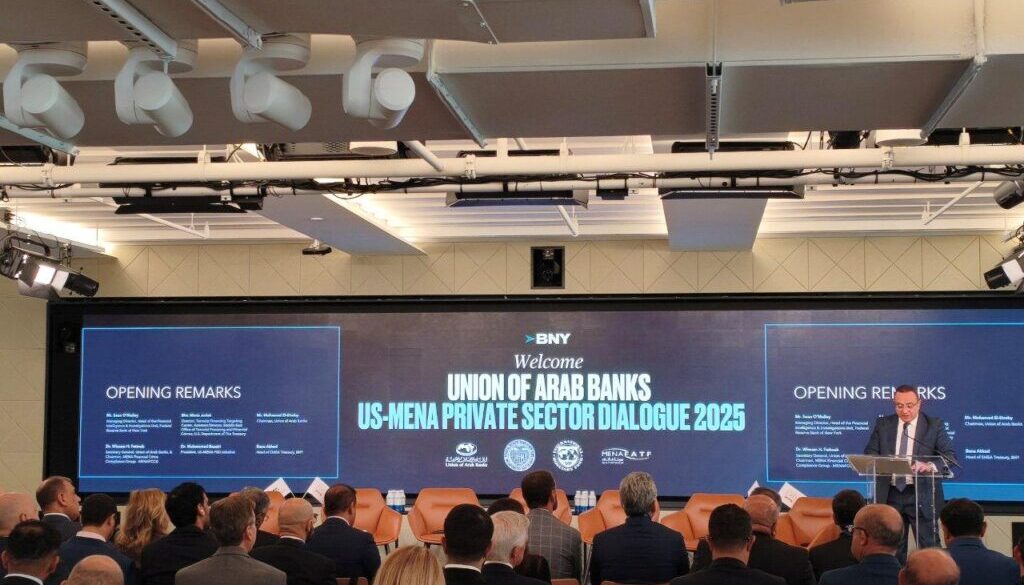
On October 10, 2025, the Union of Arab Banks (UAB) convened the 12th edition of the U.S.–MENA Private Sector Dialogue (PSD) at the headquarters of the Bank of New York (BNY) in New York City, USA. This high-level forum was organized in cooperation with the Federal Reserve Bank of New York (FRBNY) and with the participation of the International Monetary Fund (IMF), the United Nations Security Council, and the U.S. Department of the Treasury. The event brought together a distinguished group of senior officials, regulatory authorities, and banking leaders from both the United States and the Arab region.
Held under the theme “Advancing Financial Compliance in a Rapidly Evolving Global Landscape,” the 2025 edition of the U.S.–MENA Private Sector Dialogue convened at a time of profound regulatory and technological transformation. Financial institutions worldwide are contending with heightened prudential standards, intensified AML/CFT scrutiny, and the emergence of sophisticated threats such as trade-based money laundering and cyber-enabled financial crime. Concurrently, technological disruption—particularly the growing use of artificial intelligence in compliance—has reshaped how risks are identified and managed. These developments have compounded longstanding structural pressures, including the fragility of correspondent banking relationships and the challenges of integrating digital assets into regulated financial systems. In this context, the Dialogue served as a timely platform for fostering transregional cooperation, enabling U.S. and MENA stakeholders to confront shared compliance challenges and safeguard cross-border financial integrity. Since its inception in 2006, the PSD has aimed to build trust, deepen regulatory engagement, and promote collaborative solutions—a mission the 2025 conference reaffirmed with clarity and purpose.
About the U.S.–MENA PSD
The U.S.–MENA Private Sector Dialogue is a long-running initiative designed to foster closer regulatory and banking cooperation between the USA and the Arab world. First established in 2006 by public and private sector stakeholders from both sides, the PSD has since held numerous gatherings aimed at strengthening mutual understanding. It operates as a policy-focused bridge between U.S. authorities (such as the Treasury and Federal Reserve) and MENA-region financial regulators, central banks, and banking executives. By institutionalizing this dialogue, the PSD provides a sustainable platform for tackling issues of common concern – from money laundering and sanctions compliance to financial innovation and inclusion – in a frank and collaborative setting.
The vision behind the initiative is based on promoting the stability and integrity of the banking sector across both regions. Concretely, the UAB and its partners pursue several key objectives through the PSD framework. This initiative seeks to:
- Promote robust AML/CFT standards and strengthen anti-corruption measures.
- Support compliance with evolving regulations to safeguard the financial system against security threats.
- Foster constructive engagement and communication between U.S. and MENA banking communities.
- Strengthen collaboration among regulators, supervisors, and the private sector in addressing shared compliance challenges.
By pursuing these goals, the U.S.–MENA PSD helps align regulatory expectations and best practices across jurisdictions. It has become a “much-anticipated event” on the annual banking calendar, drawing a broad coalition of institutions – including the IMF and other international bodies – to collectively advance financial integrity and inclusion. In essence, the PSD functions as a trusted forum for policy discussions: it enables US and Arab bankers and regulators to share experiences, discuss emerging trends, and coordinate responses to financial crime and compliance risks. Over time, this dialogue has contributed to building greater trust between correspondent banking partners, improving the transparency and resilience of MENA banks, and ensuring that progress in AML/CFT is carried forward through joint efforts. The 2025 edition continued this tradition, reinforcing the PSD’s importance as a driver of cross-border cooperation in an era of rapid change.
Highlights from the Opening Speeches
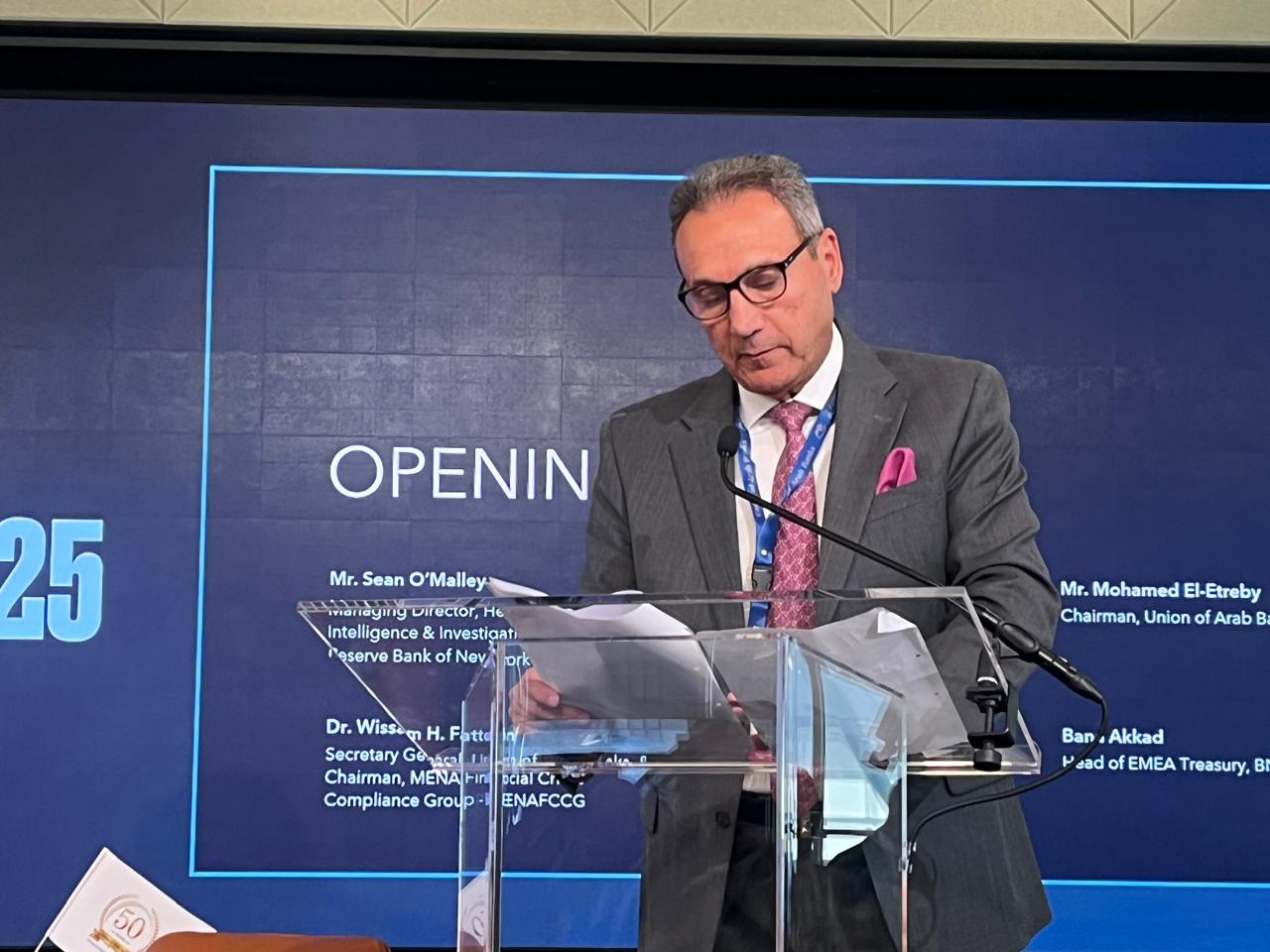
Mr. Mohamed El Etreby, Chairman, Union of Arab Banks
In his keynote remarks, Mr. El Etreby expressed an optimistic yet resolute tone about the evolving role of compliance in modern finance. He noted that each year the U.S.–MENA PSD strengthens “the bridge between the Arab region and the United States – a bridge built on trust, cooperation, and a shared commitment to safeguarding the integrity of the global financial system”. Acknowledging the conference theme, he observed that we live in an age of exponential change – with new technologies disrupting finance, shifting geopolitical currents, and threats from financial crime, cyber-attacks, and sanctions testing institutional resilience. In this context, “with challenge comes opportunity.” Compliance, once viewed as a regulatory burden, is now “the passport to credibility, sustainability, and growth in global markets”, and the foundation upon which trust is built – with trust itself “the very currency of modern finance”. El Etreby outlined the remarkable transformation of the compliance function over the past two decades: what began as a narrow focus on AML and KYC has expanded into a comprehensive framework encompassing counter-terrorism financing, sanctions, tax transparency, cyber-security, and even ESG considerations. Compliance is no longer reactive, he stressed, but has become predictive and technology-driven, leveraging advanced analytics, real-time transaction monitoring, artificial intelligence, and blockchain solutions to detect anomalies and mitigate risks before they escalate. This evolution means compliance is a “living, adaptive system” that must continuously evolve to counter increasingly sophisticated threats.
Crucially, Mr. El Etreby emphasized that Arab banks are not standing idle in this evolution. “We are moving forward,” he said, “transforming compliance from a defensive shield into a proactive driver of innovation, resilience, and competitiveness.” Regional banks are investing in people, by training new generations of compliance leaders, and harnessing technology – deploying AI, machine learning, and RegTech tools – to stay ahead of emerging risks. They are also embracing transparency not merely to satisfy regulators but because customers, partners, and societies demand it. The vision, as El Etreby articulated, is for the MENA region to not just meet international standards but to set an example of compliance leadership, leveraging the region’s youthful energy and potential to be at the forefront of global best practices. He highlighted the PSD as more than just a conference – rather, “the US-MENA Dialogue is a living partnership” that keeps Arab banks connected to global markets and U.S. institutions engaged in one of the world’s most dynamic regions. This cooperation is essential not only to reduce risks but also to expand opportunities. In a pointed reference to de-risking, El Etreby argued that “compliance should not lead to exclusion. It should lead to inclusion.” Effective risk management, in his view, ought to facilitate legitimate flows of trade, investment, and remittances that uplift communities and power development, rather than inadvertently cutting off regions from the financial system. He closed by urging boldness, adaptability, and collective action in the face of change. Armed with innovation, committed regulators, and an unyielding belief that integrity is non-negotiable, the U.S.–MENA partnership can “shape” the future of finance rather than merely react to it. By doing so, he affirmed, this partnership will continue to thrive not out of necessity but as “a beacon of how regions, working hand in hand, can create trust, resilience, and prosperity for generations to come”.
Dr. Wissam Fattouh, Secretary General, Union of Arab Banks and World Union of Arab Bankers:
In his address, Dr. Fattouh reinforced many of the same themes while focusing on concrete developments and challenges in the MENA financial sector. He addressed the PSD as a “important platform” reflecting a shared U.S.–Arab commitment to communication and cooperation in service of financial stability and sustainable growth. Offering thanks to the conference partners (FRBNY, IMF, U.S. Treasury – the last of which was absent due to a U.S. government shutdown – and BNY as host), Fattouh noted that the broad participation of stakeholders underscored a collective responsibility to shape the future of the financial sector. He then turned to the state of the region, observing that the past year brought significant positive change and new opportunities. Notably, the threat of terrorism that once destabilized the region is receding: “terrorism is being steadily defeated,” evidenced by the drying up of terror financing sources in countries like Syria, Lebanon, and Iraq. However, he cautioned that this mission is not yet complete. To consolidate the gains in combating illicit finance, remaining gaps in financial transparency must be addressed. Most importantly is the persistent challenge of the cash-based economy in many Arab countries, as well as alternative money-laundering methods. Dr. Fattouh cited the misuse of high-value assets – such as art, antiques, precious stones and other valuables – to disguise and transfer illicit funds as a growing concern. “As long as cash dominates and these alternative channels remain unmonitored,” he warned, illicit flows will find a way, and public confidence in financial systems will be undermined.
This reality points to a simple truth: ensuring the lasting drying up of terrorist financing and other illicit flows requires comprehensive banking sector reforms, not just better compliance. “Reform is not only about compliance; it is about building the structures, systems, and governance that enable banks to drive integration, modernization, and growth across our economies,” Fattouh said. In other words, the fight against financial crime is intertwined with broader economic and institutional development. On this front, the UAB has been at the forefront of modernization efforts, working closely with regulators, central banks, and financial institutions to upgrade banking practices, enhance compliance cultures, and promote greater financial inclusion across MENA. Dr. Fattouh provided an objective assessment of several country situations to illustrate the region’s diverse challenges and the UAB’s role in addressing them.
In Iraq, UAB has consistently offered support to strengthen the banking sector, yet progress has been limited by the absence of a unified, effective counterpart on the ground (beyond the central bank) to implement reforms. There remains a big gap between a few well-established Iraqi banks that are relatively compliant and profitable, and a long list of weaker institutions – many evolved from money exchange houses – that still face serious compliance and regulatory deficiencies. This imbalance is unsustainable: as Dr. Fattouh noted, Iraq cannot achieve a durable economic recovery without decisive banking reform. The foundations for such reform exist, but the commitment to carry them out must become “stronger, firmer, and more determined”.
In Syria, following the recent lifting of certain international sanctions, a major opportunity for financial sector progress has opened – but the road is steep. Years of conflict and isolation left Syria’s banking system with weak regulations and a loss of public trust. To address these, UAB has proposed a phased roadmap for Syrian banking rehabilitation: start with restructuring troubled banks and building basic compliance infrastructure, then institute robust governance and transparency measures, undertake extensive training and capacity-building (especially for staff who operated during the sanctions era), and finally pursue sustainable growth through innovation and new international partnerships. This systematic approach aims to gradually reintegrate Syria’s banks into the global fold.
Regarding Lebanon, Dr. Fattouh deferred detail to the conference’s Lebanese speaker (Dr. Mazen Soueid, Chairman, Banking Control Commission, Lebanon) but highlighted one positive trend: even as Lebanon copes with severe economic strain, there has been a gradual shift away from cash reliance, with increasing use of electronic payments (debit and credit cards) by the public – an encouraging sign of progress in modernizing the financial culture.
In Yemen (specifically Aden), he mentioned the resilience of banks that, despite extreme conditions, have improved their compliance and AML/CFT practices. UAB has been proud to support these efforts, including helping establish a new Yemeni Banks Association (whose president was present at the conference) – a development Dr. Fattouh described as a model of resilience for the region.
On a less positive front, Dr. Fattouh acknowledged that in Sudan, although sanctions were lifted in recent years, the outbreak of war in 2023 tragically reversed much of the hard-won progress in its banking sector.
Zooming out, Dr. Fattouh drew attention to important regulatory developments across MENA. In the Gulf Cooperation Council (GCC) countries, he noted, the large scale of the banking sector and its extensive international ties force banks to maintain strong correspondent relationships and uphold the highest standards of AML/CFT compliance, technology infrastructure, and transparency. Several jurisdictions have made significant reforms: for example, the United Arab Emirates and Jordan both implemented major legal and regulatory enhancements, enabling them to exit the FATF “grey list” of jurisdictions under increased monitoring. These successes have further bolstered the strength and credibility of their financial systems, and UAB has closely monitored such advancements (indeed, these topics were slated for discussion in the conference’s Session II).
Among the most pressing themes in Dr. Fattouh’s speech was the ongoing challenge of correspondent banking access and de-risking. He recalled that in 2015, the first joint IMF–UAB survey on de-risking revealed severe impacts on MENA banks: nearly 40% of banks in 17 countries had seen correspondent accounts closed or restrictions tightened, resulting in costlier and less accessible remittances and trade finance for the region. A full decade later, in 2025, de-risking remains a major concern. Global regulatory pressure has not abated, and banks across MENA still struggle at times to maintain their correspondent relationships. The difference today, Dr. Fattouh observed, is the emergence of alternative channels for cross-border payments and transfers. “In 2015 there were limited alternatives,” but now technologies like blockchain-based solutions, fintech and money service businesses, and digital payment platforms offer new avenues. However, these alternatives are not yet fully regulated and could introduce serious risks if left unchecked. It is therefore essential, he argued, that such emerging channels be brought under clear and consistent regulatory frameworks – ensuring that innovation strengthens rather than undermines the stability of the financial system. (Recognizing the strategic importance of this issue, the PSD organizers dedicated a special session of the conference to digital finance and fintech oversight.) Despite the challenges enumerated, Dr. Fattouh’s message was ultimately one of determination and guarded optimism. He noted that the conditions for reform, growth, and reintegration in the region are now aligning as never before, and that the UAB is assuming a lead role – working hand in hand with local and international regulators, supervisory authorities, and banks – to develop a strong, integrated Arab banking sector that can operate confidently and competitively on the global stage. He closed by thanking the partners and participants, and reinforcing that through deepened cooperation and unwavering commitment to high standards, the U.S.–MENA partnership will continue to drive positive transformation in the years ahead.
Additional Distinguished Opening and Keynote Addresses
Also delivering opening and keynote remarks were Mr. Sean O’Malley, Managing Director and Head of the Financial Intelligence & Investigations Unit at the Federal Reserve Bank of New York, and Dr. Muhammad Baasiri, President of the U.S.–MENA PSD initiative, and Mrs. Bana Akkad Azhari, Managing Director at BNY, who emphasized the Dialogue’s enduring value as a platform for strengthening mutual understanding and reinforcing trust between regulators and the banking community across both regions. Their interventions were complemented by keynote addresses from Mr. Rory Corcoran, Directorate Coordinator at INTERPOL’s Financial Crime and Anti-Corruption Centre, and Ms. Sandra Ro, CEO of the Global Blockchain Business Council and Member of the U.S. CFTC GMAC Digital Asset Markets Subcommittee, who highlighted the importance of international coordination and technological innovation in combating financial crime and shaping secure, transparent digital finance ecosystems.
Awards and Recognitions
The Union of Arab Banks also presented honorary awards to key partner institutions for their sustained support of the U.S.–MENA PSD. The Federal Reserve Bank of New York — represented by Mr. Sean O’Malley, Managing Director and Head of the Financial Intelligence & Investigations Unit — the U.S.–MENA PSD initiative — represented by Dr. Muhammad Baasiri, President of the U.S.–MENA PSD — and BNY Mellon — represented by Mrs. Bana Akkad Azhari, Managing Director at BNY — were each recognized for their strategic cooperation and support. In addition, Mr. Chip Poncy, Global Head of Financial Integrity and Board Member at K2 Integrity, was awarded for his distinguished contributions to strengthening global financial integrity and advancing the objectives of this long-standing dialogue.
Forum Sessions Overview
After the opening remarks, the conference proceeded through three focused panel sessions, each examining a critical aspect of financial compliance and collaboration. Senior U.S. officials, Arab regulators, international experts, and private sector leaders featured prominently across these discussions, providing a rich exchange of perspectives. Below is an overview of each session and its key takeaways:
Session I: Strengthening and Modernizing Financial Institutions’ AML/CFT Programs
The first session, Moderated by UAB’s senior adviser Dr. Chahdan Jebeyl, centered on how banks can bolster their anti-money laundering and counter-terrorist financing (AML/CFT) frameworks in light of new regulations and emerging risks. Mr. Sean O’Malley, Managing Director and Head of the Financial Intelligence & Investigations Unit at the Federal Reserve Bank of New York, set the scene with an engaging and forward-looking overview of how evolving U.S. regulatory priorities and global financial intelligence trends are reshaping the compliance landscape. The panel included panelists from U.S. and MENA institutions – among them, compliance veterans like Chip Poncy (K2 Integrity), Jacqueline Shire (Federal Reserve Bank of New York), Dr. Mazen Soueid (head of Lebanon’s Banking Control Commission), -Mr. Sameer Pandit, MD/Chief Compliance Officer – Treasury Services, Global Client Management & Credit Services, BNY, Mr. Jamal El-Hindi, Counsel, Clifford Chance US LLP, Former Acting Direction FinCen, US Treasury, USA, and Mr. Mitch Berger, Senior Partner, Squire Patton Boggs. A major focus was “what’s new” in U.S. AML/CFT programs and how these developments impact banks abroad. For example, the panel examined the recent introduction of U.S. National AML/CFT Priorities (as outlined by FinCEN in 2024) and strategies for banks to integrate these priorities into their own institutional risk assessment frameworks. This includes aligning internal risk models with the areas highlighted by regulators (such as combating cybercrime, terrorist financing, fraud, corruption, etc.) and ensuring that board-level governance is attuned to these national priorities.
Building on that, participants discussed advancing risk-based compliance approaches to make AML/CFT efforts more effective. This entails moving beyond a tick-box mentality and using data-driven methods to allocate compliance resources where risks are highest. The panel emphasized the importance of embedding strong governance and oversight at the board and senior management level so that compliance considerations are woven into strategic decision-making. By strengthening the “tone at the top,” financial institutions can better cultivate a culture of compliance that is proactive rather than reactive.
Another key topic in Session I was the compliance challenges facing Arab banks, especially those operating in or with high-risk jurisdictions. The discussion touched on the current state of regulatory compliance in countries like Iraq and Syria – recognizing both progress and ongoing difficulties – and provided an update on global sanctions regimes affecting the region. Panelists noted that banks in conflict-affected or post-conflict markets often confront unique obstacles: infrastructural gaps, weaker oversight environments, and the legacy of past sanctions or isolation. Sharing insights from both U.S. and regional perspectives, the speakers underscored the need for tailored capacity-building in such contexts. They highlighted that modernizing AML/CFT programs is not a one-size-fits-all endeavor; it requires sensitivity to local conditions even as banks strive to meet international standards. Concluding the session, there was a general consensus that continuous improvement and modernization of compliance programs – through innovation, staff training, and regulatory engagement – is indispensable for banks to remain resilient and confidently integrated into the global financial system.
Session II: Safeguarding Correspondent Banking Access – Rising Compliance Expectations and Emerging Challenges
The second session tackled the delicate balance between stringent compliance demands and the need to maintain healthy correspondent banking relationships. Moderated by Mr. Chahdan Jebeyli, Senior International Adviser for Legal and Compliance at the Union of Arab Banks and the Association of Banks in Lebanon, the panel brought together leading experts who deal first-hand with correspondent banking and financial crime risks. The distinguished speakers included Mr. Rashid Naseem, Director of Risk Management and Head of Specialized Risk Management, Markets Group, Federal Reserve Bank of New York; Mrs. Myriam Khairallah, Expert at the 1267/1988 Monitoring Team, United Nations Security Council; Mrs. Sarah K. Runge, Executive Managing Director, K2 Integrity and former U.S. Treasury FATF Lead; Mr. David Wildner, Global Head of AML and Deputy Global Head of FCC, BNY Mellon; Mr. Arz El Murr, Senior Financial Sector Expert, International Monetary Fund (IMF), USA; and Mr. Michael Matossian, Global Head of Group Regulatory Compliance, Arab Bank Group.
A core theme was meeting evolving correspondent bank requirements through transparency and dialogue. Correspondent banking – the lifeblood of cross-border payments – has come under intensified scrutiny in recent years, with correspondents (often large U.S. or European banks) expecting higher standards of due diligence, customer transparency, and risk management from their respondent bank partners. The panel stressed that banks in the MENA region must actively engage with their foreign correspondents, clearly demonstrate their compliance upgrades, and share information to build mutual trust. Open lines of communication can help prevent misunderstandings and preempt the kind of risk concerns that lead to “de-risking” decisions. Importantly, regulators have a role to play in facilitating this ongoing dialogue and encouraging proportionate approaches so that entire jurisdictions or sectors are not unfairly cut off from the international system.
To further address de-risking pressures, the discussion explored practical steps banks and authorities are taking. One positive development noted was the wave of regulatory reforms in MENA aimed at strengthening corporate governance and enforcement within local banks. For instance, as mentioned in the opening speeches, countries like the UAE and Jordan have implemented robust improvements to their AML/CFT legal frameworks and supervisory regimes – moves which have been recognized internationally (e.g., by removal from FATF watch-lists). Such progress, panelists argued, can help reassure global partners that MENA banks are committed to upholding international standards. Nonetheless, participants acknowledged that risk perceptions can lag behind reality, and so continuous engagement and evidence of improvement are needed to truly ease correspondent concerns.
The session also explored into informal finance and non-bank financial channels as emerging challenges intertwined with the correspondent banking issue. Banks often face heightened scrutiny in part because of risks in the surrounding financial ecosystem – particularly in predominantly cash economies. The panel pointed to the prevalence of cash-based transactions and informal money transfer networks in several MENA markets as a “compliance risk multiplier”. When large portions of the economy operate outside the banking sector’s view, it raises overall risk and can deter correspondents. Similarly, the rise of money service providers (MSPs) and shadow banking systems presents a double-edged sword. On one hand, these alternatives (including fintech remittance providers, currency exchangers, and other non-bank entities) can help fill payment needs, especially where banks have retrenched. On the other hand, if not properly regulated, they can become conduits for illicit finance or sanctions evasion, further worrying correspondent banks. The experts echoed Dr. Fattouh’s earlier remarks: while such alternative channels are growing, it is crucial to bring them into the regulatory fold. Clear regulatory frameworks and supervision for MSPs, fintechs, and informal value transfer systems will help ensure that innovation does not come at the cost of financial integrity. Indeed, the panel noted that a failure to control risks in these areas could ultimately harm banks by prompting correspondents to pull back even more.
In summary, Session II underscored that safeguarding correspondent access requires a multifaceted effort. Transparency, improved compliance controls, and continuous communication are the immediate tools for banks to maintain and regain correspondent relationships. Concurrently, regulators must reinforce the domestic banking environment – through stronger governance, enforcement, and oversight of all financial intermediaries – so that international partners gain confidence in the overall system. By tackling both the banks’ internal compliance and the external ecosystem risks, the aim is to reduce indiscriminate de-risking and preserve the vital financial links that support trade, remittances, and investment in the MENA region.
Session III: Governing the Digital Financial Ecosystem and Utilizing AI
The third and final session turned to the frontier of financial innovation – digital finance – and its implications for compliance and regulatory governance. As digital transformation accelerates, banks and regulators face the challenge of managing new technologies and services (such as cryptocurrencies, fintech payment platforms, and artificial intelligence tools) that transcend borders. Moderated by Eng. Suleiman Baradah, Managing Partner at Xeevolve, Qatar, the panel featured a distinguished lineup of experts from the technology, legal, and compliance sectors. The speakers included Mr. Bhavin Shah, Managing Director, Secretariat, UAE; Mr. Stuart Jones, Jr., CEO of Sigma360, USA; Mrs. Gretel Echarte Morales, Counsel at Mayer Brown LLP, USA; and Mr. Sterling Daines, Managing Director of Risk & Compliance at BNY Mellon. Their combined expertise provided deep insights into the opportunities presented by digital finance and the critical safeguards required to ensure innovation advances in a secure, transparent, and compliant manner.
A central topic was the array of emerging digital finance tools and the importance of addressing their cross-border dimensions. Unlike traditional banking products, digital financial services (such as crypto-assets or online remittances) often operate on global platforms and can be accessed from almost anywhere. This ubiquity can exacerbate regulatory arbitrage and pose challenges for any single jurisdiction’s controls. The panel discussed efforts to coordinate internationally on standards for cryptocurrencies and virtual asset service providers (VASPs) – building on guidance from bodies like the FATF – to ensure that risks like money laundering, terrorist financing, and fraud are mitigated even as innovation flourishes. One focus was on supervising digital finance: regulators need new technical capacities and legal tools to oversee fintech firms, cryptocurrency exchanges, and other non-bank entities that now facilitate significant financial flows. Panelists highlighted risks such as illicit crypto-asset channels (e.g. misuse of exchanges, mixers, or privacy coins by bad actors) and the vulnerabilities of decentralized finance, all of which require vigilant monitoring and cross-border information-sharing.
From the industry side, speakers stressed the responsibility of institutions engaged in digital finance to implement robust institutional risk controls for digital asset transfers. Banks and fintech companies dealing with crypto or other digital products must strengthen their compliance programs – for example, by conducting thorough customer due diligence on VASP clients, monitoring transactions on blockchains for red flags, and ensuring they can mitigate technical risks like cyber threats or protocol hacks. Strengthening VASP compliance is not just about following regulations but about protecting the integrity of the broader financial system. The audience heard that some leading banks are already developing stringent frameworks for engaging with digital assets, often exceeding current regulatory requirements in anticipation of future rules.
Finally, the session explored how artificial intelligence (AI) and advanced analytics can be harnessed to enhance AML/CFT efforts and overall financial integrity. There was broad agreement that AI-driven tools – from machine learning algorithms that detect suspicious transaction patterns, to natural language processing that can help with customer screening and negative news monitoring – hold great promise in making compliance functions more efficient and effective. For instance, AI can sift through massive datasets far faster than human analysts, potentially identifying complex money laundering typologies or sanctions evasion networks that would otherwise go unnoticed. However, the panel also cautioned that AI is not a silver bullet. Effective governance is required to ensure these technologies are used ethically and reliably. Issues such as algorithmic transparency, data privacy, and avoiding bias in AI models were noted as important considerations for regulators and banks alike. Moreover, integrating AI tools into legacy bank systems and workflows remains a practical challenge. Regulators, for their part, are still adapting their frameworks to accommodate AI – developing guidelines on model risk management and validation for AI in compliance. Despite these caveats, the consensus was that intelligent use of technology is indispensable in a rapidly evolving global landscape where illicit actors are themselves quick to exploit innovation. As one speaker remarked, the financial community must leverage AI and other regtech solutions so that it can “become more effective and efficient” in protecting the system, keeping pace with the speed and complexity of modern finance.
Final Remarks
As the 12th edition of the U.S.–MENA Private Sector Dialogue drew to a close, participants and organizers alike underscored the forum’s vital role as an ongoing policy and regulatory bridge between the two regions. In the words of one speaker, the dialogue is a “living partnership” that ensures Arab banks remain connected to global markets while U.S. institutions stay engaged in the opportunities and challenges of a dynamic MENA region. Going forward, this platform is set to continue evolving in response to the international financial climate – providing a much-needed space for frank discussion, knowledge exchange, and coordinated action on emerging issues. By convening bankers, regulators, and policymakers on a regular basis, the U.S.–MENA PSD helps sustain an open dialogue on core financial integrity and stability issues.
Perhaps most importantly, the dialogue builds the personal and institutional relationships that underpin trust – the critical currency in correspondent banking and international finance. In an era of fast-changing technology and regulatory complexity, the PSD has proven to be a cornerstone for reinforcing mutual understanding and resilience. It enables both sides to align on standards, address frictions, and find common ground in strengthening the global financial system’s defenses against illicit finance. As highlighted throughout the conference, fostering such trust and alignment is the key to ensuring that compliance requirements do not result in unintended financial exclusion, but rather pave the way for a more inclusive and secure financial ecosystem. The U.S.–MENA PSD’s ongoing efforts thus contribute to the broader goal of integrating MENA’s banking sector confidently into the global economy, to the benefit of stability and prosperity on all sides. By continuing to work hand-in-hand through this dialogue, American and Arab banking leaders aim to turn shared challenges into shared successes – making the partnership not just a response to current needs, but “a beacon” for how cross-regional cooperation can create lasting trust, resilience, and growth in international finance.