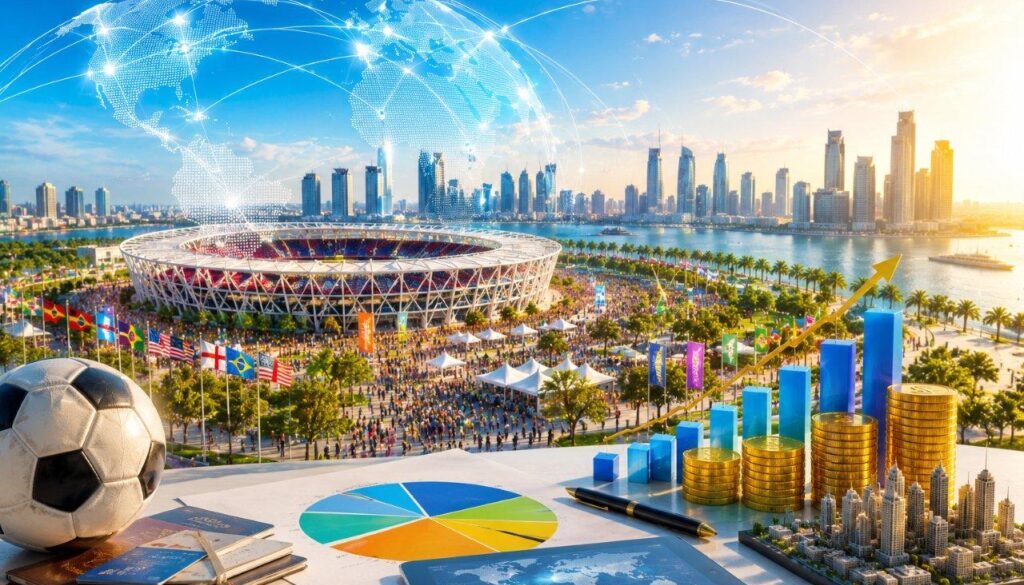
Football is becoming financial infrastructure.
The World Cup monetizes global attention.
Banks must follow where value settles.
A fan arriving in New York for the 2026 FIFA World Cup may believe his journey begins at the stadium gate.
In reality, it began weeks earlier.
It began with an airline booking, a hotel prepayment, a ticketing platform, a currency conversion, a card authorization, a travel insurance policy, a mobile notification, and a quiet movement of data through the global financial system. Before the player touches the ball, banks have already entered the match. Before the referee blows the first whistle, payment networks, foreign exchange systems, merchant acquirers, hospitality lenders, sponsors, insurers, cybersecurity teams, and public authorities are already at work.
The fan sees football.
The financial system sees a temporary city.
This is the deeper story of the 2026 FIFA World Cup, hosted by the United States, Canada, and Mexico. It will be the largest edition in the tournament’s history: 48 teams, 104 matches, 16 host cities, three countries, and millions of people moving through airports, stadiums, hotels, restaurants, fan zones, digital platforms, and payment networks. FIFA confirms that the 2026 tournament will run from June 11 to July 19, 2026, with 48 teams competing across 104 fixtures.
The tournament will be discussed, naturally, as a sporting spectacle. It will be covered through goals, stars, injuries, national hopes, historic rivalries, and the emotional theatre that only football can produce. But for bankers, policymakers, regulators, sovereign wealth funds, and investors, the more important question is different.
What does the World Cup reveal about the modern economy?
The answer is that the World Cup is no longer simply a sports event with economic effects. It has become a temporary financial city built around global emotion. It is assembled for a few weeks, but its financial structure is prepared years in advance. It converts attention into transactions, transactions into data, data into strategy, and strategy into power.
Football gives the world the story.
Finance builds the system around it.
From National Pride to Financial Platform
The first World Cup in 1930 was a very different event. Hosted by Uruguay, it was small by today’s standards, limited in reach, and rooted in the idea of national sporting prestige. The tournament was a stage for countries, not yet a global commercial platform.
For decades, the World Cup was primarily about identity. Nations sent teams as symbols of pride. Fans followed through radio, newspapers, and later television. The drama was political, emotional, and cultural before it was commercial.
Then television changed everything.
Once football could be transmitted live across borders, the tournament became a global attention machine. The World Cup was no longer confined to those inside the stadium. It entered homes, cafés, public squares, airports, hotel lobbies, and eventually mobile phones. This transformed the economics of the game. Broadcasting rights became one of the most valuable assets in sport. Sponsors understood that a World Cup audience was not merely large; it was synchronized. Hundreds of millions of people were watching the same story at the same time.
In a fragmented media world, synchronized attention is rare.
And what is rare becomes expensive.
The late twentieth century brought another shift: the professionalization of sports sponsorship. Global brands began to recognize that football offered something advertising could not easily buy elsewhere: emotional legitimacy. A logo placed beside the World Cup did not simply appear before consumers. It appeared inside a moment of national feeling.
The logic was simple but powerful. If a brand could stand close enough to the emotion, some of the emotion might transfer to the brand.
Then came the age of mega-events as national strategy.
The 1984 Los Angeles Olympics showed that a major sporting event could be organized through a more commercially disciplined model, with television rights, sponsorship, private-sector involvement, and controlled public exposure. Barcelona 1992 demonstrated another possibility: that a sporting event could become a catalyst for urban rebranding, infrastructure renewal, tourism repositioning, and long-term city identity.
Since then, major sports events have become more than tournaments. They have become instruments of visibility, investment, diplomacy, infrastructure, and soft power.
Qatar 2022 was a milestone in this history. It was the first World Cup in the Arab world, but it was also more than that. It was a national positioning project. It placed a small Gulf state at the centre of global attention for a month and connected football to infrastructure, aviation, hospitality, security, media, and diplomacy.
Saudi Arabia 2034 will take this story further. It will not merely be another World Cup in the region. It will be a test of whether sport can be integrated into a national economic transformation strategy at scale.
This is the arc of the modern World Cup: from national pride, to television product, to sponsorship machine, to sovereign strategy, to financial ecosystem.
The 2026 World Cup sits at the center of that evolution.
The New Commodity: Attention
For most of the twentieth century, strategic economic power was associated with tangible assets: oil fields, factories, ports, railways, canals, shipping routes, pipelines, airports, and industrial capacity. These assets moved goods, energy, armies, and trade.
In the twenty-first century, those assets still matter. But another asset has risen beside them: attention.
Attention is not soft in economic terms. It can be priced, sold, sponsored, insured, financed, measured, redirected, and converted into loyalty. It is the raw material of the platform economy, the media economy, the entertainment economy, the influencer economy, the sports economy, and increasingly the tourism economy.
The most valuable companies in the digital era understood this early. Platforms did not merely sell products. They captured attention, studied behaviour, and monetized engagement. Sport is now moving along a similar curve. Its advantage is that it does not need to manufacture emotion artificially. It already has it.
The World Cup may be the largest temporary concentration of shared human attention on earth.
That is its real economic power.
A single tournament can gather billions of viewers, millions of travellers, thousands of companies, hundreds of sponsors, dozens of governments, and nearly every major media market into one synchronized emotional calendar. For one month, the world knows where to look.
This is rare.
And because it is rare, capital follows it.
Broadcasting rights follow attention. Sponsorship follows attention. Tourism follows attention. Hospitality follows attention. Digital platforms follow attention. Merchants follow attention. Payment systems process attention. Banks finance the infrastructure around attention. Sovereign wealth funds increasingly invest in the industries that capture attention.
This is the article’s central point: the World Cup is not merely monetizing football. It is monetizing attention at planetary scale.
Once this is understood, the tournament looks different.
The opening match is not only a sporting event. It is the activation of an attention asset. The stadium is not only a venue. It is a physical interface for a global media product. The fan is not only a spectator. He is a consumer, traveller, data point, cardholder, customer, and participant in a temporary economy. The sponsor is not only buying visibility. It is buying proximity to collective emotion.
The twentieth century rewarded those who controlled resources.
The twenty-first century increasingly rewards those who can organize attention.
The World Cup sits at the intersection of both.
The World Cup as a Temporary Financial City
The most useful way to understand the 2026 World Cup is not as a tournament, but as a temporary financial city.
This city has no single mayor. It has no permanent residents. It disappears after the final whistle. But for several weeks, it behaves like a real economy.
It has transport flows. It has accommodation demand. It has food and beverage consumption. It has security costs. It has retail activity. It has public spending. It has temporary employment. It has digital traffic. It has insurance needs. It has fraud risks. It has foreign exchange demand. It has merchant settlement. It has credit needs. It has data trails.
Like any city, it requires infrastructure.
But unlike a normal city, its infrastructure is built around attention.
The more attention the tournament attracts, the more valuable the city becomes. Every match creates a concentration of demand. Every host city becomes a short-term economic zone. Every fan movement becomes a transaction opportunity. Every stadium becomes a node in a wider financial network.
The stadium is the visible center. But it is not the full economy.
The real World Cup economy is in the airport that receives the fan, the hotel that increases occupancy, the restaurant that doubles its turnover, the taxi app that processes more rides, the card terminal that captures spending, the foreign exchange desk that serves travellers, the telecom network that carries streaming traffic, and the bank that settles the transaction.
The match lasts 90 minutes.
The financial city operates before, during, and after it.
This distinction matters because it changes how banks should think about sport.
A bank that sees only the stadium sees sponsorship.
A bank that sees the temporary financial city sees payments, credit, data, loyalty, risk, merchant relationships, tourism finance, foreign exchange, and long-term customer acquisition.
That is the difference between buying visibility and building an ecosystem.
The Paradox of Mega-Events
The 2026 World Cup will generate enormous financial activity. FIFA’s revised budget for the 2023–2026 cycle targets record revenues of approximately USD 13 billion, reflecting the expansion of its flagship tournaments, including the 2026 World Cup. FIFA’s revised budget also shows investment spending of approximately USD 12.9 billion for the same cycle.
And yet, this is where the economics become more interesting.
A mega-event can be financially enormous and still have a modest effect on national GDP.
This is the paradox of modern sport. The numbers at the event level can be spectacular, while the macroeconomic effect at the national level remains limited, especially in a very large economy such as the United States. The World Cup can fill hotels in a host city, lift restaurant sales near a stadium, increase card spending in certain districts, and generate local employment for a short period. But that does not mean it transforms the economic trajectory of the host country.
For bankers and policymakers, this is not a weakness in the story. It is the story.
The World Cup is not primarily a national growth miracle. It is a selective liquidity event.
Its impact appears in specific sectors, specific cities, specific merchants, and specific weeks. It benefits hotels, restaurants, transport providers, event companies, retailers, broadcasters, sponsors, airlines, payment processors, and digital platforms. But the distribution is uneven.
Some value remains local. Some leaks out.
A fan may stay in a local hotel, but book through a global platform. He may buy from a local merchant, but use an international card network. He may attend a match in one city, but spend the largest part of his travel budget on an airline headquartered elsewhere. FIFA captures global rights and tournament-level revenues. Sponsors capture visibility. Host cities carry public costs. Local businesses capture demand only if they are prepared.
The serious economic question is therefore not: how many billions will the World Cup generate?
The better question is: where will the value settle after the crowd goes home?
That question should interest every minister, mayor, central banker, bank CEO, and development strategist.
Mega-events do not automatically create wealth. They redistribute attention, spending, bargaining power, and risk. The countries and institutions that benefit most are those that prepare mechanisms for local value capture.
That means SME readiness. Payment readiness. Transport readiness. Hospitality readiness. Digital readiness. Regulatory readiness. Security readiness. And, above all, financial readiness.
The Invisible Bank Inside the Stadium
Most fans will never think about the bank when they enter a stadium.
But the bank is everywhere.
It is in the card used to buy the ticket. It is in the payment gateway that processes the purchase. It is in the merchant account of the food vendor. It is in the point-of-sale terminal selling shirts and scarves. It is in the foreign exchange conversion charged to a visiting fan. It is in the credit facility extended to a hotel that renovated its rooms before the tournament. It is in the insurance coverage for event organizers. It is in the payroll of temporary workers. It is in the fraud alert triggered by unusual cross-border spending. It is in the cybersecurity systems protecting thousands of digital transactions.
A modern stadium is not only a sports venue. It is a dense financial environment.
During a tournament of this scale, transaction volumes rise sharply in concentrated locations and time windows. A matchday creates a surge economy. Tens of thousands of people arrive, spend, move, connect, and leave within a compressed period. For banks, this is both an opportunity and an operational test.
Payment systems must work. Card terminals must not fail. Digital wallets must process instantly. Fraud systems must distinguish between legitimate tourist spending and suspicious activity. Banks must manage chargebacks, refunds, merchant settlements, currency conversion, and customer support across borders and time zones.
For a fan, a failed payment is an inconvenience.
For a bank, repeated friction during a global event is a reputational failure.
This is why major sports events increasingly function as stress tests for financial infrastructure. They test the speed of payments, the reliability of digital channels, the capacity of acquiring networks, the strength of fraud monitoring, the resilience of cybersecurity, and the ability of banks to serve both merchants and consumers under pressure.
The World Cup is not only played on grass.
It is also played across payment rails.
The Data Beneath the Emotion
The next layer is data.
Every major sporting event produces a visible crowd and an invisible map. The visible crowd appears in the stadium. The invisible map appears in spending patterns, mobility flows, booking behaviour, digital engagement, social media activity, loyalty programmes, and payment data.
For banks, this data can be strategically valuable if handled responsibly and within strong privacy and regulatory standards.
It can show where visitors come from, where they spend, what sectors benefit, how demand shifts before and after matches, how merchants perform, which districts capture value, and where bottlenecks emerge. It can help banks understand tourism behaviour, SME needs, affluent customer preferences, card usage, foreign exchange patterns, and digital adoption.
In the old sports economy, the sponsor asked: how many people saw our logo?
In the new sports economy, the more sophisticated question is: what did the event teach us about customers, cities, merchants, and future demand?
This is a profound shift.
Sport used to be a branding platform. It is becoming a data environment.
And once sport becomes a data environment, banks can no longer treat it only as a marketing expense. They must treat it as a strategic intelligence opportunity.
The bank that understands matchday spending can support merchants better. The bank that understands fan mobility can design better cards and wallet offers. The bank that understands tourism flows can help hotels, restaurants, and transport companies prepare earlier. The bank that understands event-linked demand can offer smarter working capital.
In this sense, the World Cup becomes a laboratory.
It shows how emotion moves through an economy.
Sport as an Asset Class
The growing financial importance of sport is not limited to one tournament. It is part of a wider movement: sport is becoming an asset class.
This does not mean sport is only about money. Its power comes precisely from the fact that it is not only about money. It is identity, loyalty, competition, culture, memory, and belonging. But because those emotions are durable, transferable, and global, they create financial value.
Investors have noticed.
Football clubs, leagues, media rights, stadiums, sports-tech platforms, academies, fan-data businesses, streaming agreements, and event franchises increasingly attract capital. Private equity looks at sport and sees scarcity. There are only so many elite clubs, only so many global leagues, only so many premium events, and only so many moments capable of commanding global attention.
Sovereign wealth funds look at sport and see something even larger: a combination of financial return, national branding, tourism development, youth engagement, international visibility, and soft power.
That is why the Gulf’s sports strategy cannot be reduced to sponsorship or prestige. Qatar 2022 was not simply an event. Saudi Arabia 2034 will not simply be an event. PIF’s growing role in international football is not simply a logo strategy. These are elements of a broader repositioning of sport within national economic planning. FIFA and PIF announced in May 2026 that PIF had become an official tournament supporter in North America and Asia for the 2026 World Cup, with FIFA describing sport as a priority sector for PIF.
This is where Arab banks should pay close attention.
If sport becomes an asset class, then it will require an ecosystem of finance.
It will need project finance for venues and surrounding infrastructure. It will need corporate banking for clubs, federations, event companies, and hospitality operators. It will need SME banking for merchants, suppliers, food providers, transport companies, and retail businesses. It will need investment banking for acquisitions, partnerships, and media assets. It will need insurance and risk management. It will need digital payment platforms. It will need private banking experiences. It will need capital markets.
The question is not whether banks should sponsor sport.
The question is whether banks understand the balance sheet of sport.
Sponsorship Is No Longer Enough
For decades, banks have used sport sponsorship as a visibility tool. A bank places its logo on a national team shirt, a stadium board, a federation campaign, or a television advertisement. The goal is familiarity, trust, and emotional association.
There is nothing wrong with this. Football remains one of the strongest emotional languages in the world.
But sponsorship alone is no longer enough.
A logo is exposure. A platform is strategy.
The strongest financial institutions will not ask only where their logo appears. They will ask what ecosystem they are building around the sponsorship.
Can the sponsorship support youth football? Can it promote women’s participation? Can it strengthen financial literacy? Can it drive digital payment adoption? Can it help small merchants? Can it connect national pride to responsible banking? Can it create loyalty products that are useful rather than decorative? Can it support community development? Can it generate data that improves service without exploiting consumers?
These questions matter because the public is more demanding than before. Sport is emotional, but it is also scrutinized. Sponsorship can build trust, but it can also expose institutions to criticism if it appears superficial, opportunistic, or disconnected from real value.
In the Arab world, this is particularly important.
Football is not simply entertainment in Arab societies. It is a public language. It crosses generations, social classes, cities, villages, and national identities. A bank that enters football enters a space of deep emotion. That creates opportunity, but also responsibility.
The best banking sponsorships of the future will not simply decorate the game.
They will serve the economy around the game.
The Question Nobody Should Avoid: Who Really Wins?
Every mega-event produces winners. It can also produce disappointments.
The uncomfortable question is not whether the World Cup creates economic activity. It clearly does. The question is whether that activity produces lasting value for the host economy and its communities.
Public authorities often spend heavily on security, transport, public services, crowd management, mobility planning, and urban readiness. Local businesses may face higher rents, labour shortages, inventory costs, and temporary pressure. Residents may face congestion, price increases, or disruption. Some merchants benefit greatly, while others are left outside the event economy. Some infrastructure remains useful. Some becomes underused.
This is why the economics of mega-events must be evaluated carefully.
Gross spending is not the same as net benefit.
Tourist arrivals are not the same as retained value.
Temporary employment is not the same as productivity.
Media visibility is not the same as long-term competitiveness.
A full hotel is good for the hotel. It is not automatically a development strategy.
This does not mean mega-events are bad. It means they must be managed with discipline. The most successful host cities are not those that merely stage an event well. They are those that connect the event to an existing long-term strategy.
Barcelona 1992 is still remembered because the Olympics were linked to urban regeneration, transport, tourism, and city identity. Los Angeles 1984 is remembered because it helped redefine the commercial model of major sports events. Qatar 2022 is remembered because it placed an Arab country at the centre of a global conversation about sport, infrastructure, identity, and soft power.
The lesson is clear.
A mega-event becomes valuable when it accelerates a strategy that already exists. It becomes dangerous when it becomes a strategy by itself.
For policymakers and banks, this distinction is critical.
The World Cup should not be treated as a month of excitement. It should be treated as a deadline for institutional readiness and a test of economic design.
Sport as Sovereign Strategy
The 2026 World Cup is being hosted by North America, but its meaning is global.
For the United States, Canada, and Mexico, the tournament is a continental showcase. It links three economies through a shared event and gives North America a major global platform before the 2028 Los Angeles Olympics. It will project capacity, tourism, infrastructure, security coordination, corporate strength, and cultural reach.
But the more interesting long-term story may be outside North America.
In the Gulf, sport has become part of national economic strategy. Qatar used the 2022 World Cup to amplify its global visibility. Saudi Arabia is preparing for 2034 within a broader transformation agenda that connects sport to tourism, entertainment, infrastructure, media, urban development, and investment. PwC Middle East projects that Saudi Arabia’s sports market will grow from USD 8 billion to USD 22.4 billion by 2030, reflecting how sport is being positioned as a serious economic sector, not a recreational afterthought.
This matters because sport offers states something rare: influence without the formal language of diplomacy.
A country can speak to the world through a tournament, a club acquisition, a global partnership, a league investment, or a hospitality experience. It can place itself in the emotional memory of millions without issuing a communiqué or signing a treaty. In an era of geopolitical fragmentation, sport offers a softer but powerful channel of visibility.
For countries seeking diversification, sport also supports adjacent sectors: tourism, aviation, hospitality, retail, logistics, media, digital platforms, fitness, sports medicine, education, entertainment, and urban development.
For Arab banks, this creates a serious question.
If sport becomes a pillar of national diversification, are banks prepared to finance it as an economy rather than sponsor it as entertainment?
That means understanding clubs, leagues, venues, academies, sports-tech companies, ticketing platforms, fan engagement systems, payment infrastructure, hospitality operators, and event suppliers. It means developing lending models for sports enterprises. It means understanding revenue streams from media, sponsorship, ticketing, merchandising, and digital commerce. It means supporting SMEs around major events. It means building products for fans, families, tourists, merchants, and high-net-worth clients.
The Arab sports economy will not be built by stadiums alone.
It will require a financial system that understands sport as business, infrastructure, community, and soft power.
The Banking Playbook Before 2034
The 2026 World Cup should be studied carefully by Arab banks, especially as Saudi Arabia prepares to host the 2034 edition.
The first lesson is that banks should treat major sporting events as financial ecosystems, not marketing seasons.
The second lesson is that preparation must begin early. Hotels need financing before tourists arrive. Restaurants need working capital before demand peaks. Merchants need payment terminals before matchday. SMEs need inventory financing before fan zones open. Cybersecurity teams need scenarios before transaction volumes surge. Fraud teams need models before abnormal spending patterns begin.
The third lesson is that the opportunity extends across banking lines.
Retail banks can create cards, wallets, loyalty programmes, travel offers, youth campaigns, and family-oriented products. Corporate banks can support hospitality groups, transport firms, logistics providers, retailers, contractors, and event-service companies. SME banking can become central to local value capture. Private banks can design hospitality and experience packages for affluent clients. Investment banks can advise on sports assets, venues, media platforms, and partnerships. Compliance teams can protect institutions from fraud, ticketing abuse, cybercrime, and reputational exposure.
The fourth lesson is that central banks and regulators have a role as well.
Major events create unusual payment patterns, high transaction volumes, foreign card usage, temporary vendors, online ticketing activity, and consumer-protection challenges. Regulators should think about payment-system resilience, fraud prevention, data protection, transparency, and dispute resolution. The goal is not to overregulate the event economy. The goal is to ensure that trust remains intact when activity accelerates.
The fifth lesson is that data should be used responsibly to measure impact.
A serious post-event assessment should not rely only on visitor numbers or media impressions. It should examine card spending, merchant turnover, hotel occupancy, SME loan demand, digital wallet usage, foreign exchange activity, customer acquisition, sectoral gains, and local value retention.
The institutions that measure well will learn well.
And the institutions that learn from 2026 will be better prepared for 2034.
The Future Stadium Is a Financial Platform
The next generation of sport will be more financial, not less.
Tickets will become more digital. Fan identities will become more integrated across platforms. Payments will become more embedded. Loyalty will become more personalized. Artificial intelligence will shape offers, pricing, security, crowd movement, and content. Hospitality will become more segmented. Sponsorship will become more measurable. Stadiums will become data-rich environments. Clubs and federations will behave more like media companies. Fans will be customers long before and long after matchday.
This creates opportunities, but also risks.
Dynamic ticket pricing may raise affordability concerns. Digital platforms may increase data-privacy questions. Cross-border transactions may increase fraud exposure. Climate concerns may reshape how tournaments are judged. Public investment may face greater scrutiny. Sponsors may face reputational pressure. Banks may be expected to support access, inclusion, transparency, and responsible innovation.
The future sports economy will reward institutions that combine ambition with governance.
For banks, this is a familiar challenge. They already operate at the intersection of growth and trust. Sport will simply bring that challenge into a more emotional public arena.
The winners will not be the institutions that merely attach their names to the biggest events. The winners will be those that understand how events create temporary economies, how temporary economies produce data, how data informs strategy, and how strategy builds long-term value.
After the Crowd Goes Home
When the final of the 2026 World Cup is played, the world will remember the goals, the celebrations, the tears, and the image of one captain lifting the trophy.
But by then, the financial story will already have been written.
It will be written in hotel revenues, restaurant receipts, card transactions, airline bookings, public budgets, merchant settlements, insurance contracts, security costs, media rights, sponsorship deals, digital engagement, and the millions of small purchases that turn football emotion into economic activity.
The World Cup is still the beautiful game.
But it is also a balance sheet.
And more than that, it is a mirror. It shows how the modern economy works when the world is watching: attention becomes traffic, traffic becomes spending, spending becomes data, data becomes strategy, and strategy becomes power.
The twentieth century was shaped by those who controlled resources.
The twenty-first century may increasingly be shaped by those who control attention.
The World Cup sits at the intersection of both. It gathers the world’s attention, converts it into economic activity, and redistributes value across institutions, cities, companies, and nations.
That is why the future of sport matters to bankers.
It is no longer merely a game.
It is becoming infrastructure.
The countries and institutions that understand the next World Cup will not be those that only count the goals.
They will be those that understand where the value settled after the crowd went home.