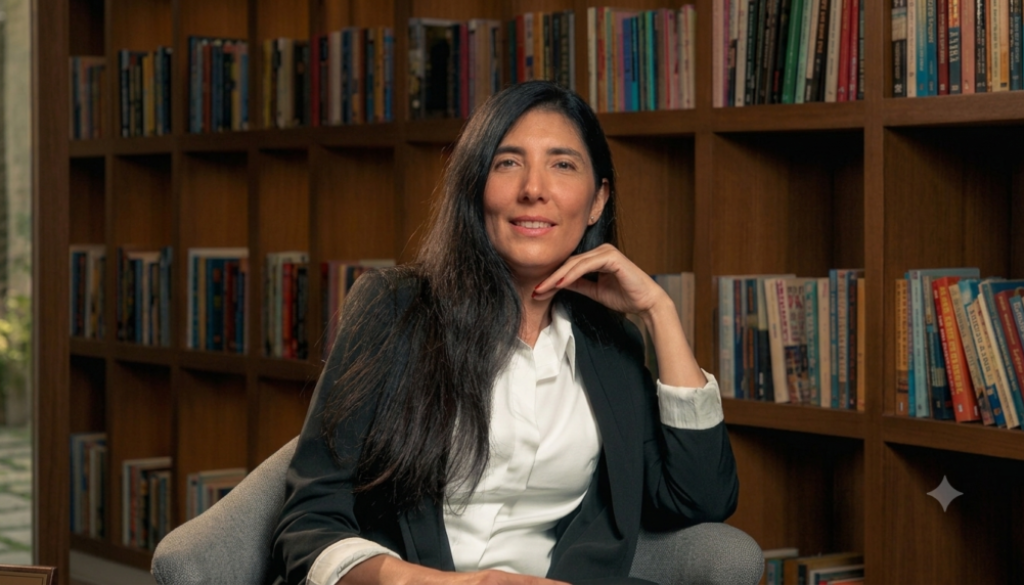
Interview with Randa Naboulsi | Group Chief Financial Officer, Monty Holding (UK)
Randa Naboulsi has spent nearly three decades building financial discipline across industries and borders. As Group Chief Financial Officer of Monty Holding, a UK-headquartered enterprise operating across 40 entities in fintech, telecom, and mobile financial services, she led the group’s transformation into a fully banked global operation, securing over 40 million dollars in institutional funding. Banking Executive spoke with her about what that journey required, and what it means for the future of digital finance across the Arab region.
65% ESCWA, 2025: Nearly 65% of adults across the 22 Arab countries remain outside formal financial systems, the highest rate globally. Mobile money accounts doubled between 2020 and 2023, signalling that digital finance is the most viable path to closing this gap.
Banking Executive: You have built a career moving across industries before arriving at fintech. What drew you to this space?
Randa Naboulsi
Each industry taught me something different about how money moves through organisations. Telecom taught me infrastructure thinking at scale. When I joined Monty Group, I saw those lessons converge. Fintech is infrastructure. It is the foundation layer of how people and businesses participate in the economy, and the Arab region has needed that foundation rebuilt for some time.
The timing was shaped by circumstance as much as choice. Lebanon’s crisis in 2019 accelerated everything. When the traditional financial system came under severe pressure, the question stopped being about digital transformation and became about continuity. That is when you understand very clearly what financial infrastructure is actually for.
The question stopped being about digital transformation and became about continuity. That is when you understand what financial infrastructure is actually for.
Banking Executive Leading the finance function of a growing group through Lebanon’s financial crisis must have been an extraordinary test. What did that period require of you?
Randa Naboulsi
It required a decision that was not obvious at the time. We chose to continue building rather than to wait for conditions to stabilise. The belief inside Monty was straightforward: when recovery comes, we must be ready. So while the environment was difficult, we invested in structure.
We implemented IFRS-compliant reporting, migrated to a full ERP system without operational disruption, and built governance frameworks that allowed us to have credible conversations with Tier 1 institutions in the UK and the Middle East. The World Bank noted in its 2024 Lebanon Systematic Country Diagnostic that electronic wallets and licensed non-bank payment providers had become essential infrastructure in the market. Monty was part of that foundation years before it became a policy observation.
What the period taught me is that governance and discipline are not constraints on growth. They are the conditions that make growth possible, particularly when the external environment is uncertain.
Banking Executive You secured over 40 million dollars in institutional funding during this period. How did you build that credibility with international lenders?
Randa Naboulsi
We led with structure, not story. Every conversation with a Tier 1 institution began with our UK holding architecture, our governance policies, our IFRS reporting, and our banking relationships. We gave institutions no structural reason to be concerned by the geography.
There is a perception gap that MENA-rooted businesses face with international capital, and it is real. But it is closeable. What closes it is not narrative. It is demonstrable financial discipline. When institutions see reporting frameworks, audit trails, and compliance structures that meet or exceed international standards, the conversation moves from risk assessment to opportunity evaluation.
I would share this with any CFO in this region seeking international capital: the barrier is rarely your business model. Build the governance infrastructure around it, and the access follows.
The barrier is rarely your business model. Build the governance infrastructure around it, and the access follows. |
Banking Executive ESCWA reported in 2025 that nearly 65 percent of Arab adults remain outside formal financial systems. How does Monty’s work connect to that challenge?
Randa Naboulsi
That figure represents both a profound challenge and a significant opportunity for the entire financial services industry, banks and fintechs together. The IMF estimates that raising SME financial inclusion in MENA to the global average could create six million additional jobs. SMEs represent 96 percent of registered companies in the Arab region and employ half the labour force, yet access to finance remains constrained for many of them.
MyMonty and MontyPay are built specifically for this reality. MyMonty gives individuals access to digital wallets, transfers, cards, and financing solutions in markets where traditional banking options may be limited. MontyPay gives businesses the payment infrastructure to participate in the formal economy across channels. These are not products built for markets that already function well. They are built for markets where the financial system is being rebuilt, and where banks and fintech operators working together can achieve what neither can achieve independently.
Banking Executive Looking ahead, the MENA fintech market is projected to reach over 10 billion dollars by 2030. What will it take to realise that potential?
Randa Naboulsi
McKinsey projects 35 percent annual net revenue growth for MENA fintech through 2028, more than double the global average. That is an extraordinary trajectory, and it is grounded in real structural drivers: a young and digitally engaged population, supportive regulatory frameworks across the GCC, and a rapidly expanding mobile infrastructure.
What will determine whether that ceiling is reached is the depth of partnership between the banking sector and the fintech ecosystem. The institutions that are already building those partnerships are seeing the results. Open banking frameworks in the UAE, fintech integration programmes in Saudi Arabia, cross-border payment initiatives across the Arab Monetary Fund’s network. These are the foundations of the next decade.
My message to the financial leaders shaping the region’s future is straightforward. The digital finance infrastructure this region needs will be built through collaboration, through shared standards, and through a shared commitment to reaching the populations that both sectors exist to serve. The opportunity is there. The question is the pace at which the industry moves to capture it.
About Randa Naboulsi
Randa Naboulsi is Group Chief Financial Officer of Monty Holding, a global diversified group with businesses spanning telecommunications, fintech, technology, financial services, and beyond.
With nearly three decades of experience in finance, she has played a central role in shaping the Group’s financial growth. Under her leadership, Monty Holding evolved from a self-funded business into a fully banked international organization, securing more than $40 million in institutional funding and building the financial foundations for continued expansion.
Her leadership extends across financial strategy, banking, corporate restructuring, and large-scale transformation, including ERP implementation across the Group’s international operations. She holds an MBA from the Lebanese American University.
For Randa, finance is not only about managing capital. It is about creating the confidence and structure that allow businesses to grow.