The West and specifically the United States of America is troubled by the threat of a technologically dominant China – and keen to ensure it never materializes. And yet, given China’s current status, many argue that little can be done to impede it.
In the United States, and after one of the most intense elections in the country’s history, there is one issue on which both parties seem to agree on: the need to “stop” China.
On a larger geopolitical scale, the US government supported by the EU Commission believe that China has secured its economic and technological gains unfairly due to its government’s persistent influence over the economy. Geostrategists often push this view, imagining that a government can achieve technological superiority by investing in the fashionable sectors of the day.
However other analysts believe that this explanation is deceptive, at best. The most “successful” grand economic-development plans usually go with the grain (i.e. accept something rather than oppose it or fight against it), focusing largely on targets that, given the economy’s fundamentals, would be achieved anyway. Crediting state intervention when those targets are met is thus inappropriate.
Recent history cases studies support the above mentioned idea; Japan is a cautionary example. During its post-1945 growth spurt in the 1970s and 1980s, the Ministry of International Trade and Industry (MITI) acquired an almost mythical global reputation for the apparent success of its efforts to channel resources toward strategic sectors. Many countries were advised to emulate its model.
But in the 1980s, Japan’s real-estate bubble burst, and growth slowed significantly. As it turned out, many of the sectors MITI supported had not actually succeeded. What had really been driving Japan’s growth was not MITI’s prescience, but a high savings rate and the rapidly increasing education level of a disciplined workforce – much the same factors that have driven China’s development.
Not long ago, China’s leaders seemed to understand the limits of state intervention. In fact, the Communist Party of China’s general advice to authorities was to scale back the state’s involvement in the economy, because state-owned enterprises (SOE) generally remain far less efficient than private firms, and only about one-third as profitable. And yet, while SOEs continue to underperform, compared to private firms, China’s leaders have radically changed their views on intervention. Now, the conventional wisdom is that the country owes its progress – and, indeed, its emerging global dominance – in some high-tech sectors to the state’s guiding hand.
The true driver of China’s success, however, is its high savings rate – nearly 40% of GDP, or more than twice the rate in the US and Europe.
This gives China massive resources for investment in establishing the fundamentals for technological leadership. Notably, the country has made enormous investments in improving both the quantity and quality of education.
Regarding secondary education, China has already fully caught up with the West in attendance. And testing by the OECD’s Program for International Student Assessment suggests that Chinese secondary-school students are far better at solving problems than their American or European peers.
Moreover, tertiary education – the real key to technological leadership – has exploded in China over the last two decades. According to the US National Science Foundation, China now produces more than twice as many engineers, and more peer-reviewed science and engineering publications, than the US. Similarly, it has surpassed the European Union in spending on research and development, and on current trends, it should catch up with the US over the next decade (some think it already has).
The US is haunted by the specter of a technologically dominant China – and keen to ensure it never materializes. And yet, given China’s fundamentals, there is little the US could do to hamper, let alone arrest, its progress. Huawei is just one example of a firm that has capitalized on China’s pool of millions of engineers to develop new products. Even if the US manages to destroy Huawei, many other Chinese high-tech companies are destined to emerge, driven by the same talent.
The so-called dual-circulation strategy that is set to shape China’s next Five-Year Plan is perfectly in line with the aforementioned fundamentals. As China’s economy grows and diversifies, it is naturally becoming less reliant on exports, and its newly minted engineers will master a growing number of technologies. In other words, the government’s plans for the coming years would probably materialize, even without state intervention.
By contrast, the US strategy – which begins with an economic “decoupling” from China – has little chance of success. To be sure, the decoupling itself might be feasible. But it would also be counterproductive.
Arab bankers and financial personnel from all over the world meet under the umbrella of the World Union of Arab Bankers to serve the development and advancement of the banking profession, and make the necessary efforts to elevate the participating members by contributing to the development of their professional path. Noting that the active member is entitled to participate and vote in the work of the general assembly.
WUAB Active Members
Egypt
1
H.E. Mr. Abdel Hamid Abou Moussa
Faisal Islamic Bank of Egypt
The Governor
2
Mr. Hisham Ahmed Okasha
National Bank of Egypt
Chairman
3
Mr. Mohamed Mahmoud Eletreby
Banque Misr
Member Of The Board Of WUAB – Chairman
4
H.E. Mr. Hesham Ramez
Arab International Bank
Member Of the Advisory Council of WUAB – Chairman and Managing Director
5
Mr. Mohamed Gamal Moharam
MGM Financial & Banking Consultants
Chairman
6
Mr. Hussein Ahmed Ismaeil Refaie
Suez Canal Bank
Chairman & Managing Director
7
Mr. Mohamed Osman El-Dib
Qatar National Bank Al Ahli
Chairman & Managing Director
8
Mr. Mohamed Abdel Salam Kafafi
The Egyptian Credit Bureau “I-Score”
Chairman & Managing Director
9
Mr. Tarek Fayed
Banque du Caire
Chairman & Chief Executive Officer
10
Mr. Ashraf El-Ghamrawy
Al Baraka Bank – Egypt
Deputy Chairman & CEO
11
Mr. Mohamed Kamal Eddine Barakat
Arab International Bank
Deputy Chairman
12
Mr. Yehia Abou Elfotouh Ibrahim
National Bank of Egypt
Deputy Chairman
13
Mr. Farag Abdel Hameed Farag
United Bank
Deputy Chairman & Managing Director
14
Mr. Mohamed Jamil Berro
Emirates NBD- Egypt
Managing Director & Executive Director
15
Mr. Mohamed Mahmoud Ali Bedier
Bank Audi-Egypt
Managing Director & CEO
16
Mr. Akram Youssef Tinawi
Arab Banking Corporation – Egypt
Managing Director & CEO
17
Mr. El Sayed Mohamed Marzouk El Kosayer
The Ministry of Agriculture and Land Reclamation
Minister
18
Mrs Nevine kashmiry
United Bank
Deputy Managing Director of Business
19
Mr. Amin Hisham Ezz Al – Arab
Commercial International Bank
Chairman & Managing Director (2002 – 2020)
20
Mr. Hasan El-Sayed Abdallah
Central Bank of Egypt
First Assistant to the Governor
21
Mr. Mohamed Hani Seif El-Nasr
Arab Investment Bank
Chairman of Arab Investment Bank (2011 – 2018) Member Of the Advisory Council of WUAB
22
Mr. Mahmoud Abdul Khalek El-Nouri
Member Of the Advisory Council of WUAB
23
Mr. Ismail Farid
Export Development Bank of Egypt
Chief Information Officer
24
Mr. Hassan El Hawary
United Bank
Assistant General Manager – Custoday-Mutual Funds
25
Mr. Tarek Mahfouz
VISA International
Country Manager – Egypt
26
Mr. Ahmed Essam Noureldine
VISA International
Country Manager – Libya and Sudan
27
Mrs. Shaimaa Semary
Export Development Bank of Egypt
Executive Manager of HR and Training Section
28
Mr. Mohamed Ibrahim El Hadidy
Export Development Bank of Egypt
Executive Board Member – Operations Group Head
29
Mr. Mohamed Abul Soud
Export Development Bank of Egypt
Board Member – Chief Risk Officer
Hashemite Kingdom of Jordan
1
H.E. Dr. Ziad Fareez
Central Bank of Jordan
Member Of the Advisory Council of WUAB – Governor
2
Mrs. Khouloud El-Sakkaf
Social Security Investment Fund
Chairman
3
Mr. Hani Abdulkader Al-Qadi
Arab Jordan Investment Bank
Member Of The Board Of WUAB – Chairman
4
Mr. Micheal Faiq Al-Sayegh
Jordan Commercial Bank
Chairman
5
Mr. Shaker Toufic Fakhouri
Bank Of Jordan
Chairman
6
Dr. Mohammad Naser Salem Abu Hammour
Safwa Islamic Bank
Chairman
7
Mr. Saad Nabil Yousef Mouasher
Jordan Ahli Bank
Chairman
8
Mr. Hassan Hamdi Mango
Société Générale De Banque-Jordanie (SGBJ)
Chairman
9
Mr. Musa Abdelaziz Shihadeh
Jordan Islamic Bank
Member Of the Advisory Council of WUAB – Chairman
10
H.E. Dr. Marwan Awad
First Int. For Consultancy & Arbitration
Member Of The Board of WUAB – General Manager
11
Mr. George Sofia
Arab Banking Corporation (Jordan)
CEO/General Manager
12
Mr. Mohammed Musa Daoud
Jordan Ahli Bank
CEO/General Manager
13
Mr. Kamal Gharib Al-Bakri
Cairo Amman Bank
Chief Executive Officer
14
Mr. Nemeh Sabbagh
Arab Bank
Chief Executive Officer
15
Mr. Iyad Ghasoub Asali
Islamic International Arab Bank
General Manager
16
Mr. Saleh Ragab Hammad
Bank Of Jordan
General Manager
17
Mr. Tarek Akel
Egyptian Arab Land Bank
Regional Manager
18
Dr. Ahmed Abdul Halim El-Hussein
Jordan Ahli Bank
First Deputy CEO/General Manager
19
Mr. Daoud Adel Daoud Issa
Jordan Kuwait Bank
Chief Human Resources Officer
20
Dr. Adnan Shaher Al Araj
BLOM Bank
Regional Manager-Amman Branches
21
H.E. Dr. Umayya Toukan
Jordan Ahli Bank
Chairman of WUAB Advisory Council – Deputy Chairman
22
Mr. Haethum Samih Badrdine Buttikhi
Jordan Kuwait Bank
Head of retail and private banking
23
H.E. Mr. Abdel Karim Kabariti
Jordan Kuwait Bank
Chairman
Iraq
1
Mr. Noor Noory Ayyed El-Hanthal
Ashur International Bank For Investment
Chairman
2
Mr. Wadih Noori El-Hanthal
Iraqi private Banks League
Chairman
3
Mr. Tamken Abd Sarhan El-Hesnawi
Mousel Bank For Development & Investment
Chairman
4
Mr. Zead Khalaf Abed
International Development Bank
Chairman
5
Mr. Salar Mustafa El-Hakim Fattah
Kurdistan International Bank For Inv. And Dev.
Chairman
6
Dr. Azad Yahya Saeed Bajger
Cihan Bank for Islamic Investment & Finance
Chairman
7
Mr. Mohamed Sadi Ahmed Mohamed Saeed
Erbil Bank For Investment & Finance
Chairman
8
Mr. Abdul Meneim Mehdi Saleh El-Salawi
Alarabiya Islamic Bank
Member of The Board Of Directors
9
Mrs. Alyaa Amer Majeed Al Mrad
Ashur International Bank For Investment
Administration Board Member – General Director
10
Mr. Ali Tariq Mostaf
Iraqi private Banks League
Executive Manager
11
Mrs. Suha Zaki Abdulrassoul Al Kifaee
International Islamic Bank
Managing Director
12
Mrs. Hayfaa Abbas Baqer Mohamad
Al-Bilad Islamic Bank For Investment & Finance
Managing Director
13
Mr. Adil Nuri Al Alim
Gulf Commercial Bank
Managing Director
14
Mrs. May Mohammed Yas
Investment Bank of Iraq
Managing Director
15
Mr. Mazin Kamil Elias Aziza
Economic Bank for Investment & Finance
Managing Director
16
Mr. Hayder Kadhim Galam Hssain
Al-Qabedh Islamic Finance & Investment Bank
Managing Director
17
Mrs. Rula Falih Ali Dulaimi
Iraqi Company for Bank Guarantees
General Manager
18
Mr. Nameer Abdul Aziz Hussein
Trans Iraq Investment Bank
Manager Of International Division
19
Dr. KhawlahTalib Jabbar Alassady
20
Mr. Ahmed Tareq El-Hameshi
Iraqi private Banks League
21
Mr. Mohamed Fouad Mohamed
Al Seraj Company
22
Mr. Ahmed Yasr Akhdar
Al Seraj Company
23
Mr. Ihsan Sadeq Rashed
Al Seraj Company
24
Mr. Abdul Aziz Hassoun
Member Of the Advisory Council of WUAB
Bahrain
1
Dr. Adnan Ahmed Yousif
Bahrain Association of Banks BAB
Chairman
2
Mr. Hussein El Meeza
Al-Salam Bank-Bahrain
Member of The Board Of Directors
3
Mr. Abdullah A. Saudi
ASA Consultants
Member Of the Advisory Council of WUAB – CEO
3
Dr. Khaled Walid Mohammad El-Gazawi
Ebdaa Bank for Microfinance
Chief Executive Officer
4
Mr. Faisal Mansour Al Alwan
Business consultant/Deputy Chairman of Elaf Islamic Bank-Iraq
5
Mr. Mohammed Isa Al Mutaweh
Kuwait
1
H.E. Mr. Mohammad Y. Al-Hashel
Central Bank of Kuwait
Member Of the Advisory Council of WUAB – Governor
2
H.E. Sheikh Mohammed Jarrah Al-Sabah
Kuwait International Bank
Member Of The Board Of WUAB – Chairman
3
H.E. Mr. Majed Issa Ahmed Al-Ajeel
Burgan Bank
Chairman
4
Mr. Adel Abdul Wahab Al Majed
Boubyan Bank
Deputy Chairman & CEO
5
Dr. Haidar Hassan AlJumah
Kuwait International Bank
Member of The Board Of Directors
6
Mr. Jassem Hasan Ali Zainal
Kuwait International Bank
Member of The Board Of Directors
7
Mr. Jehad Al Qabandi
Bank of Bahrain & Kuwait B.S.C
Chief Executive Officer
8
Dr. Hamad Ali El-Hasawi
Kuwait Banking Association
Secretary General
9
Mr. Raed Jawad Bukhamseen
Kuwait International Bank
Vice Chairman-CEO/General Manager
10
Mr. Walid Sayed AbdelKarim
Member of The Board Of WUAB
11
Dr. Emad Jawad Bou Khamsine
Bukhamseen Group Holding Company
Deputy Chairman of WUAB for The Arab World – Vice Chairman and Managing Director
Lebanon
1
H.E. Minister Raymond W. Audi
Audi Bank sal
Honorary Chairman
2
Mr. Sarkis Damarjian
Demco Steel
Chairman
3
Dr. Naaman Azhari
BLOM BANK s.a.l
Head Of Group
4
Mr. Rami El Nimer
First National Bank S.A.L
Chairman
5
Sheikh Khaldoun Barakat
Lebanese Islamic Bank
Chairman
6
Mr. Elie Torbey
Credit Libanais for Insurance and Reinsurance
Chairman
7
Dr. Salim Sfeir
Bank of Beirut s.a.l.
Chairman & Chief Executive Officer
8
Mr. Joseph Sassine
Banque de L’Habitat
Chairman & Chief Executive Officer
9
Mr. Antoun Sehnaoui
Société Générale de Banque au Liban s.a.l
Chairman & Chief Executive Officer
10
Dr. Khater Abi Habib
The National Co. For Deposit insurance
Chairman and General Manager
11
Mr. Saad Azhari
BLOMINVEST Bank S.A.L
Chairman and General Manager
12
Mr. Tarek J.Khalifé
CREDITBANK S.A.L
Chairman and General Manager
13
Mr. Alexis Saghbini
Credit Card Management
Chairman and General Manager
14
Mr. Roy Khalaf
International Payment Network
Chairman & General Manager
15
Dr. Sami Nseiri
Collect S.A.L.
Chairman & General Manager
16
Mr. Abdulrazzak Ashour
Fenicia Bank
Chairman & General Manager
17
H.E. Mr. Marwan Kheireddine
Al-Mawarid Bank s.a.l
Chairman & General Manager
18
Mr. George Bechara El-Khoury
Credilease SAL
Chairman & General Manager
19
Mr. Salim Y. Habib
Intercontinental Bank of Lebanon S.A.L
Chairman & General Manager
20
Mr. Mohamed Wajih El-Bizri
Credit Libanais S.A.L Group
Member of the Board of Directors
21
Mr. Samih Seaadeh
Banque BEMO
Member of The Board Of Directors
22
Mr. Moustafa Alaedine
Lebanese Islamic Bank
Member of The Board Of Directors
23
Mr. Rabah Jaber
Credit Libanais S.A.L Group
Member of the Board of Directors
24
H.E. Mr. Minister Marwan Hamadeh
Credit Libanais S.A.L Group
Member of the Board of Directors
25
H.E. Mr. Jack Jokhderyan
Credit Libanais Investment
Member of the Board of Directors
26
H.E. Ambasador Micheal Haddad
Credit Libanais Investment
Member of the Board of Directors
27
Mr. Mutassim K. Mahmassani
Al Baraka Bank Lebanon SAL (B.B.L)
General Manager & Board Member
28
Mr. Fadi El-Daouk
Levant Investment Bank LiBank
Chief Executive Officer
29
Mr. Michel Saroufim
Fransa Invest Bank SAL
General Manager
30
Mr. Najib Semaan
First National Bank S.A.L
General Manager
31
Dr. Chafic Moharram
Lebanese Islamic Bank
General Manager
32
Mr. Alain Hakim
Credit Libanais S.A.L Group
Asst. General Manager
33
Mr. Georges Karkabi
Credit Libanais Investment
Deputy General Manager
34
Dr. Michel Khadige
Credit Libanais S.A.L Group
Deputy General Manager
35
Mr. Georges El Hajj
Credit Libanais S.A.L Group
Regional Manager
36
Mr. Nadim Issa
Credit Libanais S.A.L Group
Regional Manager
37
Mr. Maroun El-Khoury
Arab African International Bank
Regional Manager
38
Mr. Mounir Lyan
Banking Control Commission of Lebanon (BCCL)
Executive Board Member (2015 – 2020)
39
Dr. Haroutioun Y. Samuelian
Banque Du Liban
Former Fourth Vice-Governor
40
Mr. Samir Hammoud
Banking Control Commission of Lebanon (BCCL)
Chairman (2015 – 2020)
41
Mr. Ahmed Safa
Banking Control Commission of Lebanon (BCCL)
Executive Board Member (2015 – 2020)
42
Mr. Sami El-Azar
Banking Control Commission of Lebanon (BCCL)
Executive Board Member (2015 – 2020)
43
Dr. Nabil Soubra
First National Bank S.A.L
Chairman’s Advisor For Foreign Affairs
44
Dr. Francois Bassil
Byblos Bank S.A.L
Member of WUAB Advisory Council – Head of Group
45
Mr. Khaled T. Chahine
Bank MED
Head of Legal Compliance-Data Protection Officer
46
Mr. Sleiman Daoud
CREDITBANK S.A.L
Assistant General Manager – Head of Risk Management Department
47
Mr. Sarkis Yoghourtdjian
Federal Reserve Board
Former Deputy Director (Federal Reserve Group) Member Of the Advisory Council of WUAB
48
Mrs. Maya Takkoush Chehab
Fransabank Group SAL
Head of group Governance and Capital Management Department
49
Mrs Isabel Mansour
BLOM Bank
Advertising, Media and Sustainability Director
50
Mr. Antoine El Msan
CREDITBANK S.A.L
Executive Senior Manager
51
Mr. Marwan Khawand
First National Bank S.A.L
Head of Information Technologie Depart.
52
Mrs. Nahla Bou Diab
Al-Mawarid Bank s.a.l
Deputy General Manager – Chief Operations Officer
53
Mr. Ghassan Abou AdAl
Al-Mawarid Bank s.a.l
Directeur Risk Management
54
Dr. Joseph Torbey
Credit Libanais S.A.L Group
Chairman of WUAB – Chairman General Manager
55
Mrs. Alhan Ahmad Sleiman
MEAB sal
Deputy Manager
56
Mrs. Nada Rizkallah
Credit Libanais S.A.L Group
Deputy General Manager – Head of Risk Management and Strategy
57
Mrs. Hayat Nader
Credit Libanais S.A.L Group
Governments and Public Institutions Relations Coordinator
58
Mrs. Randa Bdeir
Credit Libanais S.A.L Group
Deputy Director General of the Department of Electronic Payments and Payment Card Technology
59
Mr. Georges Toufic Gerios
Credit Libanais S.A.L Group
Assistant General Manager – Operations Management
60
Mr. Jhonny Torbey
Credit Libanais S.A.L Group
Assistant Global Treasurer – Bank Consultant
61
Mr. Meguerditch H. BOULDOUKIAN
Credit Libanais S.A.L Group
Head, Global Business Development Desk (2012 – 2020)
62
Mr. Chahdan Jebeyli
Audi Bank sal
General Manager – Group Chief Legal & Compliance Officer
63
Mr. Adel Macaron
Credit Libanais S.A.L Group
Head of Legal Affairs
64
Mr. Alexandre J.Salem
Credit Libanais S.A.L Group
Assistant General Manager – Head of Treasury and Capital Markets Division
65
Mr. Elie Abi Mrad
Credit Libanais S.A.L Group
General Controller-Head of Group Internal Audit
66
Mr. Charbel Mourad
Credit Libanais S.A.L Group
AGM – Group CFO
67
Mr. Fadlo Choueiri
Credit Libanais Investment
Assistant General Manager – Head of Corporate Finance & Economic Research
68
Mr. Mohamed Ali Beyhom
Bankmed
Former CEO
69
Mr. Michel Ruwayheb
Federal Bank
Former General Manager
70
Dr. Fadi Joumaa
72
Mr. Habib Rahhal
BLOM Bank
Former General Manager
Libya
1
Mr. El-Seddiq Mohamed Abdullah Khanfar
National Commercial Bank
General Manager
2
Mr. AbdulRazzak Beleid El-Tarhoni
Gumhouria Bank
General Manager
3
Mr. Abdulrazak Mohamed Elhoush
First Gulf Libyan Bank
General Manager
4
Mr. Bashir Mabrouk Zahmour
Gumhouria Bank
Asst. General Manager
5
Mr. Al-Brane Mohamed Hasn Al-Brane
National Commercial Bank
Director of Public Affairs Department
6
Mr. Ali Atiya Omar
National Commercial Bank
Administrative Manager
7
Mr. Emhemad El-Bourawi Krir
National Commercial Bank
Chargée du Bureau du Directeur général
8
Mr. Abdulrazaq M. Lagha
Gumhouria Bank
Director International Relations
Maroc
1
M. Redouane Najmeddine
Al Barid Bank
Président du Conseil
2
M. Othman Benjelloun
Groupement Professionnel des Banques du Maroc
Deputy Chairman of WUAB For The Expatriate World – Chairman
3
M. Mustafa BENABBOU
Groupe Crédit Agricole du Maroc
Directeur du Pôle Banque Digital
Qatar
1
Sheikh Fahad Bin Mohd J. Al-Thani
Doha Bank
Chairman
2
Mr. Abdulbaset Ahmed Abdulrahman El-Shibi
Qatar International Islamic Bank
Chief Executive Officer
3
Mr. Abdulaziz Nasser Al-Khalifa
Qatar Development Bank
Chief Executive Officer
4
Sheikh Abdulrahman Ben Jaber Althani
Doha Bank
Directeur Générale Délégué
5
Sheikh Hamad Ben Naser Al Thani
General Secretarait for Ministry Cabinet
6
Mr. Abdulla A. Al-Asadi
Doha Bank
Head of CRM & Private Banking
Republic Djibouti
1
Mr. Ahmed Humaid Al Deib
CAC International Bank
Member of The Board of WUAB – Executive Director
Republic of Yemen
1
Mr. Mahmoud Ata Hasan Al Refaei
Tadhamon Bank
General Manager
2
Mr. Basheer Sultan Almaqtari
Tadhamon Bank
Deputy General Manager
Saudi Arabia
1
Mr. Ayman Sajiny
Islamic Corporation for the Development of Private Sector (ICD)
CEO/General Manager
2
Dr. Mustafa El-Sabban
Islamic Development Bank
Cheif of Staff
Sudan
1
Mr. Abbas Abadalla Abbas
Tadamon Islamic Bank
Member Of The Board of WUAB – General Manager
2
Mr. Ahmed Mohamed Galal
Export Development Bank
Deputy Chairman
3
Mr. Moawia Ahmed Elemin Abdul Rahman
Faisal Islamic Bank (Sudan)
Chief Executive Officer
4
Dr. Amer Abed El Wahab El Alawi
El-Jazeera Sudanese Jordan Bank
General Manager
5
Mr. Alnour Ajabna Izalarab Ismael
Alsalam Bank
General Manager
6
Mr. Mohamed ElTahir ElTayeb
Faisal Islamic Bank (Sudan)
Director of Total Quality Management
7
Mr. Khalid Mohammed Zeain El-Sheikh
Faisal Islamic Bank (Sudan)
Head Of Marketing Department
8
H.E. Dr. Mohamed Kheir El-Zobeir
Central Bank of Sudan
Former Chairman (Central Bank of Sudan) Member Of the Advisory Council of WUAB
9
Mr. Salah Mohamed Abdelrahim Ali
10
Mr. Abdala Ahmed Ali Fadl
11
Mr. Osman Abdel Azeem Mohamed Huissein
12
Mr. Othman El-Toum Mohamed El-Hasan
El Nilein Bank (Sudan)
Former Managing Director
Sultanate Of Oman
1
H.E.Sheikh Khalid bin Mustahail Al Mashani
Bank Muscat SAOG
Member Of the Advisory Council of WUAB – Chairman
2
Mr. Sulaiman Hamad Hamood Al Harthi
Alizz Islamic Bank
Chief Executive Officer
3
Mr. Khalid Jamal El-Kayed
Bank Nizwa
Chief Executive Officer
4
H.E.MR. Hamoud Ben Sangour Al-Zadjali
The Arab Academy for Banking & Financial Sciences
Member of The Advisory Council of WUAB – Chairman of The Board of Trustees
5
Mr. Abdul Razzak Bin Ali Bin Issa
Member Of the Advisory Council of WUAB
6
Dr. Adnan Ben Haider Ben Darwish
Oman Housing Bank S.A.O.C
Member of The Advisory Council of WUAB – General Manager
Tunisia
1
Mrs. Mouna Saaied GHATTOUFI
Association Professionelle Tunisienne des Banques&des Etablissements Financiers
Member of The Board of WUAB – Delegue General
Turkey
1
Mr. Walid Alameddine
Amdeya Group
Member of The Board of WUAB – Executive Chairman
United Arab Emirates
1
Mr. Mohamed Ahmed Abdalla Mohamed
Sharjah Islamic Bank
Chief Executive Officer
2
Mr. Walid Tabbal
Abu Dhabi Commercial Bank
Division Head Corporate Banking DNE
United Kingdom
1
H.E. Dr. Farouk El-Okdah
National Bank of Egypt (UK) Limited
Chairman
United States of America
1
Dr. George T. Abed
Institute Of International Finance (IIF)
Member Of the Advisory Council of WUAB-Distinguished Scholar in Residence
By: Dr. Mohammad Ibrahim Fheili, Risk Strategist & Capacity Building Practitioner
Lebanon walked out of Paris II in November of 2002 with US$4.5 billion in soft loans from countries friends of Lebanon. This represented, at the time, 25% of the country’s Gross Domestic Product (GDP). It must’ve been a much needed fund but it was not properly utilized. After that, political class’s appetite to spend grew stronger with little to no reforms to report or claim. The nature and magnitude of the debt problem couldn’t be made clearer with the statement of, then the chairman of the Board or Directors of the Association of Banks in Lebanon (ABL), in February of 2012, Dr. Francois Bassil, came out strong against banks continuing on the path of lending the government. It was utterly clear that Lebanon’s public debt is getting out of hands, and it is no longer sustainable. With banks operating in Lebanon bearing half of the public debt in foreign currencies, and over two-third of the debt denominated in domestic currency, that put them in the eye of the storm! The government’s disorderly default in early March 2020 turned Bassil’s legitimate fear into a horrible reality. The nature of the crisis and its magnitude make a government rescue and recovery plan very complex, and it will most definitely fall short of dealing with the causes of the crisis.
THE BANKING LANDSCAPE
Banks under-estimated the risks associated with buying in Lebanese government debt instruments, and over-invested in these securities. Isn’t it time to ask if the state of banking in Lebanon, the way it’s been, is healthy and sustainable? I doubt it is. I can think of a few areas that banks need to revisit, look long and hard to identify weaknesses, and effectively deal with them.
The Banking Model. The excessive reliance on deposits as the only source of fund for banks makes managing liability more challenging relative to a banking sector with more diversified sources of funds. Banks, in recent years, spread their wings very thin knowing the volatility of their sources of funds. Banks’ uses of funds have been effortlessly allocated as follows:
Required Reserves (25% on Lebanese Pound – LBP, and 15% on Foreign Currency – FC, which comes in the form of Mandatory Placements with Banque Du Liban, BDL, the country’s central bank) are balances held at the central bank earning no explicit return. However, what was supposed to be ready reserves failed in 70% of it when that much turned into long-term subsidized loans as a part of an expansionary monetary policy initiative which turned sour because, in pursuit of explicit returns, banks failed to match the high quality of this reserve with high quality loans! Banks utilized every penny in regulation, and, by doing so, the mandatory reserves effectively dropped from 25% to less than 18% leaving banks exposed.
Excess Reserves which, to date, remained as ready reserves in the purest sense of liquidity. Banks allocate this liquidity between cash in Automated Teller Machines (ATMs) and with tellers.
Loans to private sector. Retail (car, personal, housing, … loans to individuals), commercial (overdraft facility, term-loans, project finance, … to business enterprises). For most banks in Lebanon, the loan-to-deposit ratio jumped over 65%. Not all banks followed best practices in lending. The problems of adverse selection and moral hazard became obvious when at the first sign of deteriorating economic conditions in late 2017, non-performing loans jumped up with little impact on bankers’ appetite to lend more; lending continued until up mid-2019, right before the ‘big bang’ – the uprising of October 2019. On the other hand, in order to avoid being penalized through provisions for loan loss reserves, banks practiced a worrisome rigidity in downgrading the quality of their loans; a practice the Board of Directors and the external auditors found no harm in it. Finally, since loan sales is not a viable option here in Lebanon, loans are, by far, the most illiquid form of uses of funds even a simple delinquency in settling a payment on a loan is easily felt in the bank’s realization of ready liquidity derived from the settlement of debt.
Placements with non-resident banks, mostly correspondent banks. These placements are used [as a cushion] to facilitate the financing of international trade. Although these deposits are, in principle, ready liquid assets for the banks, today, most of them are held against off balance sheet facilities (e.g., letters of Credits, Bank Guarantees, etc.) extended by the correspondent banks (to the banks). The downgrading of the country’s credit risk rating eats away from the power of these placements in terms of their ability to support international trade.
Placements with resident banks, most of these are referred to as overnight placements but with an actual maturity of one week. This is settled quickly and it is used to manage short-lived surpluses and/or deficits in liquidity. Recent events rendered the overnight market to no use since all banks have been suffering from shortages in liquidity.
Investments in Treasury Securities and Eurobonds. The exposure that bears the higher risk is the one denominated in foreign currency. The latest awakening by the people of Lebanon over years of corruption and irresponsible spending by the fiscal government brought concerns over the interdependency between the availability of depositors’ funds, the quality of Banks’ uses of fund, the extent of the Central Bank’s exposure to the public sector, and the health of the fiscal government and its ability to honor its commitments. That describes the nature and extent of complexity the financial system in Lebanon has been enduring since early 2020. These securities are mostly held till maturity where banks benefit from the coupon payments, and a small portion is held for trading. However, recent years witnessed a noticeable conversion of Eurobonds into placements with BDL as an expression of the disapproval of banks over the conduct of the fiscal government. These forms of investments suffered immensely with the disorderly sovereign default in March of 2020. Best practices call on banks holding these types of investments to write these assets off completely and immediately! Instead, however, banks continue to consider, to date, these government securities as a part of their high quality assets in their calculations of the Liquidity Coverage Ratio (LCR), and Net Stable Funding Ration (NSFR). That’s the kind of false sense of safety and security which I spoke of earlier.
Placement with the central bank of Lebanon. These placements are over and above both the mandatory placements with BDL and the reserve requirements. They are distributed between small clearing balances, and the rest in certificates of deposit. These are, in principle, risk-free placements had the Central Bank kept them as liquid as they ought to be. But, in recent months, it became apparent that BDL used a large portion of these placements, in both domestic and foreign currencies, to bail out the government’s ailing public finance filling in the void that banks created by pulling away from lending the government.
The banking model deployed by most banks has been rigid, and outdated for being based on originate-to-hold with most of the assets. In addition, it strictly relies on short- to medium-term deposit funding; it’s very restricted with respect to banks’ ability to convert assets into cash; and weak in properly and effectively assessing the risks associated with the uses and sources of fund. I attribute that to the false sense of safety and security that banks have received from the country’s regulatory authority. I recommend that every bank should intentionally differentiate between what is required for regulatory compliance and effective risk management:
In fact, the data produced by most, if not all, banks is done just enough to satisfy BDL reporting requirements. Banks’ MIS is guided by the data reporting templates provided by the central bank; these templates that have never been challenged not in form nor in content or substance. The figures in regulatory reporting clearly understate the true risks since it is not risk-driven.
However, the bank’s own identification and assessment of all risks is what matters to its solvency. These numbers show if the bank is adequately capitalized or not; and if more needs to be done to cushion the true risks. This is at the heart of what should be expected out of the risk management unit at a bank. Banks have not been paying close attention to risks because it is not a profit-generating activity. Instead, they feel content with just compliance. Compliance is definitely not the job of the Chief Risk Officer!
The Board of Directors should introduce and enforce rules to remove incentives for excessive profit-taking behavior, and ensure that the bank is adequately cushioned against true risks at all times.
The rules of engagements between the banks and their clients. Banks ought not promise more than they can credibly, sustainably and profitably deliver. For most clients, what is possible today becomes mandatory tomorrow! This is the case in normal times, and crisis time should have its own rules of engagement. Unfortunately, banks failed to include “communication strategy” in their crisis management and business continuity plan. Ever since day one of the crisis and banks have been forcing all kind of controls on movements in clients’ accounts:
controls on withdrawals,
controls reaching the level of complete cancelation of credit and debit cards,
controls on fund transfers out of Lebanon
banks stopped opening new accounts, giving new loans, and cut working hours by half.
All of this happened with no prior notice and/or an explanation to clients why it happened! In addition, not all banks applied the same controls; each bank acted on its own, and these measures were not guided nor mandated by the regulatory authorities. The enthusiasm with which banks mobilized their resources (people, call centers, social media, etc.) to introduce new products and services all collapsed during the most recent crisis. It has been a complete communication breakdown between banks and their clients. In fact, even the Association of Banks in Lebanon, the banking community’s well-endowed lobbyist, has been an absent actor on the banking crisis scene!
The relationship between banks and the Central Bank. The Central Bank of Lebanon (BDL) failed to effectively supervise banks because the manner with which the sitting Governor planted the seed of this relationship and helped it grow, it presented BDL as a chaperone not a whip. It made banks live under the impression that compliance shall set them free not necessarily effective risk management! With the blessing of the Banking Control Commission, banks left it up to the regulators to size their (banks’) risks. In effect, this recent crisis showed that:
Commercial banks and the central bank of Lebanon are reflections of each other.
The activities of both are inextricably intertwined, and the institutions undeniably share a commonality of interests.
Central bank supervision of commercial banks, helping to assure maintenance of standards and sound banking practices, contributes to the health of the industry and to the trust and confidence upon which banking depends. This quickly tumbled on that morning after the crisis ignited; a testimony of failure!
Finally, the extent to which the Special Investigation Commission (SIC) was accommodating to banks on anti-money laundering (AML) issues resulted in the death of two banks so far, the Lebanese Canadian Bank in 2011, and Jammal Trust Bank in 2019. In most jurisdictions, the “undo” button on AML issues has been disabled long time ago; expect in Lebanon with the SIC culture, we can “undo” and do over again and again until we get it right, or we get caught by the US Treasury!
Lending practices. Banks focused more on the Credit Approval Process (CAP) and less on the Asset Life Cycle (ALC). The CAP concentrates the power of decision in the hands of one or two who are either most familiar or most intimate with clients and with a strong tendency to socialize the decision-making process; and it helps the bank score a loan with little attention to what happens after origination and recognition of the facility. However, the ALC engages the bank with proper planning ranging from developing a target market to securing that the facility is in line with the bank’s strategic objectives, all the way to securing a good performance and timely settlement of the debt leading to repeat businesses. Considering that the bank originates an asset to hold till maturity, it is the better approach to focus on the asset life cycle.
LOOKING AHEAD
A clear plan to reschedule and/or restructure public debt is undoubtedly necessary but it is not sufficient. A strong prerequisite for improving Lebanon’s capacity to recover and reclaim its economic power is a sound banking sector. Banks have failed to properly assess the risks associated with their sources and uses of funds. Today, banks are carrying loads of troubled assets which severely constrained banks’ ability to meet deposit outflows; and it most likely will drain their capital at a time the government is completely handicapped and not capable of providing the much needed bailout. Prompt restructuring, and adequate recapitalization are a must; although there shall be consequences!
Recapitalization involves a major change in the way banks are funded, and it, essentially involves providing the banks with new capital. This improves the banks’ balance sheet and prevents them from going bust. Since the start of the economic crisis and the resulting credit crunch, banks operating in Lebanon have lost much money because:
First and for most, the government of Lebanon took the irresponsible decision to default on its debt in the absence of a plan to restructure or reschedule the debt. Banks operating in Lebanon are major creditors (Banks hold 50% of the debt denominated in foreign currency, and over 70% of the debt denominated in domestic currency).
BDL’s decision to continuously bail out the bankrupted government with depositors’ money made the problem worst, and rendered recovery and BDL’s capacity as lender of last resort near impossible.
The recession was exacerbated by the un-legislated capital controls, and led to more defaults by individuals and business entities which expanded the portfolio of non-performing loans.
The credit crunch meant that banks are no longer able to lend to each other; they cannot meet the demand for deposit withdrawals; and they lost confidence. This created the need for recapitalization. Recapitalization is necessary, but not sufficient, for the rescue and recovery of banks. Over and above the drive to adequately capitalize, banks should agree to an improvement course of actions (self-imposed or imposed by the regulatory authority):
Accurately assess the true volume of non-performing loans, and maintain reasonable levels of lending since excess lending created problems in the first place,
Ensure proper identification and assessment of all risks on all placements,
Freeze the payment of bonuses and dividends until capital is restored to an adequate level,
Consolidate, downsize, and/or merge. What is important at this juncture is the health of the financial sector, and not the health of any one particular financial institution,
Reassess the capacity of key management positions to deliver. Positions such as Corporate Banking, Chief Financial Officer, Chief Risk Officer, Treasury, Chief Internal Audit, and Head of Branch Network,
Reassess the Composition of the Board of Directors, and the capacity of each member to deliver as expected and required,
Limit the period of engagement between each financial institution and its external auditors to no more than five years only,
Cleanse your institution from all political contamination, and detach from dependency on politically exposed persons.
Fresh fund can help improve bank liquidity, but it doesn’t necessarily improve nor sustain its performance. There is more to healthy banking sector than just recapitalization and the extra fresh fund.
CONCLUSION
Banks, as profit-maximizing firms, did not fail on the profit-maximizing objective but they fell short of effectively considering the constraints encountered in this optimization process. Managing risks, and abiding by regulatory guidelines constrain banks’ strive for profits. The regulatory authorities and Bank Management have always claimed success on the regulatory front. However, the state that banks are in today clearly points in the direction of an utter failure when it comes to managing risks: on lending, banks went for volume and played down the importance of quality; they were fully aware of the corruption which infested the political landscape, but despite that they continued on lending the government; on the liquidity front they did not do any better.
With the recent crisis, serious problems in the banking model and the conduct of bankers emerged and recovery is no longer about what the government should do; restructuring and reorganizing the banking sector has become urgently needed.
The year 2020 has been dictated by the ever-growing spread of the pandemic. The exponential proliferation of Covid-19 has caused entire economies to cease operations as the number of cases and subsequent deaths keep rising. As policymakers weigh the health costs of the pandemic to its economic losses, and as they frantically try to decide the extent and intensity of lockdowns, the global economy has endured a devastating shock. With the frequent shutting down of businesses, education centers, and restrictions on travel, confidence levels have plummeted as consumption and investments have reached new lows. As a result, supply chains, world trade, and the touristic sector were heavily disrupted and the financial, commodity, and stock markets experienced extreme volatility. The efforts exerted in controlling the pandemic and containing it have triggered exceptional demand and crash in oil prices. Considering the speed of which the crisis has dominated the global economy may give us a perception on how devastating the recession will be, and how difficult it might be to overcome it.
According to early estimation, major economies were expected to lose at least 2.4% on average of the value of their GDP. This led economists to decrease their 2020 forecasts of global economic growth to 2.4 percent, down from around 3.0 percent. In order to understand this estimation better, global GDP was estimated at around 86.6 trillion U.S. dollars in 2019, this translates to a mere drop of. 0.4% in economic growth amounts to almost 3.5 trillion U.S. dollars lost in economic output. Nevertheless, these estimations were made before covid-19 erupted, and long before the efforts to contain it were implemented. Ever since then, the global economy has suffered from a dramatic decline due to the outbreak, with the actual growth in global GDP for 2020 now confirmed having been -3.5%.
Sector Performances in 2020
Services: The Services sector, incorporating everything from trade, investments, industrial, tourism, and social life, has been one of the worst affected industries in 2020. The reason for its demise is that it relies mainly on face-to-face interactions, and its growth is disproportionate to the length and severity of lockdowns, something the vast majority of people have grown accustomed to in 2020. Nevertheless, not all subsectors of the services sector have been equally affected, and unfortunately aid was not distributed proportionately. In the US for example, while the accommodation and food services industry lost 32% of all jobs in 2020, the financial and insurance sector only lost 0.2% of vocations. Yet, the former only got 8.1% percent of aid distributed – equivalent to $7,800 per job loss from February to April 2020- while the latter obtained a total of $8billion in grants equaling $350,000 per job loss. Other extremes were the real estate sector totaling 91,300$ in funding per job loss and the arts and entertainment sector obtaining $8,000 per job loss.
Industry
Jobs Lost (%)
Grants (%)
Finance & Insurance Services
0.2
2.3
Real Estate Services
1.1
3.0
Information Services
1.2
1.8
Professional, scientific & technical Services
2.5
12.7
Arts & Entertainment
6.3
1.6
Accommodation & food services
31.8
8.1
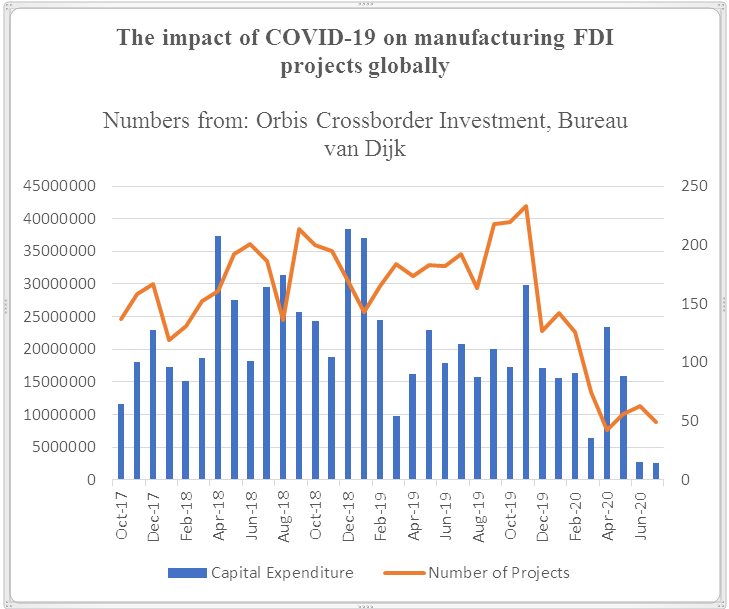
Manufacturing: While the manufacturing sector also suffered, the sector was relatively better off during 2020 than services. In fact, 94% of all manufacturing plants were operational during peak pandemic times, with 56% of them operating at full-operational capacity and 44% at partial capacity. Nevertheless, global Foreign Direct Investment in the manufacturing service sharply decreased as the pandemic caused investors to become more risk averse. In general, global FDI decreased from a high of $29,823 million for a total of 233 projects in the month of November 2019 to a low of $2,513 million across 49 projects in July 2020.
IT and Communications: As expected, the IT and communications sector had one of its best years in 2020 in terms of global adoption. From the consumer side, online shopping has increased by 15%. Amazon, an the largest IT-based company roughly doubled its entire workforce by adding 400,000 extra jobs. As for corporate adoption, a study by McKinsey and Company claims that “funding for digital initiatives has increased more than anything else—more than increases in costs, the number of people in technology roles, and the number of customers”. In fact, that same study also concluded that the pandemic has led to the percentage of North American digital consumers to rise by 58%.
Oil and Transportation: Air-travel’s decrease of 60% owing to the pandemic has left the airline industry with losses amounting to $370billion. With aviation being the primary consumer of 7.8% of all total oil consumption worldwide, it is then no surprise to see that the commodity price of oil has fallen by -32.7% in the year of 2020, with a portion of that fall reflecting the decrease in oil demand by manufacturing plants as well.
Global Trends 2020
As the pandemic primarily emerged, imposing increasing and surging human costs worldwide, the global economy was projected to decline by 3% in 2020. This is much worse than what had occurred during the 2008-2009 financial crisis. These numbers were preliminary and were based on the assumption that pandemic was supposed to fade in the second half of 2020 and lockdown measures would eventually unwound. Additionally, the global economy was projected to grow by 5.8% in 2021 as the economic activity returns to its normal pace. However, the reality is that the pandemic had a more negative impact in the first half of 2020 than anticipated and the recovery is predicted to be slower than previously estimated. Secondary estimations have predicted a further decline of growth projected at -4.9%, and a global growth of 5.4% in 2021. The stricter the lockdown measures, and the wider spread of the pandemic, the greater the uncertainty around this forecast. The baseline of the projection rests on key assumptions about the fallout from the pandemic. Specifically, among emerging markets, the first quarter GDP was worse than expected, with a catastrophic hit to the global labor market, a contraction in a global trade and weaker inflation. Nevertheless, while the impact is different across the different sectors and different regions.
Recovery: Sectors Projections
Sectors:
Services: The recovery of the service sector will depend largely on how effective vaccines are in achieving herd immunity, and how fast they are distributed. If vaccines are distributed in bulk and lockdown measures begin to fade, advanced economies would reach herd immunity by mid 2021, and the services sector would directly rebound. There is also an opportunity for developing economies to permanently shift to a more digitalized service sector, as the pandemic has given them the opportunity to familiarize themselves with appropriate technology, which has vastly increased growth in services by complementing traditional means of work.
Manufacturing: For 2021 and beyond, Covid-19 might have been a blessing in disguise for the manufacturing sector. Yes, output has vastly decreased as global trade and supply chains took a grand hit, forcing many manufacturing companies to either exit the industry completely or temporarily suspend operations. But for those that survived, 96% of manufacturing CEO’s have claimed that the pandemic has sped up their digitization plans, thus allowing them to increase outputs for a lower cost. And with the promise of better 5G networks, AI systems, and virtual reality models, the future of this industry seems promising.
IT and Communications: This sector can be seen as a hero of the pandemic. From virus heat maps and virtual clinics, to online learning and corporate meetings, the IT and communications sector helped humanity endure lengthy economic shutdowns. As for the future, the world has now embraced technology more than ever before and is not going to look back. Automated manufacturing plants and AI service robots are both set to change the manufacturing and service sectors in the near future, causing various low-to-medium skilled jobs to become obsolete while high-skilled opportunities increase.
Oil and Transportation: 2021 doesn’t look like the year in which oil rebounds, in fact, oil prices might take as long as 2023 to go back to pre-pandemic levels. This pessimistic outlook is related to the transportation sector, with new strains of the virus emerging and vaccines set to take a long time before being properly distributed in developing nations, meaning that the travel industry, and overall demand for oil, will remain stagnant. Additionally, OPEC+ producers have already agreed to increase oil output by 500,000 barrels per day at the beginning of 2021, with further discussions to possibly re-increase output by an extra 500,000 barrels per day beginning 1st of February 2021. If these increases prove to be too impulsive, oil prices could even see a further decrease in 2021.
Anticipated Growth by Regions 2021:
MENA Region:
In 2020, and after being forecasted to grow by 2.6 percentage points, the MENA region’s growth instead contracted by 5.2%. Due to the duality of the Covid-19 pandemic and oil crisis, oil exporting countries in MENA suffered incredible losses while the gains of oil-importing economies were offset by the hit of the tourism sector and the substantial decrease in remittances. In fact, output loss in the region is expected to exceed $230 billion. And as countries have to rely on expansionary monetary and fiscal policies to support struggling businesses, public debt in the region is expected to reach 58% of GDP in 2022, up from 45% in 2019. According to data from the United Nations Conference on Trade and Development, trade is also projected to have fallen by 40% in the region in 2020. In 2021 though, The MENA region is expected to bounce back strongly with a growth percentage of 3.2%, with all economies in the region expected to grow in some capacity (except for Lebanon which is expected to contract by a further 6.4%). Yet after the initial rebound, growth in the region is expected to heavily stagnate owing to the following risks.
Weak Fiscal and Health Care systems
Having populations at a constant risk of displacement (eg: Syria)
Increase in short-term inequality owing to the oil sector being the first to recover
Increased US-Iran tensions
Conflicts in Libya and Syria exacerbating and Yemen’s Peace talk imploding
Delays in the formation of governments in many MENA countries
Europe
In Europe, real GDP growth is projected to have decreased by 7.4% in 2020, more than during the global financial crisis. The impact was felt most by the region’s more advanced economies, including Spain (-12.8%), Italy (-10.6%), France (-9.8%), and the United Kingdom (-9.8%). These contractions were mostly caused by the drop in demand, exports, and tourism, as well as the volatility faced in the financial markets and supply chains. Nonetheless, the situation could have been more dire still if not for the economic support that governments showed. Job-subsidizing policies, for example, are thought to have preserved a minimum of 54million jobs and kept demand relatively higher. In 2021, Europe is expected to start its recovery with a forecasted growth of 3.6% founded by enhanced covid-19 management and preliminary vaccine rollout. In the coming years, it is also advised that Europe re-focus its policies on products instead of people, aiming to solve the continent’s long-standing problems of increasing income concentration, low productivity growth, and the short-term struggles in shifting to more climate-friendly corporate standards. The risks that might stand in the way of such progress include:
Insolvency of firms leading to a weakened banking sector at best and a financial crisis at worst
The loss of global chain partnerships
Brexit dampening trade within Europe
The continuance of the current drought affecting large parts of Eastern Europe
Asia
Remarkably, Asia was perhaps the continent that most effectively handled the pandemic. On average, Asian economies were the fastest to enforce strict lockdown measures, closing after an average of five days following an outbreak. These measures proved fruitful, as Asia is set to contract only 2.2% in 2020 and then grow by 6.9% in 2021. In fact, some Asian economies actually grew in 2020, most notably China (1.9%) and Vietnam (1.6%). What is perhaps even more astounding that despite the growth in 2020, China is still set to grow by a further 8.2% in 2021, making it the world’s most resilient economy during the pandemic. In fact, China is also Asia’s most relatively open economy, with schools and the industrial plants fully open, retail and services open with restrictions, and travel partially open. Quite a few lessons can be learned by the way most Asian economies mitigated Covid-19, for on average, Asian countries exited lockdown with the fewest new cases, showing that it is better for both overall health and the economy to only ease lockdown once the virus has been suppressed. Asian countries, on average, also had the most testing and tracing percentage in the world, highlighting the importance of government initiative in trying times. Nevertheless, some risks still remain for Asian economies to beware off in 2021 and are the following:
An escalation in the US-China trade war, and overall tensions between the two political behemoths, could be potentially disruptive to the region’s trade, financial, and technological sectors.
While Asia was relatively effective in curbing the pandemic, the crises that ensued were disproportionately impacting the most vulnerable classes, with little-to-no government action to prevent the poorest from suffering the largest burden of the costs.
An expected tightening of monetary policy directly after the pandemic could be extremely risky to small and medium enterprises in particular, and to the overall credit and debt markets in general.
An increase in regional geopolitical tensions between India and Pakistan, India and China, and the parties involved in the South China Sea dispute, could lead to a race to the bottom.
China
Despite being the pandemic’s pivot, China has become the first and only major economy to recover from the consequences of 2020 and enter 2021 with a rather optimistic outlook. The implementation of stable and “time-sensitive” policy responses has allowed China’s economic growth in the last quarter of 2020 to return to its pre-pandemic levels.
In the first quarter of 2020, China’s growth shrank 6.8%, but it bounced back in the second and third quarters with a rate of 3.2% and 4.9% respectively. This bounce back can be attributed to several strategies, one of them is the reprioritization of macroeconomic objectives, and a focus on enhancing exports, connected to the high demand for medical supplies, equipment and electronics. Factors also include a great deal of investment in infrastructure and real estate. Despite hitting a low in 2020, several experts predict China’s GDP growth will reach 8 to 9 percent in 20201.
US-China Relations: Old vs New Administration
China’s economic pre-pandemic normalization is strongly linked to its tension with the U.S. The US-China trade war was launched back in 2018 with President Trump, when the US trade deficit widened. However, because of the pandemic, there has not been much improvement from the trade war’s retaliatory tariffs. In 2019, the US trade deficit with China decreased by 8.5%, and then increased again by 5.4% in 2020. Currently, it accounts for about 37% of the US total trade deficit. Should China achieve 8% of growth this year, with predicted currency appreciation and domestic inflation, IMF forecasts that the size of China’s economy relative to the US could be higher than 75%. So, it is expected that newly elect president Joe Biden’s stance on China will remain tough. Biden has previously explained that he will not cancel the Trump’s administrational additional tarrifs on China. Also, analysts expect that Biden might seek collaboration the U.S.’s well known allies to jointly contain China.
USA
In 2020, the United States faced a truly tough year. Even though its economic contraction of 4.3% tracks with that of the rest of the world (4.4%), the U.S. faced one of the worst health scenarios as it had over 20% of world-wide Covid-19 deaths even though it accounts for roughly 4.25% of world population. Prior to the pandemic, Trump’s economy was faring quite spectacularly, with unemployment reaching a 50-year low and inflation below the target of 2%, but it soon came crashing. During the second quarter of the year, real GDP sharply fell by a tremendous 31.4% while unemployment levels reached 14.7%. But what is perhaps most astonishing is the financial markets’ nonalignment with the economic reality. Even though U.S. stocks dipped during the beginning of the pandemic, they have now peaked and are estimated to be a record-breaking 83.8% overvalued. In comparison, stocks were only 49% overvalued during the Tech Bubble in 2000. Yet, the U.S. economy is still expected to grow by 3.5% in 2021, which is 0.5% lower than what was previously projected. Nonetheless, the following risks make it clear that while U.S. GDP might fully recover, welfare will take a longer time to do so:
The U.S.A. is projected to have a K-shaped recovery. Meaning that like the letter “K” that diverges in its strokes, so will the fortune of different classes in the U.S. economy. The rich are projected to get even richer while the poor still poorer.
The “K” economic recovery will also prevalent be in the job market. Sectors such as banking, telecommunications, and real estate now offer wages at levels 50% higher than before the pandemic while jobs in the leisure and hospitality sectors suffer from lower wages and a loss of 25% of employment.
Increased divide between the U.S. population’s political affiliations might cause serious social skirmishes, not unlike the recent Trumpian storming of the capitol
Potentially dangerous escalations in the conflicts between the U.S. and North Korea, Iran, and China.
U.A.E.
2020 has been a mixed year for the United Arab Emirates. With 30% of its GDP coming from gas and oil extracts, there is no wonder that the commodity’s fall in price had damaging effects on the economy, with oil output in Q3 reaching an almost decade low. As Covid-19 cases recorded new daily highs, the U.A.E government has done everything in its power to avoid extreme lockdown measures, including authorizing the emergency use of Chinese-owned company Sinopham’s vaccines, which have so far proven to be effective in the first two clinical trials. Whilst the economy is set to contract by 6% in 2020, U.A.E. officials can take comfort in the resilience of their non-oil private sector, which has reached a 16-month PMI high. This was not at all a stroke of luck but rather a result of careful planning and decision making.
Domestic markets: The Central Bank of the United Arab Emirates announced specific policies to deliberately ensure the survival of local businesses. It launched the Comprehensive Economic Support Scheme, with a goal to use a total of $27.23 billion to relieve private businesses and retail consumers of interest accumulated on outstanding loans, which is meant to act as a monetary stimulus to both strengthen supply and demand in the economy. Fiscal policies were also adopted, with the Central Bank launching the Targeted Economic Support Scheme and the UAE Cabinet declaring a further $4.36 billion stimulus package. The policies’ main objective being the support of domestic companies by cutting the cost of doing business and investing heavily in infrastructure projects. U.A.E is already one of the most diversified oil-exporting economies, and the country plans to further strengthen more non-oil related sectors in a bid to shift to a more modernized strategy. The financial sector will be pivotal in determining the success of such plans with the U.A.E counting on their easygoing lines of credit to fund projects mounting to a total value of $868 billion. $672 billion of the aforementioned valuation are pipeline projects of which $417.7billion are construction related. Moreover, the U.A.E also aims to revolutionize its travel and health care industries through heavy digitization. Country officials aim to continue introducing and expanding AI systems into these sectors to improve productivity, facilitate data collection and redistribution, and reduce human error. The U.A.E has already tested these AI models in their National Unified Medical Record, an AI central database in Dubai that was successful in redefining the region’s health care industry, and that is now being implemented nation-wide
Cross-border operations: The UAE’s recent success in negotiating an agreement with Israel to build a pipeline in Ashkelon is projected to substantially increase Emirati oil demand as the pipeline will be used to transport oil into Europe. On the 6th of January 2021, the U.A.E and Qatar agreed to fully reestablish diplomatic ties, which were severed on the 5th of June 2017 as part of the Qatar diplomatic crisis. Consequently, the U.A.E should see first quarter boosts to its trade and travel sectors. Lastly, it is predicted that the UAE will find itself largely unaffected by regional political instability, despite heavy Iranian tensions. As for domestic politics, the system is also expected to prove itself stable with a possible transfer of power from Abu Dhabi ruler His Excellency Khalifa bin Zayad Al Nahyan to Crown Prince Mohammed bin Zayed Al Nahyan expected to flow smoothly if the former’s health issues are to further deteriorate.
Political reality: In 2021, UAE’s economy is set for a recovery of 2.5% in real GDP, as well as a much-anticipated political reform. His Highness Sheikh Mohammed bin Rashid Al Maktoum has announced that the U.A.E will alter, merge, and change a number of governmental bodies in a bid to facilitate future governmental reforms by creating a more “agile, flexible, and speedy government”.
Possible Risks: Economists have been predicting a harsh expat exodus facing the UAE, with the UAE losing approximately 10% of its residents owing to a loss of 900,000 jobs. Due to expats having no welfare schemes and no permanent-citizenship routes, the loss of jobs has left most of them unable to bear the burden of the pandemic and contemplating a move back to their original countries. Nevertheless, the UAE once again acted swiftly to mitigate the effects of such a disaster by passing a decree that allows expats to use their native laws instead of the Sharia when dealing with personal affairs. It has also launched a virtual visa scheme that allows working professionals to relocate to Dubai and enjoy access to unfettered services, and started a retirement program for foreigners over 55, all in the hopes of encouraging foreign labor. On the supply side, Dubai has commenced an e-commerce platform called the Virtual Company License that allows businesses from all over the globe to freely explore the UAE market, with the platform set to attract over 100,000 companies in the near future. However, all of the aforementioned schemes, stimuli, and policies to protect the economy from the effects of the pandemic may backfire. As a result of these generous measures, Dubai’s governmental debt is estimated to have reached 77% of GDP ($80billion), and if we were to add government-related entity debt to that number, ratings agency S&P predicts that total debt is an astronomical 148% of GDP($153.8 billion).
To summarize, the UAE will start recovering in 2021 but future growth might slow down as a result of Dubai’s growing debt and the possibility of an Abu Dhabi bail-out similar to the one in 2009. A shift to increased diversification and fast vaccine rollout has helped the economy resist a further contraction of GDP but oil still remains fundamental. As such, lower-for-longer commodity prices are set to also contribute to the economy’s slow growth, even if the U.A.E does manage to capture a larger share of the European oil market.
Other Countries worth mentioning
Turkey: Turkey’s case in 2020 is an interesting one to say the least. Even though it contracted by 3.8%, and even though its Lira was heavily devalued when measured against the US dollar, Turkey still managed to avoid a bigger contraction as a result of intense policies oriented towards increasing credit. Nevertheless, Turkish businesses still suffered from the pandemic, especially those affiliated with the touristic sector and those that had limited solvency before the currency devaluation. And even though Turkey’s policies were an overall success, the nations’ restricted monetary reality left it incapable of carrying out all of the procedures it had originally planned.
KSA: In comparison, Saudi Arabia has had a relatively less rosy year. Stringent lockdowns coupled with a decrease in oil prices throughout 2020 has left the economy in shambles, with a growth rate of -5.4%. While some investors are optimistic that KSA’s economy is set for a rebound in 2021, others are warry seeing that growth in Saudi Arabia will largely depend on the recovery of global demand and the price of oil, which is expected to face another dip. The pandemic may also leave quite a lasting scar in the economy as the instability of financial markets and the country’s rising public debt might hamper the KSA’s plans to increase economic diversification in the near future. Still, save an exogenous shock or increased non-compliance by OPEC+ countries, KSA’s economy is set to grow by 3.1% in 2021.
Russia:Following its worst recession since World War II, the Russian economy is set to contract by 3.6% in 2020, with the hardest hit industries being retail, manufacturing, and construction. The pandemic has had a spillover effect on most Russian livelihoods, with the shrinking of businesses estimated to thrust 130 million people into extreme poverty by 2021. The Russian government, however, acted swiftly and have put in place several countercyclical fiscal policies raging from substantial macro-monetary support for struggling corporations to targeted social safety net policies meant to alleviate the burden of carried by the most vulnerable. Nonetheless, Russia was still helpless to combat certain issues, such as disrupted trade with the EURO zone -its largest trading partner- due to the pandemic’s effect on global value chains. In 2021, Russia is expected to start a strong rebound of 3%, followed by a complete recovery in 2022 when it is estimated to grow by a further 3.9%. Russia’s relative ease in rebounding from this pandemic lies in its still largely unfulfilled potential, with a gradual shift towards more technological driven manufacturing the basis for Russia’s expansion in the coming few years.
Global Trends:
Trade
We know that trade tends to be volatile and extremely susceptible to such crises (Bussière et al. 2013). In fact, total trade has decreased by 18.5% this year, the “steepest drop on record”, according to WTO Director General Roberto Azevêdo. Causes for such a deep contraction are various. Covid-19’s impact on travel has adversely affected the tourism sector, which is in turn responsible for the consumption of approximately 6.5% of world-wide goods and services. Moreover, the closure of borders between countries, accompanied by stricter import inspections, have resulted in an unwanted strain on the production and delivery of durable goods, most notably on electrical and automotive industries. As delivery time increases, most businesses that rely on day-to-day transactions have suffered from an increase in costs, and the air freight industry has been barely avoiding total ruin. Finally, disturbances in the credit market has had a rippling effect throughout trading economies, and as such, many agreements have fallen through. While the growth of global trade is imminent in 2021, complete recovery is less so. As borders gradually start the reopening process, airlines will start refilling their seats, and manufacturers will go back stocking their inventories. Nonetheless, trade’s recovery path depends on both overall confidence level, which will take time to go back to pre-pandemic levels, and the time needed to replace firms that have either contracted or shutdown due to low demand. In short, global trade should expect nothing more than a slow, L-shaped recovery
Food Crisis
The corona virus could not have come at a worse time for the 2030 zero hunger goal. With global food chains being hampered by the pandemic and job losses caused by economic tolls leading to more poverty, a large percent of the population will become food deprived in the coming years. The most vulnerable countries so far are Afghanistan, Burkina Faso Cameroon, The Central African Republic, Congo, Ethiopia, Haiti, Lebanon, Mali, Mozambique, Niger, Nigeria, Sierra Leone, Somalia, South Sudan, Sudan, Syria, Venezuela, Yemen and Zimbabwe. The UN estimates this crisis to be the worst food-related calamity in half a century. In fact, more people are now projected to die from Covid-associated food shortages than from the actual virus itself.
A potential debt crisis: Dangers of the Fourth Wave of Debt
The global recession triggered by Covid-19, along with the economic policy response, have generated a rise in debt levels, especially in emerging market and developing economies (EMDEs). Pre-pandemic, however, there has been an increasing concern about a “fourth wave” of debt accumulation, specifically in these economies, that can spark the possibility of financial crisis. This pandemic merely added to the risks and consequences of this fourth wave by intensifying this crisis. In 2019, global debt has increased to 230, an alltime high, and government debt to a record of 83% of GDP. In EMDEs specifically, total debt reached 176 percent of GDP and government debt is expected to rise by 9% of GDP in 2020.
As a result of substantial financial stimuli, accrued interest on loans, and weaker capital flows, world debt has risen to 365% of global GDP, growing by more than $15 trillion in 2020 alone. Even though the global financial system is less inter-connected today than pre-2008 levels, six countries (Argentina, Belize, Ecuador, Suriname, Lebanon, and Zambia) defaulting in 2020, along with the IMF disbursing aid to 81 nations, has left a fiscal strain that could soon burst. The G20 has already identified this potential risk and has tried to address it by creating a “Common Framework” to oversee the management of a debt relief system but has so far been undermined by the U.S.’ unwillingness to endorse further IMF resource support.
Concluding Remarks
2021 holds a great many uncertainties, challenges, and confusion as policymakers have to decide on whether or not to pursue recovery-inducing expansionary stimuli at a risk of ever-increasing debt and an imploding financial system. And while advanced economies generally have the means to induce economic activity, international organizations fear that this pandemic will hurt emerging countries’ prospects for decades to come. Not only will this crisis roll-back years of hard-work in reducing poverty, but the overall impact on welfare cannot be measured. Research has shown that a great number of college graduates that do not immediately find a job will suffer from related consequences for the rest of their lives, as evident by Japan’s lost generation where limited job opportunities between 1991 and 2003 has caused 3.4million 40 to 50 year-olds to remain jobless today. Prolonged mental health issues caused by either the health or economic toll of the pandemic is also something we find difficult to measure and is an unaccounted welfare cost of the virus. If all goes according to pre-set plans and no new crises emerge, the global economy is set to grow back by 5.2% in 2021 in real GDP. Alternatively, this number, along with actual welfare, could even prove to be too low if the global community was to cooperate and come up with collaborative solutions. Making sure that vaccines are manufactured and distributed swiftly, providing a safety cushions for the most vulnerable classes, sharing expertise on the navigation of Covid-19 induced calamities, and setting up an international framework to build up global resiliency to future crises through sustainable growth will not only allow for faster world-wide recovery, but might also prevent future disaster scenarios by building global ties able to withstand pressure.
During the first week of March 2021, the first official and legitimate transfer of money from Sudan to the United States of America took place ending 24 years of economic sanctions.
In December 2020, the United States announced that it had officially removed Sudan from its list of state sponsors of terrorism after the country was added in 1993. Subsequently, the process to re-establish direct transactions between the two countries started when the U.S. Department of Treasury sent a message encouraging banks to do transactions with Sudan.
H.E. Nureldin Satti, Ambassador of Sudan to the USA received the test wire transfer from Qatar National Bank in Khartoum to his personal account at Wells Fargo in the United States.
H.E. Satti commented “One of the banks was Qatar National Bank which responded favorably to this request and got in touch with Well Fargo which also accepted the request and the offer”
H.E. Satti added in an interview with Voice of America “A trial money transfer will also be carried out from a US bank to Sudan, and should it succeed, Sudanese Nationals in the US would be able to transfer money to their country”
A Brief History: From Sanctions Imposition to Lifting
In 1993, and during his first year as President of the United States, Bill Clinton, placed Sudan on the list of State Sponsors of Terrorism for harboring international terrorists.
In 1997, through an executive order, President Bill Clinton banned all U.S. investment in Sudan and most bilateral trade citing Sudan’s continued support to international terrorism, its poor human rights record including lack of religious freedom, and its efforts to destabilize the region.
However, by the end of the second Obama administration term, it began the process of lifting economic sanctions on Sudan citing Sudan’s cooperation with the United States on counterterrorism and its efforts to improve its human rights record. The U.S. officially rescinded Sudan’s designation as a State Sponsor of Terrorism in December 2020 following the political change the country witnessed and the transitional government’s agreement to compensate terror victims.
Economic Reforms Required
Many local and international economic experts argue that direct bank transactions to Sudan remain problematic because of “distortions” in the Sudanese economy and the multiple and widely varying exchange rates of the Sudanese pound to the U.S. dollar.
The huge gap between Sudan’s official exchange rate, which was 55 pounds to the dollar, and the black-market exchange rate, which stood at nearly 400 pounds to the dollar was at heart of this distortion.
Accordingly, Sudan’s Central Bank has sharply devalued its currency, the Sudanese pound, in an attempt to get debt relief, crack down on the black market, and attract money back to the country. The bank unified the price of the currency with the black market at 370 pounds for one U.S. dollar.
This action was implemented as part of broader economic reforms that Sudan’s transitional government made under a plan endorsed by the International Monetary Fund in October 2020.
Sudanese officials look forward to the fact that the unification of its multiple exchange rates will boost direct trade and investment in Sudan and enable transactions between Sudan-based banks and the outside world through official channels.
Imagine if your boss told you “you did a great job and you will be paid in bitcoin”. How would you react? Are you being deceived or is it an advantage? In this article we discuss the validity of the Bitcoin currency and explore it from various angles.
Numerous forms of currencies evolved throughout time: goods, gold, silver, banknotes, and electronic money. Today Bitcoin is emerging as an innovative payment network and a new kind of currency. It uses peer-to-peer technology to operate with no central authority or banks. Bitcoin cryptocurrency is a virtual currency that uses Blockchain paving the way for cashless, digital economy. However, the essence of Bitcoin is still unclear. Is it money, commodity or simply a hype? The answer is not straightforward and distinct views are plausible.
The popularity of bitcoin has boomed since it was invented in 2010 capturing the interest of investors looking for an alternative to traditional investments. Investors consider cryptocurrency as a good investment in times of economic uncertainty because of expected high returns. Large investment in Bitcoin led to a surge in Bitcoin value. Bitcoin are traded on independent exchanges worldwide. The advantages of investing in Bitcoin are high accessibility, liquidity, returns, and transparency. The disadvantages on the other hand are lack of regulation, limited use, volatility, and lack of security.
Today there is over a thousand of Cryptocurrencies worldwide. There are two ways for obtaining Cryptocurrencies: buying or mining. Buying involves signing up with a cryptocurrency exchange. Platforms for buying Cryptocurrencies include Coinbase, Binance and Coinmama. Mining is generating new cryptocurrency by solving complex algorithmic problems.
The computational resources needed to mine bitcoin use huge electrical power. Hence bitcoin mining is not environmentally friendly.
Bitcoin can be spent in various places online and offline. Bitcoin ATMs allow exchange of bitcoin for cash. Bitcoin can be converted to cash by selling it in a cryptocurrency exchange.
Many Muslims are reluctant to trade cryptocurrency due to surrounding uncertainty and speculative nature. Bitcoin is not compliant with Islamic economy where investment serve the real economy and promote its growth. Thus, Bitcoin is not ideal Islamic investment unless a regulated framework is established. However, Shariah Advisory Council of Malaysia’s advised that it is permissible to invest and trade cryptocurrencies on registered crypto exchanges. Shariah-compliant crypto exchange won license from Bahrain central bank. CoinMENA is offering spot trading in five major cryptocurrencies.
Bitcoin was designed to replace fiat currencies and becoming a global digital currency. Bitcoin estimated growth is high reaching over $100,000 by 2025. However, Bitcoin cannot replace banks. The rush for cryptocurrency is attributed to a misunderstanding of how money is created. The value of bitcoin is not backed by anything. Hence, no one can predict the future of Bitcoin. Various scenarios arise: Bitcoin may be digital gold of digital economy; Bitcoin may be regulated and taxed; Bitcoin may be used to buy goods and services; Bitcoin network might be down or hacked; World financial institutions like IMF and central banks might start mining their regulated Cryptocurrencies; Bitcoin will replace cash money.
Advances in artificial intelligence and machine learning have raised fears of large-scale job losses. And while labor-market adaptation is likely to stave off permanent high unemployment, it cannot be counted on to prevent a sharp rise in inequality.
Perhaps no single aspect of the digital revolution has received more attention than the effect of automation on jobs, work, employment, and incomes. There is at least one very good reason for that – but it is probably not the one most people would cite.
Using machines to augment productivity is nothing new. In so far as any tool is a machine, humans have been doing it for most of our short history on this planet. But, since the first Industrial Revolution – when steam power and mechanization produced a huge, sustained increased in productivity – this process has gone into overdrive.
Not everyone welcomed this transition. Many worried that reduced demand for human labor would lead to permanently high unemployment. But that didn’t happen. Instead, rising productivity and incomes bolstered demand, and thus economic activity. Over time, labor markets adapted in terms of skills, and eventually working hours declined, as the income-leisure balance shifted.
And yet, as augmentation of human labor gives way to automation – with machines performing a growing number of tasks autonomously in the information, control, and transactions segments of the economy – fears of large-scale job losses are again proliferating. After all, white- and blue-collar jobs involving mostly routine – that is, easily codified – tasks have been disappearing at an accelerating rate, especially since 2000. Because many of these jobs occupied the middle of the income distribution, this process has fueled job and income polarization.
As in the nineteenth century, however, labor markets are adapting. At first, displaced workers may seek new employment in jobs requiring their pre-existing skills. But, facing limited opportunities, they soon begin pursuing jobs with lower (or easily attainable) skill requirements, including part-time jobs in the internet-enabled gig economy, even if it means accepting a lower income.
Over time, a growing number of workers begin investing in acquiring skills that are in demand in non-routine, higher-paying job categories. This is generally a more time-consuming process, though it has been accelerated in some countries, including the United States, by initiatives involving government, businesses, and educational institutions.
But, even with institutional support mechanisms, access to skills development is usually far from equitable. Only those with sufficient time and financial resources can make the needed investment, and in a highly unequal society, many workers are excluded from this group. Against this background, we should probably be worried less about large-scale permanent unemployment and more about an uptick in inequality and its social and political ramifications.
To be sure, technological adaptation may reduce the magnitude of the skills-acquisition problem. After all, markets reward innovations that make digital equipment and systems easier to use. For example, the graphical user interface, which enables us to interact with electronic devices via visual indicator representations, is now so pervasive that we take it for granted. As such intuitive approaches are applied to increasingly complex technological processes, the need for re-training – and, thus, the digital revolution’s distributional impact – will be diminished.
Progress on artificial intelligence will also have an impact. Until about ten years ago, automation relied on the codification of tasks: machines are programmed with a set of instructions that reproduce the logic of human decision-making. But what about tasks that cannot be distilled into a series of logical, predefined steps? From understanding natural language to recognizing objects visually, a surprisingly large number of activities – even ostensibly simple ones – fit into this category. This has kept many jobs “safe” from automation, but not for much longer, owing to advances in machine learning.
Machine learning is essentially very sophisticated pattern recognition. Using large pools of data and massive computing power, machines learn to do things we cannot code. They do this using examples rather than rules-based logic. Advances in machine learning have opened vast new areas of automation: robotics, autonomous vehicles, and scanning technical medical literature for key articles. In many areas – such as pattern recognition in genetics and biomedical science – machines not only become capable of replacing human workers; in certain respects, their capabilities dwarf those of any human.
This is better news than it may seem. Yes, far more tasks and subtasks will be reallocated to machines. But the purpose and end point of the digital revolution must be to turn automation of work into digital augmentation. And when machines perform tasks humans cannot, augmentation is precisely what we are getting.
Digital transformation and the digital economy are the pillars for sustainable growth. However, one of the main striking challenge is the difference in the perception of nations of what digital transformation and digital economy are. Each country is conceiving digital transformation in its own way depending on its capacities, resources, and ecosystems. Moreover, within a single nation, various institutions are conceiving digital transformation in their own ways, putting their own digital transformation strategies, and implementation roadmaps.
The concept of digital economy linked or a by-product of the digital transformation is also varying across countries. Hence it is difficult to put global benchmarks for digital transformation and compare growth in digital economies.
A Global Digital Economy Platform GDEP aims at unifying practices, helping to put benchmarks, and leading to global sustainable growth.
THE FRAMEWORK
We hereby propose a simple and straightforward three tiers framework for a Global Digital Economy Platform (GDEP):
Tier1: GROW
KNOWLEDGE
RESOURCES
FINANCES
Tier 2: BUILD
APPLICATIONS
TOOLS
INFRASTRUCTURES
Tier 3: DEPLOY
ACROSS SECTORS
ACROSS COMMUNITIES
ACROSS COUNTRIES
This GBD (GROW – BUILD – DEPLOY) framework is supported by a DASHBOARD tracking performance and measuring SUSTAINABLE GROWTH indicators.
Below we briefly describe each tier and we elaborate on each tier in subsequent future articles.
TIER 1 GROW – KNOWLEDGE
The digital transformation and the digital economy changed the job market landscape. New digital skills are needed and non-skilled labor are opted out. New jobs are created while others are disappearing. More complex technological skills are required hence the need to grow skill and knowledge to stand up to the digital transformation challenge. New technology solutions and application are emerging but we need to figure out use and benefit. The digital economy and the digital transformation are widening the digital divide and social distancing is rising. We need to grow knowledge and raise awareness to reduce the digital divide.
The key to address the digital transformation and digital economy jobs and skills challenges is to GROW KNOWLEDGE – learn and educate:
Learn to integrate in the job market
Learn to innovate
Learn to deploy and implement digital solutions
Learn to integrate in the digital society
Learn to wipe the digital divide
Learn to lead the digital transformation
Learn to govern the digital economy
Education infrastructures need to be transformed and adapted to the digital economy needs. New education models and modes of delivery are the way forward … we have to catch up with the education trend.
TIER 1 GROW – RESOURCES
Wealth of resources are generated by the digital economy and digital transformation including data, products and services.
Technologies and generated data are the drivers of change and transformation in the digital economy. The key is to consolidate and integrate these resources.
New technologies are continuously emerging. Below we briefly overview some of the main technologies behind the digital transformation. These technologies are generally designated as technologies of the fourth industrial revolution (Industry 4.0) and they include:
Artificial Intelligence: Artificial intelligence involve the analysis and filtration of huge amounts of incoming information from different types of sensors to assist the interpretation and suggestion of the most recommended course of action.
Machine Vision: is technology and methods used to extract information from an image on an automated basis, as opposed to image processing, where the output is another image. The information extracted can be used for such applications as automatic inspection and robot and process guidance in industry, for security monitoring and vehicle guidance.
Augmented Reality: Augmented reality (AR) is an interactive experience of a real-world environment whereby the objects that reside in the real-world are “augmented” by computer-generated perceptual information. Augmented reality is related to two largely synonymous terms: mixed reality and computer-mediated reality. Augmented reality is largely used in the entertainment and gaming businesses, knowledge sharing, educating, managing the information flood and organizing distant meetings. Augmented reality is also transforming the world of education.
Big Data: Big data is the large volume of data, both structured and unstructured, generated by businesses on a day-to-day basis. Big data can be analyzed for insights that lead to better decisions and strategic business moves.
Internet of Things: The Internet of things (IoT) is the network of physical devices, vehicles, home appliances, and other items embedded with electronics, software, sensors, actuators, and connectivity which enables these things to connect, collect and exchange data.
Business Intelligence: Business Intelligence BI basically relies on transforming raw data into usable, valuable and actionable information for decision-making. It can be classified as a kind of data-driven decision support system.
Bitcoin: Bitcoin is a crypto currency, a form of electronic cash. It is a decentralized digital currency, without a central bank or single administrator that can be sent from user-to-user on the peer-to-peer bitcoin network without the need for intermediaries. Transactions are verified by network nodes through cryptography and recorded in a public distributed ledger called a Blockchain.
Blockchain: The bitcoin Blockchain is a public ledger that records bitcoin transactions. It is implemented as a chain of blocks, each block containing a hash of the previous block up to the genesis block of the chain. A network of communicating nodes running bitcoin software maintains the Blockchain.
3D printing or additive manufacturing: is a process of making three dimensional solid objects from a digital file. The creation of a 3D printed object is achieved using additive processes. In an additive process an object is created by laying down successive layers of material until the object is created.
TIER 1 GROW – FINANCES
Financing the digital transformation is important to leverage the advantages and tap the potential of digital transformation. We need to grow and digitally enable investment in:
Fourth Industrial Revolution Technologies are growing in size and complexity. We need to turn these technologies and deploy them in applications, tools and services for all devices and build intelligent digital networks of things and people forming the supporting infrastructure.
Industry 4.0 technologies triggered a series of 4.0 application domains such as Banks 4.0, Health 4.0, Work 4.0, and Global Supply
Chain 4.0, Manufacturing 4.0, Trade 4.0 etc. This reflects a profound impact of the digital transformation on every aspect of life. In the 4.0 realm, potential, challenges and threats arise. The potential include promised progress and interconnectivity. The challenges are the complexity and the needed change in all practices and up skill. The threats are Cybersecurity, misuse, and lack of governance and ethical framework.
TIER 3 DEPLOY: ACROSS SECTORS – ACROSS COMMUNITIES – ACROSS COUNTRIES
All economic sectors are concerned with the digital transformation and are part of the digital economy. We need to deploy application, tools, and networks across all economic sectors and we need to grow knowledge to serve all economic sectors in the digital transformation realm. All communities should be integrated and part of the digital transformation. Distant and minor communities should be empowered by the needed skills and resources to ensure social inclusion for all.
DASHBOARD
The DASHBOARD is a crucial component of the Global Digital Economy Platform GDEP it is useful for tracking performance and measuring SUSTAINABLE GROWTH indicators. Novel metrics quantitative and qualitative are to be developed to assess impact of the digital economy on sustainable growth and to identify best practices and establish digital economy benchmarks across countries.
The Butterfly wealth effect can be best explained by the small money decision that are made today and could have a dramatic effect on a person’s life for years down the road.
Small decisions that you make every day can be the difference between you owning a luxurious house while running the business of your dreams and renting a modest apartment while working at a low paying job. These decisions start off small; they are typical daily ones that eventually compound over time to make one giant changing your life.
In order to dive into how this works. Let’s take a look at the cases of two average Millennials. These Millennials have a net worth of about $10,000 each. They both have an average income of $39,000 per year, they are both likely working in the service industry. They spend roughly $1,100 a month on rent, $350 on groceries, a few hundred month on health insurance, their monthly utilities are about a $150 per month and they have a series of other fixed expenses, like internet, taxes, car payment, student loans, phone bill and other necessary expenses. At the end of everything these two typical Millennials usually have a few hundred dollars a month left over to spend on whatever they want. In our case, we’re going to say that each of these Millennials has about $300 per month in excess money. So what are they going to use the Money for?
Type
Millennial A
Millennial B
Net Worth
$10,000
$10,000
Yearly income
$39,000
$39,000
Entertainment
$150
$150
Rent
$1,100
$1,100
Groceries
$350
$350
Utilities
$150
$150
Excess Money Left
$150
$150
Both of them spend about $150 per month in some form of entertainment takeout or other experience, maybe Netflix, whatever it may be…
Here is where they diverge; every morning Millennial A spends about $5 a day on the coffee and maybe a snack from a local coffee shop. Millennial B instead, puts that money into an investment account. This is the only divergence in their life so far; just a morning coffee and snack.
Fast forwarding about 30 to 40 years, if nothing else in their lives were to change -meaning that they make the same amount of money and had the same expenses-, this small daily divergence will result in Millennial B having a $300,000 investment portfolio by the time of his retirement. Meanwhile, Millennial A will have no investment account. Worthwhile restating that this is just assuming that neither of these Millennials got a raise, promotion or change to jobs during their lifetime.
But what if they did?!
By introducing another small divergence; Millennial B spends a few hours of his free time per week reading books or trying to learn new skills which help his career. On the other hand, Millennial A does not do this, and instead replaces that time by watching Netflix or spending time on social media. Millennial A would still likely get some promotions in job offers because he is still gaining valuable experience from work, but Millennial A would progress at a slightly slower rate than Millennial B career-wise because Millennial B is learning new skills during his free time and that’s more attractive to his current or other companies, hence he can ask for slightly more money or a slightly better position. In other words, because Millennial B brings more to the table than Millennial A, when both are able to change jobs or ask for a raise Millennia A gets an average salary increase of 3% per year -that is roughly the same for the average worker in the United States- but since Millennial B is a slightly more valuable than Millennial A, he would most likely be able to get a 5% pay raise rather than the average 3%. This is just a 2% difference in terms of what he is able to get for a salary, but this has dramatic effects in the long term. By the time Millennial A is 55 years old, his salary will be approximately $94,000 per year which is a good salary. However, Millennial B would be making $170,000 per year because of the higher salary which has compounded over time.
Now if Millennial B decided to put the additional income into the saving account, the difference in net worth between these two Millennials could be millions of dollars.
In brief this is the butterfly effect, where small decisions we take today would have a significant outcome in the future
The short-term economic outlook remains worrying worldwide, particularly for borrowers at the lower end of the credit scale or in the industries hit hardest by COVID-19 restrictions. But a large-scale debt crisis may not be nearly as likely as many fear.
As countries, companies, and households confront the COVID-19 pandemic’s economic fallout, many market watchers are sounding the alarm about rapidly rising leverage worldwide. And for good reason: in an acceleration of a years-long trend, the debt-to-GDP ratio among these three sets of borrowers is set to swell by 14% this year, to a record 265%. But while this has raised the risk of insolvencies and defaults, particularly among corporations, S&P Global Ratings believes a near-term debt crisis is unlikely.
Given the higher leverage and a challenging operating environment, S&P has downgraded the credit ratings of roughly one-fifth of corporate and sovereign debt issuers globally, especially speculative-grade borrowers and those suffering the most from COVID-19’s economic effects. For corporate borrowers, insolvency risks are likely to increase if cash flows and earnings do not return to pre-pandemic trend levels before extraordinary fiscal stimulus is withdrawn.
The world is likely to experience a gradual, albeit choppy, economic recovery, assuming that accommodative financing conditions are maintained, in a lower for longer environment, and adjustments to spending and borrowing behavior are made. Add to that a widely available COVID-19 vaccine by mid-2021, and global leverage should flatten out around 2023, with governments scaling back stimulus, firms slowly repairing their balance sheets, and households spending more conservatively.
But absolute debt levels are only part of the story. We must also – and more importantly – consider borrowers’ ability to repay. Today, unprecedented fiscal and monetary stimulus is keeping the liquidity tap open for firms through bond markets and bank loans. Borrowing costs are very favorable, and appear likely to remain so for a long time: we expect benchmark interest rates to remain historically low into 2023. Meanwhile, credit spreads have tightened from their March peak; as it stands, they are more sensitive to business-specific risks than market risks, particularly for the lowest-quality borrowers.
For the most part, the increased debt is intended to help create conditions for an economic recovery that improves borrowers’ future ability to repay. This is especially true for sovereigns, whose fiscal-stimulus measures aim to reduce the pandemic’s economic impact.
All sovereigns will emerge from the pandemic with a larger stock of debt. The most developed economies are likely to bear the largest share of increases. However, they are largely wealthy, with strong financial markets and substantial monetary flexibility, allowing them to sustain their overall creditworthiness thus far.
We assume that governments will reverse the trajectory of fiscal deficits as economies recover, stabilizing debt dynamics. So far, S&P has not lowered the ratings of any G7 country. Speculative-grade sovereigns are more vulnerable to downgrades, given their inherently weaker finances and higher susceptibility to shocks. Most of the negative sovereign ratings actions over the last few months have been in this category.
For all sovereigns, much will depend over the next year on how the new debt is used. If it finances productive activity, boosts national income, and increases government revenues, it will ultimately be supportive of debt sustainability and current ratings levels. But if the economic recovery drags on for longer than expected, or if governments are unable to consolidate fiscal results toward pre-pandemic levels, negative pressure on the ratings will increase.
As for business, many large companies have so far used the proceeds from their newly acquired debt to add cash to their balance sheets as precautionary reserves or to refinance their existing liabilities. Overall, it is estimated estimate that US investment-grade nonfinancial firms have kept about three-quarters of the money they borrowed in the first half of 2020 on their balance sheets. In Europe, that figure is just over 50%.
This is not the case for firms at the lower end of the ratings scale or for small and medium-size companies, especially in the industries that have been directly affected by social-distancing rules and the pandemic-induced recession. Fighting to survive, they are borrowing to cover income shortfalls and working capital needs.