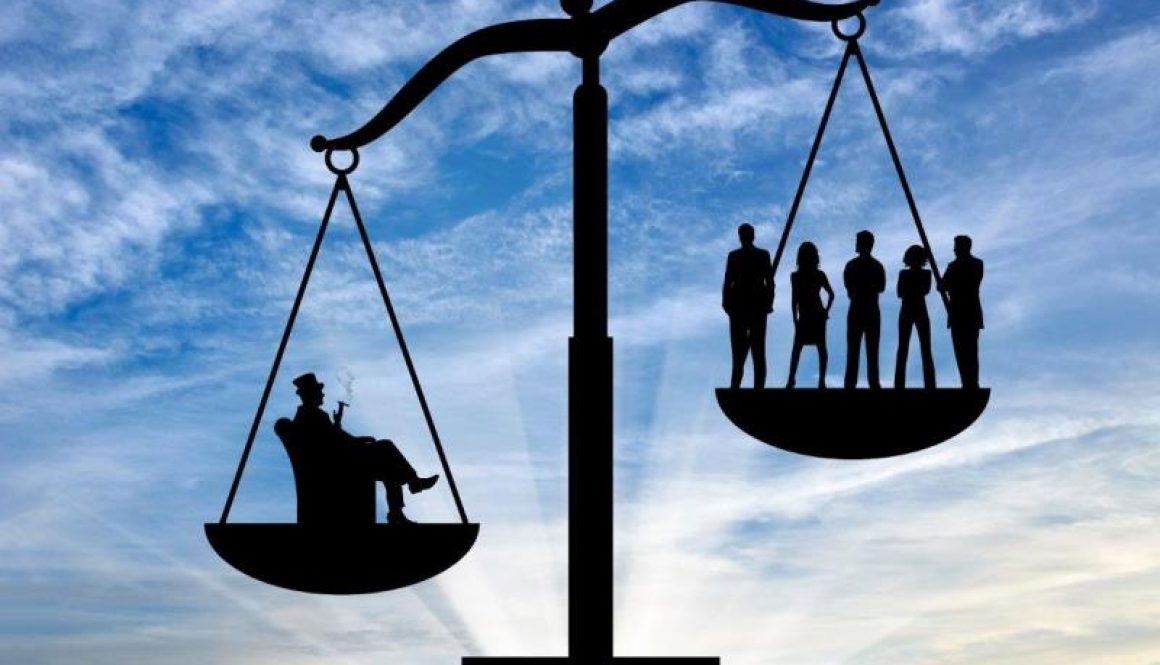
The past few weeks witnessed demonstrations and social uprisings in the United States of America and many other western developed countries. Racial equality was at the main demand of these uprisings, however it falls under the umbrella of a wider demand which is “Equality”.
Since economics is at the center of any change, policymakers can no longer afford to view inequality as an issue separate from boosting employment and incomes. Addressing it through a wealth tax, combined with more effective antitrust policies and enforcement, has become essential to sustaining economic growth, including by encouraging the creation and growth of new business.
Previously, economists and decision-makers considered inequality to be separate from the main concerns of macroeconomic policy. Since the 18th century’s Industrial Revolution, the rule was that people want higher incomes and a larger number of good jobs – and that the best way to achieve these goals is through faster economic growth. Therefore, the priority was given to the question of how to design and run monetary and fiscal policies that can sustain higher aggregate growth rates.
Inequality was regarded as a secondary and separate issue, which could be addressed at the margin through making net taxes more or less progressive. Rich people would contribute a higher share of their total incomes to the public finances than would the middle class.
It is increasingly apparent that there are three main problems with this view of the world.
According to Simon Johnson, former chief economist at the International Monetary Fund, as he wrote for Project Syndicate, first the tax system has ceased to be progressive. Warren Buffett famously remarked in 2011 that his tax rate is lower than his assistant’s – and this is not an isolated occurrence. Since the 1970s, effective taxes on income from capital (for the rich) have fallen dramatically, while taxes have remained much steadier for wage earners such as assistants.
If we include health-care costs – insurance premiums, deductibles, and out-of-pocket expenses – then median take-home pay (available to spend on everything other than health care) has barely budged in recent decades. There is nowhere near as much redistribution as there was in the post-World War II decades.
Second, the extent of inequality has increased, owing partly to barriers to market entry, which also undermine economic growth. Owning firms that are difficult for others to challenge is undoubtedly good for profits. But economic policymakers’ goal should not be to maximize profits for one sector, let alone one group of investors. More entrepreneurship and more market entry tend to erode incumbents’ profits and thus mitigate inequality, because the entry of new firms into an industry will likely create more jobs, boost incomes, and lead to new products, better services, or both.
Third, inequality has become a driver of worsening outcomes in a broader political-economy sense. When rich people spend their money to influence political decisions, they do not typically seek to ensure freer entry for others into the sectors that generate their wealth, precisely because that would likely mean less for them. On the contrary, powerful incumbents want more protection from domestic and foreign competition. They also want more subsidies, whether through the tax code or otherwise. And their most cherished goal is to become too important to fail, so that they are likely to be bailed out in times of trouble.
For starters, if the existing system is broken, the easiest and fairest way to fix it would be with a modest wealth tax. The specifics can be debated, but a tax on wealth over $50 million would impact only the richest 0.1% of all Americans.
Moreover, if barriers to market entry are becoming a problem, then we should change the focus of antitrust activity to reduce those barriers in a reasonable and timely manner. If traditional criteria, developed in and for the pre-Internet era, prove cumbersome or ineffective, then we should update them.
And if wealthy people are buying political access, with the result that the economy is becoming more distorted and less fair, then we should change the campaign-finance and lobbying rules. In the US, a higher rate of tax on wealth over $1 billion (or a similar very high level) would affect only about 600 people, but it would send a powerful signal that their outsize influence will be addressed.
Inequality at modern levels is not an accident. It is the result of policy choices that were influenced or swayed by relatively rich people (again, Unbound has the details). The pendulum can – and should – swing back in the other direction.
Economic policymakers can no longer afford to view inequality as an issue separate from boosting employment and incomes. Addressing it through a wealth tax, combined with more effective antitrust policies and enforcement, has become essential to sustaining economic growth, including by encouraging the creation and growth of new business.
Source: WUAB Research Department – Project Syndicate