Trade is entering a new era.
Geography is reclaiming its power.
The Arctic is only the beginning.
## Why the Arctic May Become the Next Great Trade Corridor
For generations, the architecture of global trade appeared remarkably stable.
Oil flowed through the Strait of Hormuz. Manufactured goods left Asian factories and crossed the Indian Ocean before passing through the Strait of Malacca, the Red Sea, and the Suez Canal on their journey toward Europe. The Panama Canal connected oceans. The Turkish Straits linked the Black Sea to global markets. Around these routes, governments built policies, ports expanded, shipping alliances emerged, and financial institutions financed trillions of dollars in commerce.
The system was not perfect, but it was predictable.
Today, that predictability is under pressure.
Across several of the world’s most important maritime corridors, disruptions, tensions, and bottlenecks have emerged simultaneously. Security concerns have altered traffic patterns in some waterways. Capacity constraints continue to affect others. Insurance costs have increased. Shipping companies are reassessing traditional routes. Governments are reviewing contingency plans. Supply-chain managers are seeking alternatives.
For business leaders, policymakers, and investors, a question that once sounded improbable is now increasingly relevant:
What happens when the world’s trade arteries begin to look vulnerable at the same time?
The answer may lie thousands of kilometers to the north, in a region long associated with ice, isolation, and exploration rather than commerce.
The Arctic.
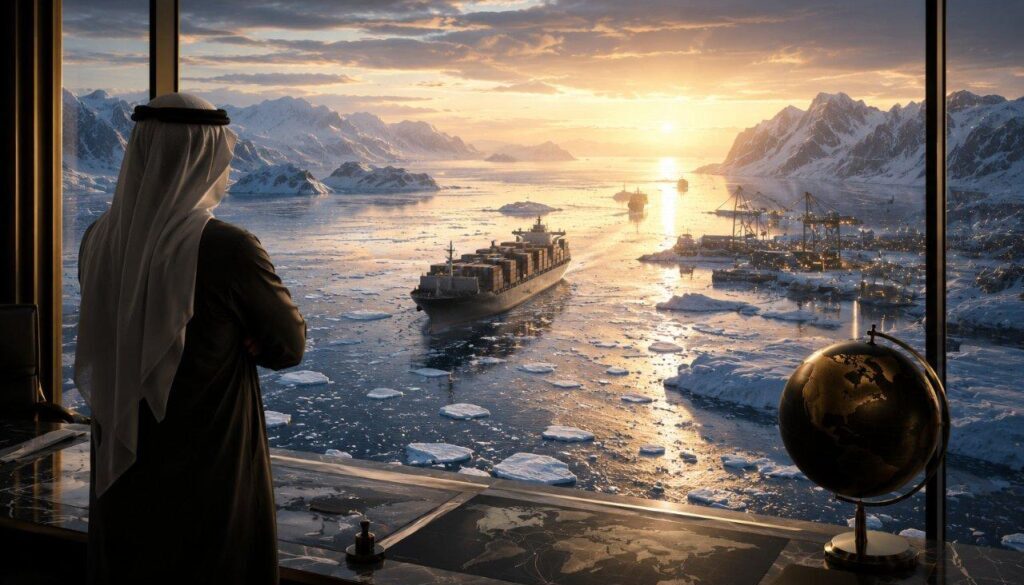
What was once considered one of the least accessible places on Earth is gradually entering discussions about the future of global trade, economic security, and geopolitical influence. At the center of that conversation stands a route that, until recently, existed largely on maps and strategic planning documents—the Northern Sea Route.
Stretching along Russia’s Arctic coastline from the Bering Strait in the Pacific Ocean to the Barents Sea near Northern Europe, the route has become the focus of growing attention from Moscow, Beijing, Washington, shipping companies, energy producers, and global investors.
The reason is simple.
As pressures mount on traditional trade corridors, the Arctic is becoming more accessible.
And when geography changes, economics often follows.
## The Tyranny of Geography
For all the advances in technology, finance, and logistics, global trade remains remarkably dependent on geography.
A relatively small number of strategic chokepoints carry a disproportionate share of the world’s commerce.
The Strait of Hormuz remains one of the most important energy corridors on the planet. The Strait of Malacca serves as a critical gateway connecting East Asia to Europe, the Middle East, and Africa. Bab el-Mandeb links the Indian Ocean with the Red Sea and the Suez Canal. The Panama Canal continues to shorten routes between the Atlantic and Pacific Oceans. The Turkish Straits provide access between the Black Sea and international markets. Meanwhile, the Suez Canal remains one of the most significant trade arteries in modern economic history.
Collectively, these passages support the movement of energy, food, industrial products, critical minerals, and consumer goods that sustain the global economy.
For decades, policymakers and markets largely assumed these routes would remain available and efficient.
That assumption is now being reassessed.
The issue is not necessarily the vulnerability of any single corridor. Rather, it is the growing realization that multiple strategic routes can face pressure simultaneously.
When such situations arise, shipping costs increase. Insurance premiums rise. Delivery schedules become less predictable. Supply chains become more fragile. Ultimately, consumers, businesses, and economies bear the cost.
This growing awareness is encouraging governments and corporations to seek something increasingly valuable in an uncertain world:
Redundancy.
Not because existing routes are becoming obsolete, but because resilience has become as important as efficiency.
The Arctic enters the picture precisely at this point.
## Why Bankers Should Care
For financial institutions, these developments are not merely logistical.
Trade routes influence capital flows. Capital flows influence investment decisions. Investment decisions shape economic growth, infrastructure development, and financial activity.
When shipping patterns evolve, trade-finance requirements evolve with them. Insurance markets adjust. Infrastructure financing opportunities emerge. Supply-chain financing structures change. Risk assessments are recalibrated.
In this sense, the Arctic story is already a banking story.
The route itself may still be developing, but the strategic decisions surrounding it are beginning to influence the broader financial ecosystem that supports global commerce.
For central banks, sovereign wealth funds, development institutions, and commercial banks, understanding these shifts is not an academic exercise. It is increasingly becoming part of long-term strategic planning.
## The Geopolitics of Geography
Behind the commercial arguments surrounding the Arctic lies a deeper strategic reality.
Global trade may be powered by technology, finance, and logistics, but it is ultimately governed by geography.
For much of the post-Cold War period, global markets operated under the assumption that the major trade corridors connecting continents would remain largely accessible and secure. Naval power, international cooperation, and the interconnected nature of global commerce helped sustain that assumption.
Today, policymakers increasingly recognize that concentration itself creates vulnerability.
The challenge is not simply the risk associated with any single chokepoint. Rather, it is the possibility that several strategic corridors could experience pressure simultaneously. In such an environment, governments and corporations alike begin to ask a different question:
How many alternatives exist?
This is where the Arctic enters the discussion.
For Russia, the Northern Sea Route represents both economic opportunity and strategic relevance. It provides an export corridor for Arctic resources while creating a transportation network in which Moscow occupies a central geographic position.
For China, the route offers diversification. Beijing’s interest in the Polar Silk Road reflects a long-term desire to reduce dependence on a limited number of maritime passages and create additional pathways linking Chinese production centers with international markets.
For the United States and its allies, the Arctic has increasingly become a strategic theater requiring greater attention. Investments in maritime awareness, Arctic infrastructure, icebreaker programs, and regional cooperation have accelerated as policymakers evaluate how future trade flows may evolve.
What is unfolding is not a competition over a shipping lane alone.
It is a broader reassessment of the geography of globalization.
## The End of the Efficiency Era?
For much of the past four decades, globalization was guided by a relatively simple principle: maximize efficiency.
Companies built supply chains around the lowest-cost producer. Manufacturers optimized inventory levels. Shipping companies focused on the fastest and most economical routes. Financial markets rewarded efficiency, scale, and cost reduction.
The model delivered remarkable results.
Global trade expanded rapidly. Production costs declined. International supply chains became increasingly sophisticated. Consumers gained access to goods and services from virtually every corner of the world.
Yet hidden within this model was a vulnerability that became visible only when disruption occurred.
Concentration.
When a single supplier dominates production, disruption becomes costly. When a single route carries a significant share of trade, disruption becomes systemic. When critical industries depend upon a limited number of logistics corridors, resilience becomes a strategic concern rather than an operational issue.
Recent years have exposed this reality repeatedly.
Pandemics disrupted production networks. Shipping bottlenecks affected delivery schedules. Geopolitical tensions highlighted the risks associated with concentrated supply chains. Energy market volatility reinforced the importance of strategic redundancy.
As a result, governments and corporations are reassessing priorities.
Efficiency remains important.
But resilience is becoming equally valuable.
Redundancy, once viewed as an unnecessary cost, is increasingly viewed as a strategic investment. Alternative suppliers are being evaluated. Secondary logistics corridors are gaining attention. Governments are supporting domestic production in strategic sectors. Companies are reassessing inventory strategies. Even discussions surrounding financial infrastructure increasingly emphasize continuity and resilience.
In this environment, the Arctic becomes more than a shipping story.
It becomes a symbol of a broader shift taking place across the global economy.
The growing interest in the Northern Sea Route is not simply a response to geography. It reflects a changing philosophy.
For decades, the dominant question was: What is the most efficient route?
Increasingly, the question is: What happens if that route is no longer available?
That distinction may prove to be one of the defining economic themes of the coming decade.
A Route Once Considered Impossible
For centuries, explorers searched for a northern maritime passage connecting Asia and Europe.
Most failed.
The Arctic Ocean remained locked beneath immense sheets of ice. Ships became trapped. Expeditions disappeared. Entire chapters of maritime history were written around unsuccessful attempts to overcome nature’s barriers.
For generations, the Arctic represented the limits of human navigation.
Today, that reality is changing.
Scientific research shows that the Arctic is warming at a significantly faster pace than the global average. While the environmental consequences remain profound and concerning, the commercial implications are increasingly difficult to ignore.
Sea ice coverage has declined substantially compared with previous decades.
Areas once considered permanently inaccessible are becoming seasonally navigable.
The shipping window remains limited, but it is growing.
What was once an explorer’s dream is gradually becoming a commercial possibility.
And Russia has been preparing for this moment for years.
Russia’s Arctic Bet
Few countries have invested more heavily in Arctic infrastructure than Russia.
Moscow’s vision is ambitious but straightforward.
Transform the Arctic into both an export corridor for Russia’s vast northern resources and a strategic trade route connecting Asia and Europe.
To support this objective, Russia has spent years developing ports, navigation systems, communication networks, and search-and-rescue capabilities across its northern coastline.
Its most important advantage, however, lies elsewhere.
Russia possesses the world’s largest icebreaker fleet, including nuclear-powered vessels capable of operating in some of the most challenging maritime environments on Earth.
The objective extends beyond transportation.
Control over infrastructure often creates influence over commerce.
Historically, nations that occupy critical trade corridors benefit not only from transit revenues but also from increased investment, logistics activity, financial services, insurance markets, and broader economic influence.
The Arctic therefore represents not merely a shipping project, but a long-term economic strategy.
China’s Polar Ambitions
Russia is not the only major power looking north.
China has also identified the Arctic as an area of growing strategic importance.
Beijing’s concept of a Polar Silk Road forms part of its broader effort to diversify trade routes and strengthen international connectivity.
For China, this is not simply about reducing travel time.
It is about reducing dependence.
As the world’s largest trading nation, China has a strong interest in ensuring multiple pathways exist between its industrial centers and global markets.
The Arctic offers one such possibility.
Chinese shipping companies have been among the most active in testing Arctic routes, while Beijing continues to expand its Arctic capabilities and long-term presence in the region.
The message is clear.
China views Arctic access as a strategic asset rather than a temporary opportunity.
The United States and the New Geography of Trade
The Arctic is attracting increasing attention in Washington as well.
The issue is not about replacing existing routes.
Rather, it is about understanding how the map of global commerce may evolve over the coming decades.
As climate conditions change and new shipping possibilities emerge, policymakers increasingly recognize that Arctic waters could become more economically relevant than they have been at any point in modern history.
Viewed through this lens, the Arctic is not really about icebreakers, shipping lanes, or even climate.
It is about optionality.
For decades, globalization rewarded concentration. The Arctic suggests that the next phase of globalization may reward diversification.
The countries investing in northern infrastructure today are not merely preparing for a new shipping route. They are preparing for a future in which strategic flexibility may become as valuable as economic efficiency.
That realization helps explain why governments are paying increasing attention to a region that, until recently, sat at the edge of the global economic map.
Reality Versus Expectations
Despite growing attention, perspective remains essential.
The Northern Sea Route is not about to replace the Suez Canal.
Traditional trade corridors continue to handle vastly larger volumes of cargo and benefit from decades of infrastructure development, operational experience, and commercial integration.
The Arctic remains a seasonal route. Insurance considerations remain significant. Supporting logistics networks are still developing. Major shipping companies continue to approach the route cautiously.
Yet history suggests that major changes in global commerce rarely occur overnight.
They begin gradually.
A new port opens. A railway expands. A canal shortens a journey. A route once considered marginal begins attracting attention.
Over time, those incremental developments can reshape economic geography.
The Arctic may still be in the early stages of that process.
But it has clearly moved beyond the realm of theory.
Beyond the Arctic
The Arctic story is often presented as a shipping story.
In reality, it is something larger.
It is a story about how nations are reassessing vulnerability. It is a story about how companies are reconsidering dependence on a limited number of trade corridors. It is a story about how geography is reasserting itself in an age that once believed technology had largely overcome distance.
The question is not whether the Northern Sea Route will replace the Suez Canal. It almost certainly will not.
Nor is the central issue whether Arctic shipping volumes will rival traditional corridors in the near future.
The more important question is whether the world is entering a new era in which resilience matters as much as efficiency.
If that proves to be the case, the significance of the Arctic will extend far beyond shipping.
For banks, investors, policymakers, and business leaders, the implications are profound. Trade routes shape investment flows. Investment flows influence economic development. Economic development determines where capital is allocated, where infrastructure is built, and where future opportunities emerge.
The ice is melting.
But the larger story is not about the Arctic alone.
It is about a changing global economy, a changing understanding of risk, and a changing map of international commerce.
And if future historians identify a moment when the world began shifting from the pursuit of maximum efficiency toward the pursuit of strategic resilience, they may find one of the earliest signs not in a boardroom, a stock exchange, or a policy paper, but in the gradual opening of a frozen passage at the top of the world.